Compensation Planning Software: What Sales Ops Teams Actually Need
Compensation planning software helps sales teams model plans, calculate commissions, and give reps visibility into their earnings. Here's how to find the right fit.
"Compensation planning software" covers a wide range of tools — from purpose-built commission calculators for 15-rep SaaS teams to enterprise SPM suites that manage territory hierarchies and MBO components for 500-rep organizations. The mistake most buyers make is evaluating tools designed for the wrong tier of that spectrum.
This guide covers what's actually in the market, which segment each tool targets, and how to match the right tool to your team's specific friction point.
What compensation planning software actually does
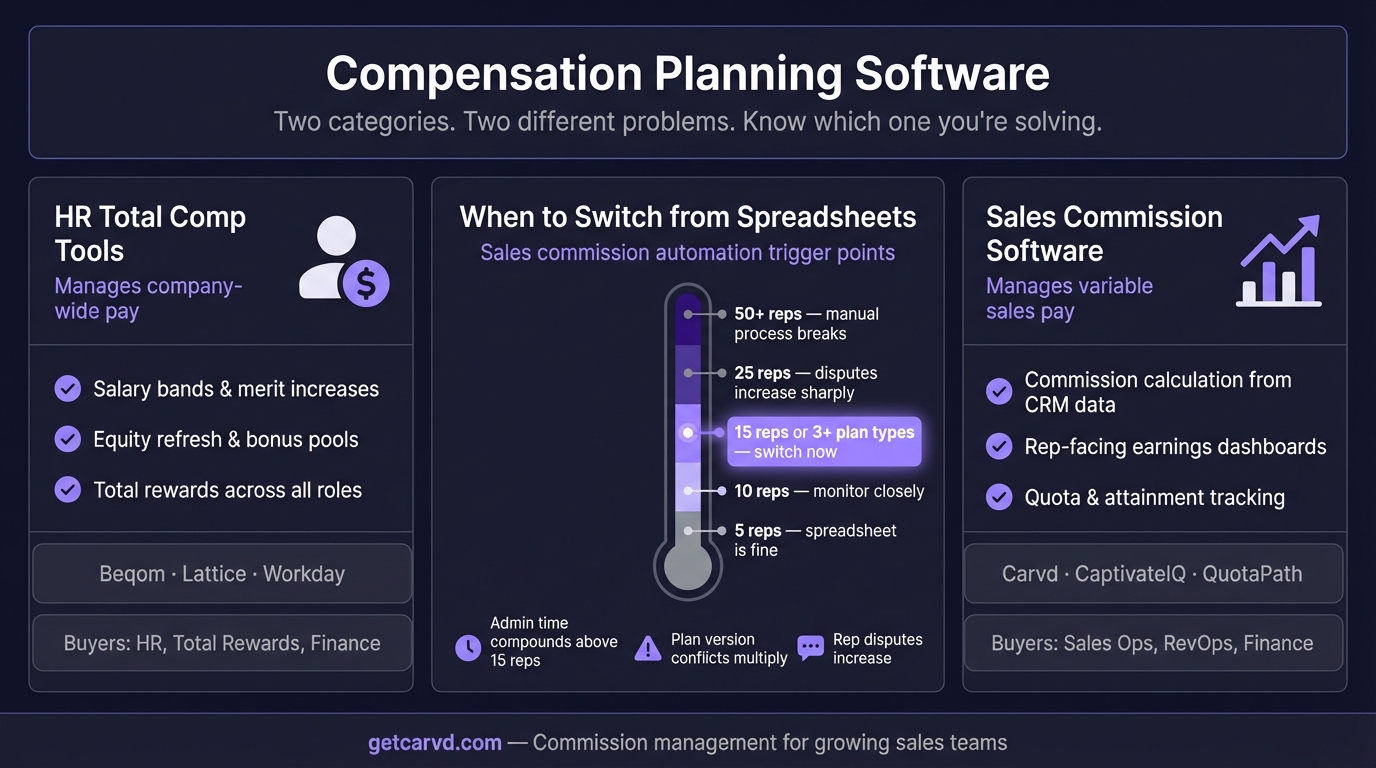
The term gets used loosely. There are three distinct categories under the same label:
Incentive compensation management (ICM) software — The core of most "commission software" discussions. ICM tools calculate commissions from closed deal data, manage plan rules (tiers, accelerators, product rates), generate rep-facing statements, and handle dispute workflows. This is what most 10-100 rep sales teams are looking for.
Sales performance management (SPM) software — A superset that includes ICM plus quota management, territory planning, coaching and performance tracking, and pipeline analytics. Enterprise platforms like Xactly Incent, CaptivateIQ, and SAP Commissions operate in this space. Sales performance management requires dedicated admin bandwidth to configure and maintain.
Strategic compensation planning tools — HR-focused tools (Workday, Anaplan, Betterworks) for headcount planning and salary band modeling. Different use case from commission management entirely.
If you're a VP of Sales or RevOps manager at a 10-50 rep company who wants commissions calculated automatically and reps to stop asking "when do my numbers land?" — you're looking for ICM software, not a full SPM suite.
When spreadsheets stop working
A spreadsheet commission model works until one of these conditions appears:
Multiple overlapping plan types. One flat rate on one plan is manageable in a spreadsheet. Three plan types with tiered accelerators and product-specific rates across 20 reps creates a model where the calculation logic itself becomes the risk. A formula error that nobody catches is a commission error that becomes a dispute.
CRM data that has to be manually imported. Copying deal data from your CRM into a commission spreadsheet every pay period is where most errors are introduced. Each copy-paste step is a potential discrepancy.
Reps who shadow-account. When reps run their own commission spreadsheets to check your numbers, that's a trust signal. According to QuotaPath's 2024 survey of 450+ revenue leaders, 78% said their reps find their comp plans difficult to understand. Shadow accounting typically means reps don't trust either the calculation or the transparency of the process.
Closing commissions takes more than a day. If running a commission cycle requires a full day of work from someone in finance or sales ops, the process has scaled beyond what a spreadsheet handles efficiently.
Below these thresholds — a single flat rate, manual deal tracking, under 10 reps — a spreadsheet is often fine. Not ready for software? Stackrows templates are a solid first step. The honest answer is that software only earns its cost when the problems above are actually present.
Core features to evaluate
When comparing tools, these are the components that vary meaningfully across tiers:
Plan modeling flexibility. Can the tool support flat rate, tiered structures, per-product rates, and accelerators? Enterprise platforms support virtually any plan structure. Mid-market tools handle the most common configurations but may not support multi-currency, complex overlay crediting, or MBO components.
CRM integration. Does the tool connect to your CRM to pull deal data automatically, or does it require CSV uploads? Native API integrations with Salesforce are standard; HubSpot and Pipedrive support varies by vendor. For a breakdown of what deal data you need for commission calculation, see how to calculate commission.
Rep-facing dashboards. Can reps see their current earnings, deal-by-deal breakdowns, and progress toward accelerators — without waiting for finance to send a statement? This single feature is the most direct driver of reduced dispute volume.
Dispute workflow. Does the platform have a formal dispute resolution process (rep raises a dispute, ops reviews and resolves, audit trail maintained)? Or does dispute handling revert to email threads?
Payroll export. Can you export a payroll-ready file at the end of each cycle? What formats are supported?
Plan document management. Does the tool house the written comp plan alongside the calculation, so reps can see both the rules and the results in the same place?
The tool landscape, by segment
Enterprise: for teams with 100+ reps and dedicated ops staff
Xactly Incent — the legacy market leader, built for complex enterprise environments with large rep headcounts, territory overlays, and multi-currency requirements. Requires implementation support and typically a contract of $25,000+/year. Custom pricing. See the Xactly alternative breakdown for where it fits and where it doesn't.
CaptivateIQ — strong workflow tooling, increasingly mid-market-focused, but pricing is per-seat and implementation-heavy. See CaptivateIQ alternative for a comparison against lighter tools.
SAP Commissions / Varicent — enterprise-grade, deep integrations with ERP systems, designed for financial services, insurance, and large B2B companies with complex crediting requirements.
The SPM software market was valued at $2.36 billion in 2023 and is projected to reach $6.53 billion by 2030, according to Grand View Research — growth driven by mid-market adoption of tools previously accessible only to enterprise buyers.
Mid-market: for teams of 25-150 reps
Everstage — strong for teams managing multiple plan types with visual dashboards for reps. Targets growth-stage SaaS and fintech. See Everstage alternative for positioning details.
Spiff (Salesforce) — now part of the Salesforce ecosystem, which is a strength for Salesforce-native teams and a constraint for everyone else. Works well when Salesforce is your source of truth. See Spiff alternative for the tradeoffs.
QuotaPath — purpose-built for fast-growing SaaS teams, good CRM integrations, and strong rep-facing UX. See QuotaPath alternative for how it compares against lighter-weight options.
Lean / fast-setup: for teams of 5-50 reps
For smaller teams, the primary friction isn't plan complexity — it's that commission calculation takes too long and reps can't verify their numbers. The right tool for this tier prioritizes fast setup, CRM data ingestion (CSV, HubSpot, Pipedrive), and deal-level rep transparency over enterprise feature depth.
Carvd is built for this tier. Flat-rate pricing (not per-seat), setup under an hour, and deals imported from HubSpot, Pipedrive, or CSV deal import. The focus is on one-click commission runs with a deal-by-deal breakdown every rep can read and verify.
How to evaluate options for your team
Match the tier to your real problem. Enterprise platforms are genuinely overkill for a 20-rep team with two plan types. You'll pay implementation and licensing costs for capabilities you'll never configure. The right tool is the one that solves your friction point — typically accurate calculation, CRM import, and rep visibility — without requiring an ops hire to manage it.
Pricing model matters as much as list price. Per-seat pricing compounds as you hire. A 25-rep team on a $30/user/month platform pays $750/month; at 50 reps it's $1,500. Flat-rate pricing doesn't change with headcount. For teams that plan to scale, understand how the total cost changes at 1.5x and 2x your current headcount.
Setup time is a real constraint. Enterprise platforms routinely quote 4-12 week implementations. For a team that needs commissions calculated next month, that's a miss. Platforms targeting SMB teams typically support self-serve setup in days, not months.
Ask whether reps can see deal-level breakdowns. A dashboard showing a total payout number doesn't reduce disputes. Reps need to see which deals were included, which plan rules applied, and the arithmetic for each step — that's exactly what Carvd's rep dashboards provide. If a vendor can't show you that in a demo, shadow accounting continues after you implement.
The connection to your comp plan design
Compensation planning software handles the calculation and reporting layer — but it only works as well as the plan it's executing. A tool can't fix a plan that's too complex for reps to understand, quotas set at the wrong level, or accelerator thresholds that don't actually drive the behavior you want.
For guidance on designing the plan itself before worrying about the software, sales compensation planning covers how to structure OTE, base-to-variable splits, quota calibration, and accelerators from first principles. Sales comp plan examples shows five real plan structures at different team stages.
The software choice should follow the plan design — not the other way around.
Related reading
- Sales Compensation Planning: How to Design Plans That Scale
- Sales Comp Plan Examples: 5 Plans for Different Team Stages
- Sales Performance Management: Strategy, Tools & Best Practices
- Commission Reporting: What Sales Ops Actually Needs
- Best Commission Software: How the Tools Actually Compare
- Sales KPIs: The Metrics That Actually Drive Revenue
Last updated: March 22, 2026