QuotaPath Alternative: When You Need More Than Basic Tracking
Looking for a QuotaPath alternative? Compare 6 commission software tools on pricing model, plan complexity, setup speed, and which fits your team best.
QuotaPath is purpose-built for SMB and mid-market sales teams that want a commission tool with CRM integration, real-time rep dashboards, and published pricing. It earns a 4.5/5 on Capterra from 120+ reviews, and the most-installed commissions app on the HubSpot Marketplace as of early 2026. It offers transparent pricing, real-time rep dashboards, and CRM integrations on all paid tiers.
It also has a complexity ceiling. Teams with territory overlays, multi-source payouts, or highly custom crediting logic routinely hit the edges of what QuotaPath can model. Data sync lag — delayed updates from Salesforce and HubSpot — shows up repeatedly in recent reviews as a concern.
For teams within QuotaPath's design parameters, it's a strong tool. For those outside them — or those who simply want to evaluate alternatives with honest pricing comparisons — this post covers the field.
Here's an honest look at where QuotaPath excels, why teams look elsewhere, and which alternatives are worth considering.
Where QuotaPath genuinely excels
Any honest comparison starts here.
QuotaPath's native integrations with Salesforce and HubSpot are available starting on the Essential tier — not locked to a higher plan. For teams on either CRM, data flows directly into commission calculations without CSV exports. Reps see their earnings update in real time, and the "earnings forecast" feature lets them model their own pipeline: close these three deals, see what that earns this quarter. That rep experience is genuinely differentiated.
On plan coverage, QuotaPath handles flat rates, tiered accelerators, draws, splits, MBO components, and multi-source payouts at higher tiers. ASC-606 compliant commission accounting is available at the Growth tier — an operational requirement for companies needing to capitalize commission expense. The platform covers most plan structures that SMB and mid-market sales teams run.
The pricing model is one of the more transparent in the category. Essential starts at $250/month for the first five users, Growth at $525/month, Premium at $800/month, with per-user add-ons for teams larger than the base count. It's not fully self-serve, but it's structured — you can estimate your cost range without a three-week procurement cycle.
HubSpot Ventures made a strategic investment in QuotaPath in April 2021. QuotaPath remains an independent company, but the investment formalized a deep product relationship that shows in the HubSpot integration quality.
For a detailed feature-by-feature comparison, see our Carvd vs QuotaPath comparison.
Why teams look for alternatives
Teams that leave QuotaPath—or evaluate it and choose something else—usually cite one of three reasons.
Per-seat pricing at scale. At $25-$35/user/month, commission software becomes one of the more expensive per-seat tools in a RevOps stack. A team of 20 reps on the Essential tier pays approximately $6,000/year. A team of 50 reps pays $15,000+. That scaling cost is a feature of the pricing model, not a bug—but it leads budget-conscious teams to look for flat-rate alternatives once headcount grows.
Plan complexity limits. QuotaPath uses a template-based plan builder that handles flat rates, tiered accelerators, draws, splits, and multi-source payouts. G2 reviewers note it works well for standard structures but can run into friction with more intricate plans. Teams with territory overlays, complex SPIF components, or multi-step approval workflows sometimes find themselves working around the tool rather than with it.
CRM sync delays. Multiple Capterra and G2 reviewers from 2024-2026 note intermittent delays in CRM data syncing from HubSpot and Salesforce—commission dashboards not reflecting closed deals in real time, requiring manual refreshes or support tickets. For teams where commission accuracy is time-sensitive, these sync issues create downstream problems.
6 QuotaPath alternatives worth evaluating
1. Carvd
Carvd is commission software for sales teams of 5-200 reps. It imports deals from HubSpot, Pipedrive, or CSV; applies flat, tiered, or per-product commission plans; and generates deal-level statements showing reps exactly how their payout was calculated.
The main difference from QuotaPath: flat-rate pricing. Carvd charges $49/month for up to 10 reps (Starter), $99/month for up to 25 reps (Growth), or $199/month for unlimited reps (Scale). No per-seat fees, no platform fee on top. A 20-rep team that pays $6,000+/year on QuotaPath pays $1,188/year on Carvd Growth.
The trade-offs are real. Carvd doesn't have QuotaPath's pipeline forecasting feature for reps, doesn't support ASC-606 compliance, and doesn't connect to Salesforce. What it does offer is a comp plan builder that handles flat, tiered, and per-product structures without workarounds. If your team runs entirely in Salesforce and needs earnings forecasting, QuotaPath is the stronger fit. If you're on HubSpot or Pipedrive and want commission costs that stay flat as you hire, Carvd is worth the 14-day trial.
Best for: Teams of 5-200 reps that want flat-rate pricing, fast setup, and deal-level commission transparency without per-seat scaling costs.
2. CaptivateIQ
CaptivateIQ is the highest-rated commission platform on G2 (3,300+ reviews, ranked #1 in Sales Compensation). It handles complex compensation structures—territory overlays, multi-step approval workflows, SPIFs, MBO components—and connects to Salesforce, HubSpot, Workday, Snowflake, BigQuery, and 15+ other enterprise systems.
It's also expensive and slow to implement. Third-party procurement benchmarks (Vendr, as of March 2026) put typical annual spend at $20,000-$120,000+. Implementation runs 8-12 weeks. Minor plan changes typically require professional services engagement.
Teams that leave QuotaPath because of plan complexity and are ready to invest in a more capable tool should evaluate CaptivateIQ seriously. Teams that leave QuotaPath because of cost will find CaptivateIQ is not the answer.
Best for: Mid-market and enterprise teams (50+ reps) with complex commission structures that QuotaPath's plan builder can't accommodate.
3. Everstage
Everstage is a sales performance management platform with published pricing starting at $30/user/month. It combines commission calculation with quota management, pipeline visibility, and gamification features like leaderboards and performance boards.
G2 users rate Everstage 4.8/5 from 1,700+ reviews as of early 2026, with reviewers consistently highlighting the rep experience and modern UI. It offers a no-code plan builder and includes earnings forecasting similar to QuotaPath, plus quota attainment tracking that most commission-only tools don't have.
For teams that want to move up from QuotaPath's functionality—not down in cost—Everstage is the closest modern equivalent. At $30/user/month, a 20-rep team pays $7,200/year, slightly more than QuotaPath's Essential tier. The additional quota management and performance features may justify the step up depending on your team's needs.
Best for: Mid-market teams (20-100 reps) that want QuotaPath-level commission tracking plus quota attainment visibility in one platform.
4. Commissionly
Commissionly is an SMB-focused commission software platform with a specific strength: recurring and residual commission plans. If your reps earn ongoing commissions from renewals, subscription revenue, or multi-year contracts—structures where QuotaPath's per-deal model gets cumbersome—Commissionly's data model is built around recurring payouts.
Pricing is not published publicly (as of March 2026). Commissionly is positioned below QuotaPath and CaptivateIQ on complexity but above pure spreadsheet-replacement tools.
G2 reviewers note Commissionly's customer support as a strength and cite the recurring commission handling as the main reason for choosing it over alternatives. Teams without recurring commission structures have less reason to choose it over QuotaPath or flat-rate tools.
Best for: Teams with recurring commission structures—subscriptions, renewals, multi-year contracts—where per-deal tracking misses how payouts actually accrue.
5. ElevateHQ
ElevateHQ is a commission management platform targeting SMB and mid-market sales teams. It offers a no-code plan designer, real-time rep dashboards, approval workflows, and integrations with Salesforce, HubSpot, Pipedrive, and several others.
Pricing is not published publicly (as of March 2026). Based on third-party data and positioning, ElevateHQ sits in a similar price range to QuotaPath but competes on ease of setup and plan flexibility.
G2 reviewers give ElevateHQ 4.7/5 (150+ reviews) and frequently mention the responsive support team and the ability to build commission logic without spreadsheet workarounds. Teams that find QuotaPath's template-based builder limiting may find ElevateHQ's plan designer more flexible for custom structures.
Best for: Teams of 15-100 reps that want QuotaPath's CRM integrations and rep dashboards with more flexibility in how commission logic is configured.
6. Sales Cookie
Sales Cookie is a commission automation tool in the SMB segment with a specific focus on supporting complex plan types without a complex implementation. It handles tiered rates, splits, overrides, draws, and product-based rates. Pricing starts at $20/user/month and is published.
For teams that hit QuotaPath's plan complexity ceiling but don't want to jump to CaptivateIQ's cost structure, Sales Cookie is a practical middle option. It's not as polished as QuotaPath's rep experience, but the plan builder handles more edge cases at a lower price point.
Best for: Teams with non-standard commission structures—overrides, splits, product-specific rates—who find QuotaPath's templates constraining and don't need enterprise-scale tooling.
Side-by-side comparison
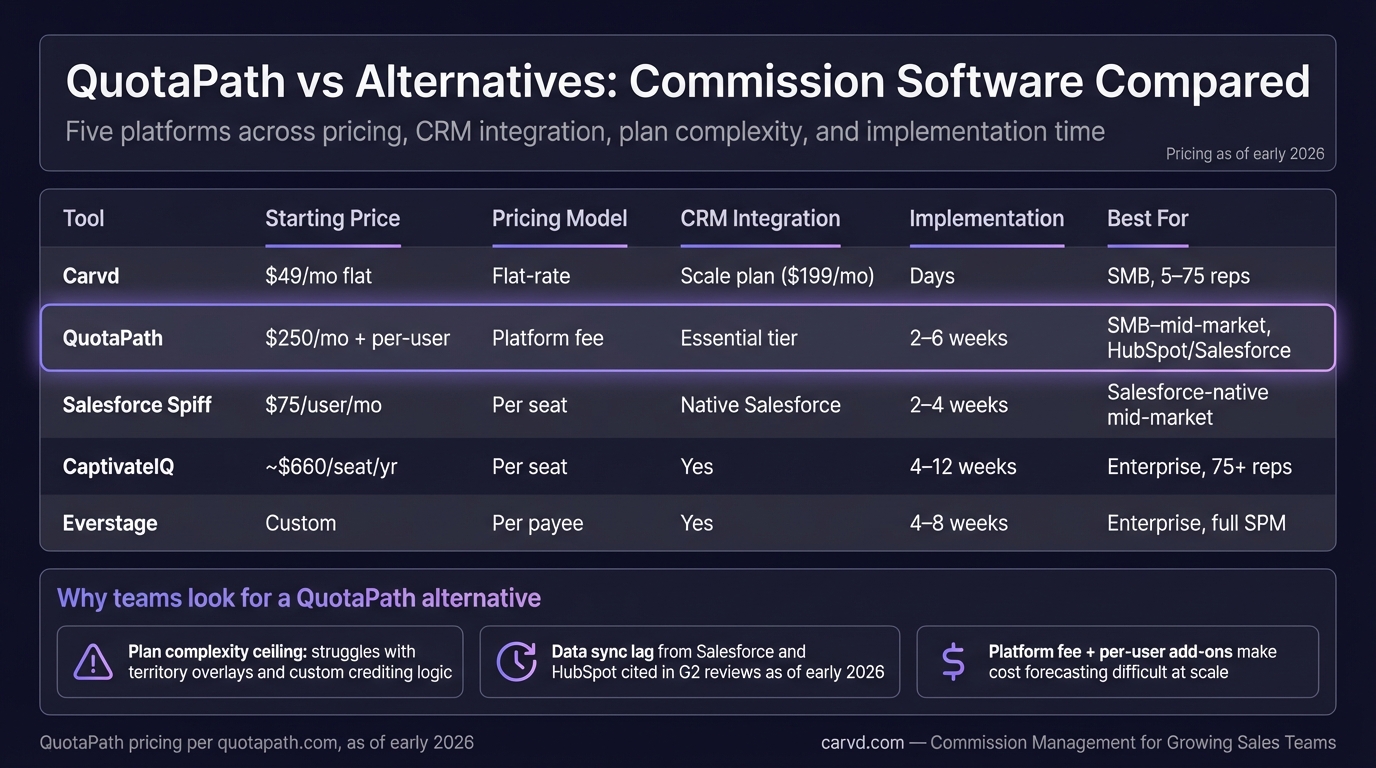
| Tool | Starting price | Pricing model | CRM integration | Implementation | Best for |
|---|---|---|---|---|---|
| Carvd | $49/mo flat | Flat-rate | Scale plan ($199/mo) | Days | SMB (5–75 reps), predictable cost |
| QuotaPath | $250/mo + per-user | Platform fee | Essential tier | 2–6 weeks | SMB–mid-market, HubSpot/Salesforce shops |
| Salesforce Spiff | $75/user/mo | Per seat | Native Salesforce | 2–4 weeks | Salesforce-native mid-market |
| CaptivateIQ | ~$660/seat/yr* | Per seat | Yes | 4–12 weeks | Enterprise (75+ reps), complex plans |
| Everstage | Custom | Per payee | Yes | 4–8 weeks | Enterprise, full SPM needs |
*CaptivateIQ pricing per Vendr procurement data, as of early 2026. Excludes integration and professional services costs.
How to choose
If cost is the driver: Carvd's flat-rate pricing stays constant regardless of rep count. A 20-rep team pays $1,188/year (Growth plan) vs. $6,000+/year on QuotaPath. The difference is meaningful enough to run a trial.
If plan complexity is the driver: Evaluate ElevateHQ for incremental flexibility or CaptivateIQ for significantly more complex structures. Sales Cookie is a practical middle option if you need more than QuotaPath's templates without enterprise pricing.
If you want more features alongside commission tracking: Everstage adds quota management and performance visibility to QuotaPath's core commission functionality, at a comparable price point.
If recurring commissions are your structure: Commissionly is built for that data model in a way that QuotaPath's per-deal approach isn't.
Most teams don't need CaptivateIQ's complexity or Xactly's enterprise feature set. They need accurate commission calculations, rep dashboards that show the math, and an approval workflow before payroll runs. Several alternatives on this list handle that at a meaningfully lower cost than QuotaPath's per-seat model allows.
Carvd offers a 14-day free trial. Connect your HubSpot or Pipedrive account, or upload a CSV of closed deals, and you'll have commission calculations in under an hour. No demo call required.
Questions to ask in every demo
"Show me my most complex plan type configured — not described." Any vendor who responds with "we support that plan type" instead of demonstrating it live is giving you a sales answer, not an engineering answer. The gap between described capability and demonstrated capability reveals a lot.
"How often does data sync from our CRM, and what happens when it's delayed?" If sync reliability matters, consider tools with a clean CSV deal import as a fallback. For QuotaPath specifically, this question surfaces the sync lag issue. Get a specific SLA, ask how reps are notified when sync is delayed, and ask what the manual override process looks like.
"What does implementation look like for a team my size?" Ask for the realistic range, not the best case. Ask who does the configuration work and how long the median customer takes to process their first commission run.
"What's the total annual cost including integrations, implementation, and support?" Line-item the all-in number. The platform fee is rarely the only cost.
"Can I talk to a customer with a similar team size and plan type?" A vendor with real customers at your profile should be able to arrange a reference call. If the only references are much larger or simpler than your situation, treat that as signal.
Related reading
Last updated: March 22, 2026