Sales Comp Plan Examples: 5 Plans for Different Team Stages
See five real sales comp plan examples with actual OTE splits, commission rates, and quota ratios — from early-stage startups to scaling AE teams.
Most sales comp plans are built backwards. A founder looks at what competitors are paying, picks a number that feels right, and starts making offers. That works for one or two reps. By rep five, the inconsistencies compound — different base salaries, different OTE splits, some with accelerators and some without — and the plan stops making sense to anyone.
Here are five comp plan examples, matched to specific team stages, with real numbers.
How to read these examples
Each plan covers:
- OTE: On-target earnings at 100% quota attainment
- Pay mix: Base salary / variable split
- Commission rate or payout structure
- Quota: Annual ARR or activity-based target
- Quota-to-OTE ratio: The multiple of quota versus OTE. A 4x ratio means a rep with $150K OTE carries a $600K quota
The Alexander Group's principle: the more direct influence a rep has over the buying decision, the more aggressive the pay mix (lower base, higher variable). A field AE who owns the full sales cycle runs 50/50. An inbound SDR who books meetings runs 70/30.
The 3x leverage rule: at 100% OTE, the plan is fair. At 150% quota attainment, top performers should earn roughly 2-3x their target variable. That means a rep with $50K at-risk variable should have the potential to earn $100-150K in variable at 150%+ attainment.
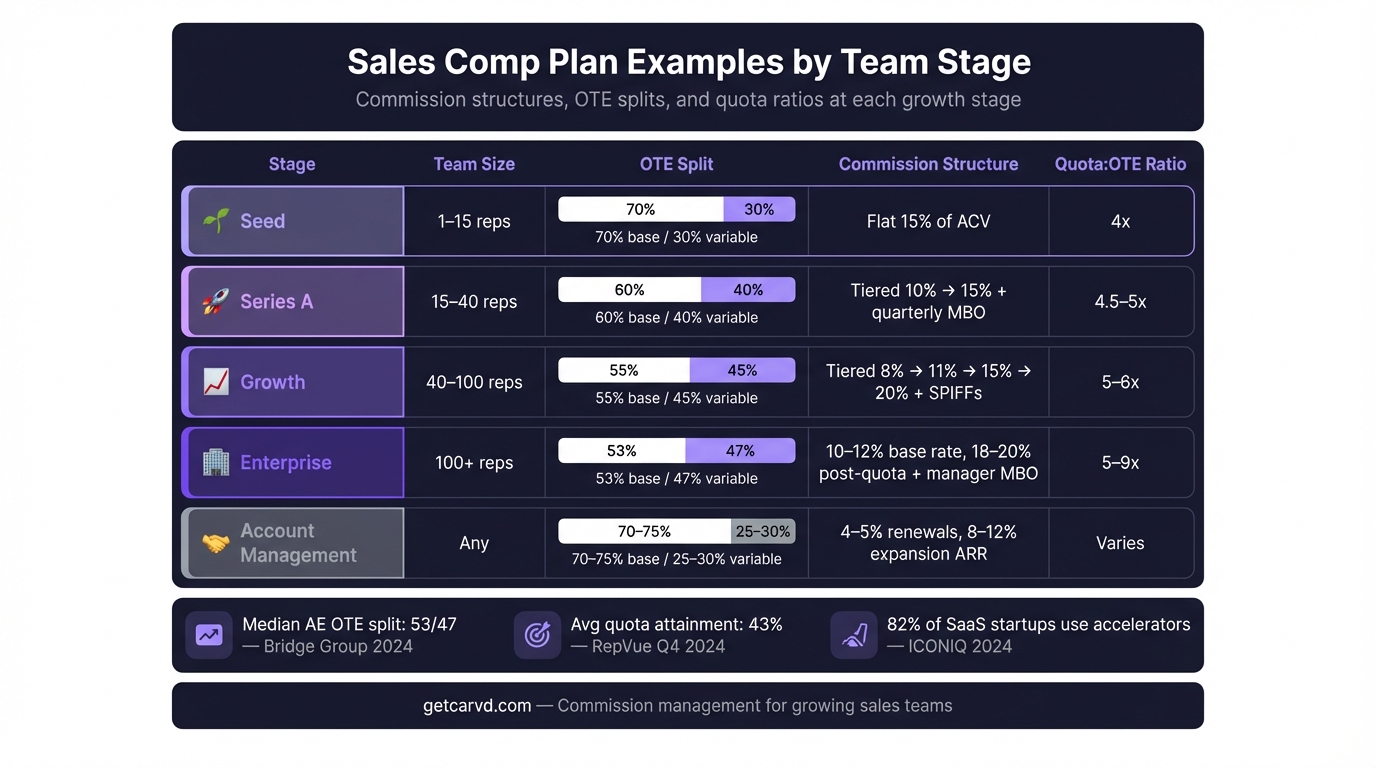
Plan 1: First reps at an early-stage startup
Who it's for: Pre-Series A or early Series A. You have 2-5 reps. Your comp plan needs to be simple enough that you can explain it in 30 seconds and calculate it in a spreadsheet.
| Component | Example |
|---|---|
| OTE | $150K |
| Pay mix | 50/50 base/variable |
| Base | $75K |
| Target variable | $75K |
| Commission rate | Flat 10% of ACV |
| Annual quota | $750K |
| Quota-to-OTE ratio | 5x |
How the math works: A rep closes $750K in ARR and earns $75K in commission ($750K × 10%). Total comp: $150K. Above quota, every dollar is still at 10% — no accelerators yet. Keep it simple until you have enough data to calibrate accelerators meaningfully.
What to watch: Early-stage companies often set quotas using rough revenue projections rather than historical close rates. Scale Venture Partners recommends calibrating early quotas so that new reps can realistically hit 75% of quota within their first six months of ramp. A quota that assumes full productivity from day 30 is a retention risk.
Carvd note: At this stage, a spreadsheet probably works fine — or use the commission spreadsheet template as a starting point. Download editable plan templates from Stackrows. You don't need software for 3 reps on a flat plan. The inflection point is usually when you have multiple plan types running simultaneously or more than 8-10 reps.
Plan 2: SDR team (activity-based)
Who it's for: SDR or BDR teams focused on outbound prospecting. Pay is tied to activities and pipeline milestones, not closed revenue. SDRs have less control over whether deals close, so variable pay should reflect what they actually control.
| Component | Example |
|---|---|
| OTE | $80K |
| Pay mix | 65/35 base/variable |
| Base | $52K |
| Target variable | $28K |
| Meeting held | $75/meeting |
| SQL created | $150/SQL |
| Deals closed (assist) | 1% of ACV |
| Monthly quota | 8 meetings held, 4 SQLs |
How the math works: A rep books 10 meetings (8 held), creates 5 SQLs, and assists on $200K in closed ARR. Monthly variable: (8 × $75) + (5 × $150) + ($200K × 1%) = $600 + $750 + $2,000 = $3,350. Annualized: $40,200. Total comp: $92,200. Above target, each additional meeting and SQL keeps paying at the same rate.
What Bridge Group's data says: According to The Bridge Group's 2023 SDR Metrics Report, SDR pay mixes typically run 64% base to 36% variable. Commission per meeting ranges widely — some teams pay per booked meeting (higher risk of no-shows), others pay per held meeting (what this example does), and some pay only on SQLs or closed-won outcomes. Paying on meetings held rather than booked reduces sandbagging and no-shows.
What to avoid: Don't pay SDRs a percentage of closed ARR as their primary metric. They have limited control over whether an AE closes a deal, and the lag between meeting booked and deal closed can be 60-120 days. Activity-based payouts keep SDRs motivated within their actual sphere of influence.
Plan 3: Mid-market AE with accelerators
Who it's for: A scaling sales team with 5-20 AEs. You have enough quota data to calibrate where top performers land, and you want to reward overperformance without raising base commission rates for everyone.
| Component | Example |
|---|---|
| OTE | $190K |
| Pay mix | 50/50 base/variable |
| Base | $95K |
| Target variable | $95K |
| Annual quota | $800K ARR |
| Quota-to-OTE ratio | 4.2x |
Commission tiers:
| Quota attainment | Rate | Effective payout at tier |
|---|---|---|
| 0–100% of quota | 8% | $0–$64K |
| 100–125% | 12% | $64K–$94K |
| 125%+ | 16% | $94K+ |
How the math works: A rep closes $960K (120% of quota). First $800K at 8% = $64K. Next $160K at 12% = $19.2K. Total variable: $83.2K. Total comp: $178.2K. A rep at 125% earns $95.2K variable — essentially hitting full OTE with room for more above.
Why 4.2x quota-to-OTE: According to The Bridge Group's 2024 SaaS AE Metrics & Compensation Benchmark Report, the median quota-to-OTE ratio for SaaS AEs in 2024 was 4.2x, with a range of 3.2x to 4.8x. Below 3x, the plan is too generous and unsustainable for early-stage companies. Above 5x, quota attainment rates fall and top reps start looking elsewhere.
The accelerator math check: Use the 3x leverage rule to verify your accelerators. If target variable is $95K, a rep at 150% attainment should earn roughly $190K-$285K in variable — or $285K-$380K total. That requires aggressive accelerators at 150%+, but it's the incentive that keeps top performers from leaving.
Plan 4: Multi-product or per-product commission
Who it's for: Teams selling multiple products or services with different margins or strategic priorities. A flat rate treats a $10K/yr SaaS subscription and a $500K enterprise services deal the same — which usually isn't what you want.
| Product | Commission rate | Strategic reason |
|---|---|---|
| Core SaaS subscription | 10% of ACV | Primary revenue driver |
| Professional services | 5% of revenue | Lower margin, want to sell but not over-prioritize |
| Multi-year contracts | 12% of Year 1 ACV | Strategic priority — lock in longer commitments |
| Renewal | 3% of ARR | Keep reps engaged in retention, not just new logos |
How the math works: A rep closes a 2-year SaaS deal at $50K/yr, adds $20K in services, and renews an existing $30K customer. Commissions: ($50K × 12%) + ($20K × 5%) + ($30K × 3%) = $6,000 + $1,000 + $900 = $7,900 for the pay period.
Where per-product plans get complicated: When you have more than 4-5 rate types, reps start optimizing for the highest-rate products regardless of customer fit. If services commissions are too low, reps will undersell implementation and the customer churns. If renewal rates are too high, reps spend time on renewals at the cost of new business. Calibrate rates to reflect both margin and strategic priority, not just revenue.
Carvd handles per-product commission calculations automatically — you import deals via CSV or CRM, each deal gets a product tag that routes to the right rate, and there's no spreadsheet math required on pay day.
Plan 5: Customer success / expansion
Who it's for: CSMs or account managers responsible for retention and expansion, not new logo acquisition. Variable pay should reflect what these roles actually control: keeping customers and growing them.
| Component | Example |
|---|---|
| OTE | $110K |
| Pay mix | 80/20 base/variable |
| Base | $88K |
| Target variable | $22K |
| GRR target | 92% of managed ARR |
| NRR target | 108% of managed ARR |
| GRR payout | $11K at 100% target |
| NRR payout | $11K at 100% target |
How the math works: A CSM manages a $1.5M ARR book. If gross retention comes in at 93% (above 92% target), they earn 100% of the GRR variable. If NRR hits 112% (above 108% target), they earn 100% of the NRR variable. Total variable: $22K. Total comp: $110K.
Why 80/20 for CSMs: Per Prowi's 2026 commission benchmarks, CSMs average an 83% base / 17% variable split. CSMs have limited control over whether customers churn — market conditions, product fit, and executive relationships all play a role. A 50/50 plan punishes CSMs for churn they can't prevent, which drives disengagement. A retention-weighted variable keeps them focused on what they can actually influence.
Expansion commission: For CSMs who own upsells, add a 7-10% expansion commission on net new ARR added to existing accounts. Keep it separate from the retention metrics so reps don't face conflicting incentives.
Calibrating your plan
A well-designed comp plan should produce roughly 60-70% quota attainment across your team. If fewer than half your reps are hitting quota, the problem is usually quota level or plan structure — not rep quality.
Three checks before you finalize:
1. Can a rep calculate their commission in under two minutes? If not, the plan is too complex. Run the numbers through a commission calculator to verify. Reps who can't verify their own pay will shadow-account in spreadsheets, and discrepancies cause disputes.
2. Does the plan reward the behaviors you actually want? A per-SQL SDR payout rewards creating opportunities that convert. A pure closed-won payout rewards skipping discovery to close faster. Make sure the incentive structure matches the sales motion.
3. Does it pass the "top performer" test? Run the numbers at 150% attainment. If a top performer would earn $220K on a $190K OTE plan, that's right. If they'd earn $200K, the accelerators aren't aggressive enough to retain your best reps.
For ongoing performance tracking against these plans, see Sales KPIs: The Metrics That Actually Drive Revenue and Quota Attainment: How to Measure, Benchmark & Improve It. For how to build the plan structure from scratch, see Sales Compensation Plan: How to Build One That Works and Sales Performance Management: Strategy, Tools & Best Practices.
Last updated: March 22, 2026