Sales Performance Management: Strategy, Tools & Best Practices
Sales performance management covers goal-setting, coaching, tracking, and comp alignment. Here's how to build an SPM process that actually improves quota attainment.
Sales quota attainment is declining. According to The Bridge Group's 2024 SaaS AE Metrics & Compensation Benchmark Report, 51% of SaaS AEs hit quota in 2024 — down from 66% in 2022. QuotaPath's 2024 Compensation Trends Report found that 91% of sales teams failed to hit quota expectations, and average quotas rose 37% year-over-year in 2024.
The problem isn't usually that reps are bad at selling. It's that most companies set quotas, measure results, and skip the middle part: the management process that connects goals to performance and performance to pay.
That's what sales performance management is for.
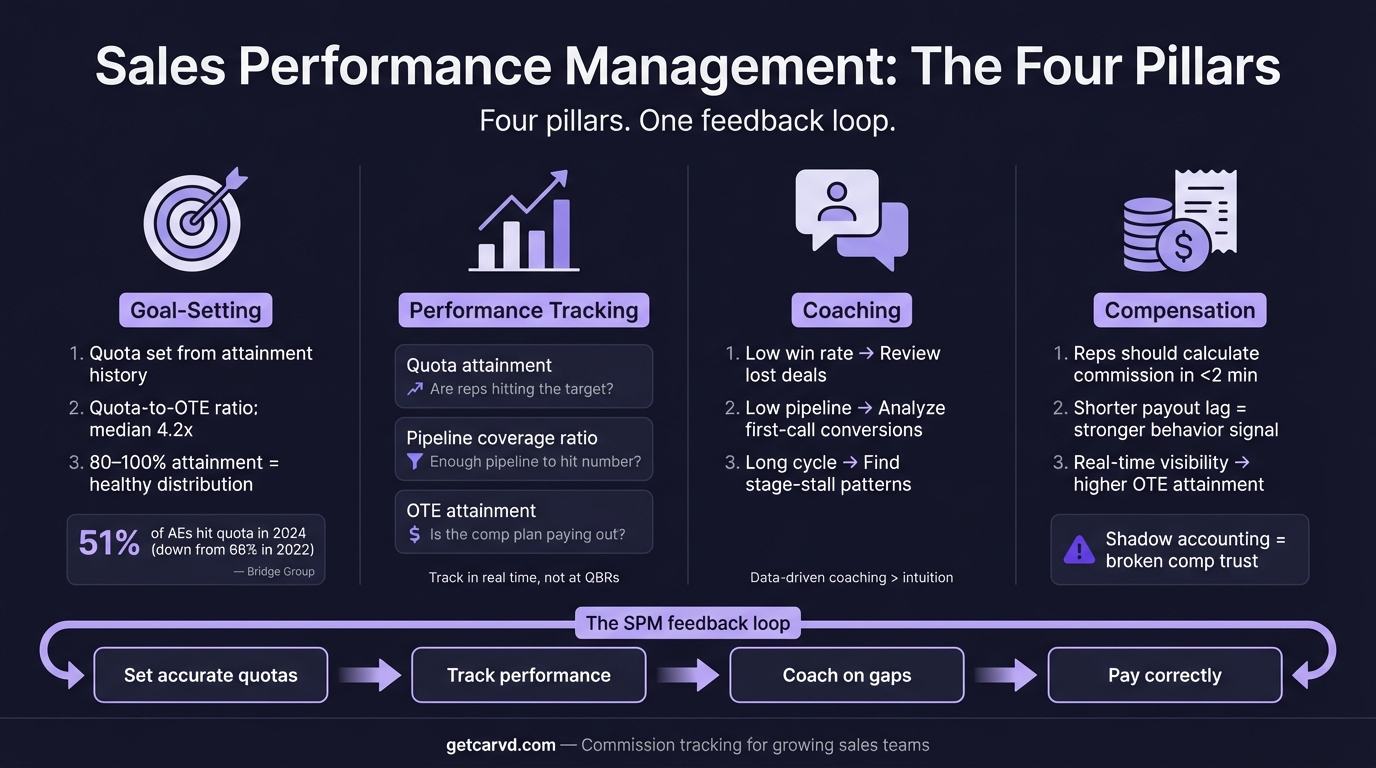
What sales performance management actually covers
Sales performance management (SPM) is the set of processes for setting sales goals, tracking progress, coaching reps, and aligning compensation with results. It's not a single tool or a quarterly review — it's the operational system that connects how you set expectations, how you develop people against them, and how you pay when they're met.
The four components:
- Quota and goal-setting — translating revenue targets into individual rep quotas, with plan structures that are achievable for median performers, not just top ones
- Performance tracking and reporting — measuring the metrics that predict whether reps will hit quota before the quarter ends, not just whether they did after
- Coaching and development — regular feedback loops between managers and reps, focused on the behaviors that drive pipeline conversion
- Incentive compensation management — commission plans reps can understand, verify, and trust
Most sales organizations have the first and second. The third is inconsistent. The fourth — specifically the "reps can verify" part — is often missing entirely.
Why SPM breaks down in practice
The Salesforce State of Sales (6th edition, 2024), based on a survey of 5,500 sales professionals, found that reps spend only 28% of their week actively selling. The rest goes to admin, data entry, and internal coordination. That means sales managers are coordinating with people who are themselves mostly doing non-selling work.
That compression matters. According to Gartner research, the average sales manager span of control grew from 10.9 reps in 2024 to 12.1 reps in 2025, which further reduces the time available per rep for actual coaching. Gartner's analysis of manager burden found that high levels of administrative load on sales managers can trigger double-digit declines in team quota attainment.
The common SPM failure modes:
Quotas set for top performers, not median ones. When quotas assume 130% attainment from the top 20% of reps, the plan doesn't work for the other 80%. QuotaPath's data shows average quota attainment sitting around 43% across tracked teams. That's a quota calibration problem, not a motivation problem.
Coaching that happens once a quarter. Performance reviews aren't a coaching cadence. Deal inspection in a one-on-one is useful, but it's reactive. Effective coaching addresses skill gaps before they show up in closed-lost reports.
Commission plans reps can't check. When reps can't independently verify their commission calculations, they run their own spreadsheets. Carvd's rep dashboards give each rep real-time visibility into exactly how their payout was derived. When those numbers disagree with payroll, disputes and disengagement follow. This is the trust tax on an unclear comp process.
Metrics that only look backward. Revenue closed and quota attainment are lagging indicators. If your reporting only shows you where you are, not where you're going, there's no time to intervene before a miss.
The components that matter most
Quota design
A functional quota-setting process starts with the company revenue target, divides by headcount (accounting for ramp), and calibrates for attainability. The standard benchmark for a well-calibrated plan is that 60-70% of reps hit or exceed quota. When fewer than half of your reps are hitting, the issue is usually quota level, territory equity, or ramp assumptions — not rep quality.
For comp plan design specifically, see Sales Compensation Plan: How to Build One That Works and Sales Comp Plan Examples: 5 Plans for Different Team Stages.
Performance tracking
The metrics that give early warning before a miss:
- Pipeline coverage ratio — the value of open pipeline vs. quota. A 3x ratio gives enough buffer for typical win rates; below 2x is a warning sign
- Stage conversion rates — where deals stall reveals whether the problem is qualification, competitive positioning, or close
- Activity-to-outcome ratios — how many meetings convert to qualified opportunities; how many opportunities convert to proposals
These are leading indicators. Win rate and quota attainment are lagging. For a full breakdown of which metrics to track at each stage, see Sales Metrics: What to Track at Every Stage of the Funnel.
Coaching cadences
What works for small and mid-market teams:
Weekly pipeline reviews — not a status update, but a deal inspection: what's the next action, what's blocking it, what does the rep need. These should be short (20-30 minutes per rep) and focused on the next 30 days.
Call review sessions — one recorded call per week reviewed together. Most sales coaching fails because it's based on what managers think is happening in calls, not what's actually happening.
Skill development conversations — separate from deal inspection. These address patterns: if a rep consistently loses at proposal, the coaching conversation is about business case framing, not the specific deal that slipped.
The frequency matters more than the format. Quarterly reviews don't change behavior; weekly check-ins do.
Commission plan transparency
The most overlooked SPM component is whether reps can verify their own commission. McKinsey's analysis found that companies that formalize sales operations can achieve one-time productivity improvements of 20-30%, with sustained annual increases of 5-10%. A significant driver is trust — when reps know their comp is calculated correctly, they focus on selling.
A rep who receives a commission statement showing one number, runs their own spreadsheet and gets a different number, and then has to chase down the discrepancy spends time that should go toward pipeline. That's the actual cost of an opaque commission process, and it compounds across a 15-rep team.
SPM software: what it does and when you need it
The SPM software market was valued at $2.36 billion in 2023 and is projected to reach $6.53 billion by 2030 at a 16.3% CAGR, according to Grand View Research. The growth reflects that more mid-market companies are formalizing processes they previously ran manually.
SPM software generally covers some combination of:
- Quota management — building, assigning, and adjusting quotas across rep and team hierarchies
- Territory management — defining territory boundaries and assigning accounts
- Incentive compensation management (ICM) — calculating commissions, handling plan rules, generating rep statements
- Performance analytics — dashboards and reporting across the rep portfolio
Enterprise platforms (Xactly, CaptivateIQ, SAP Commissions) cover all of these, with complex workflow support and integrations. They're built for companies with 100+ reps and dedicated ops teams to manage them.
For smaller teams, a more practical approach is to use a purpose-built tool for the component that's causing the most friction. For most 10-50 rep teams, that's commission calculation and transparency. A tool like Carvd handles the ICM layer — calculating commissions from your CRM data and giving reps deal-level visibility into how their payout was derived — without requiring an implementation project.
Building an SPM process for small and mid-market teams
For teams of 10-50 reps, a workable SPM process doesn't require enterprise software. The minimum effective version:
1. Set quotas with a calibration model. Use historical attainment data to set quota at a level where 60-70% of reps can hit it in a typical quarter. Adjust for ramp (new hires typically need 2-3 quarters to reach full productivity).
2. Define 3-5 leading indicators to track weekly. Pipeline coverage, stage conversion, and activity-to-outcome ratios. These go on a weekly report that managers review before pipeline calls.
3. Run weekly one-on-ones with a structured format. Focus on pipeline, not admin. A simple template: what closed last week, what's at risk this week, what's the rep's biggest obstacle.
4. Make commission statements verifiable. Every rep should be able to see which deals were included in their commission run, which plan rules applied, and what the calculation produced at each step. A formal dispute resolution workflow gives reps a clear path to flag discrepancies instead of escalating through email. If they can't verify their number, disputes and shadow accounting follow.
5. Review attainment distribution quarterly. Look at the full distribution — what percentage of reps hit 100%+, 70-99%, below 70%. Flat or improving distribution is the signal that the SPM process is working.
The connection to compensation
Sales performance management and compensation are the same system viewed from different angles. SPM defines what performance you want; comp design incentivizes it; commission execution closes the loop.
The Gartner December 2024 survey of Chief Sales Officers found that only 11% of sales organizations drive commercial success while also executing a transformation. A common failure mode in the other 89% is comp plans that lag behind strategy changes — new go-to-market priorities that aren't yet reflected in how reps are paid, or quota adjustments that aren't communicated clearly enough for reps to re-anchor their own planning.
Getting commission right is the part of SPM most directly within sales ops control. Everything else — coaching quality, manager spans, territory design — is harder to change quickly. A transparent, accurate commission process — backed by a commission calculator that produces deal-level breakdowns — is a lever that can be pulled faster.
Related reading:
Last updated: March 22, 2026