Quota Attainment: How to Measure, Benchmark & Improve It
Quota attainment measures how much of their sales target a rep achieves. Learn the formula, what good looks like, and how to improve attainment without gaming the metric.
Most sales teams track quota attainment. Far fewer use it well.
The metric is simple enough — what percentage of target did a rep achieve? But the interpretation is where most sales ops and RevOps teams go wrong. A company where 45% of reps hit quota isn't necessarily a failing company. A company where 90% of reps hit quota isn't necessarily thriving. The number only tells you something useful in context.
This guide covers how to calculate quota attainment, what the benchmarks actually say, and how to use the metric to make better comp plan and quota decisions.
What is quota attainment?
Quota attainment is the percentage of a sales target that a rep achieves in a given period. It can be measured monthly, quarterly, or annually, and it's usually the primary metric that determines whether a rep earns variable commission — and how much.
Most commission plans are structured around quota attainment thresholds: a base rate below quota, a higher rate at or above quota, and accelerators above 100% for top performers.
How to calculate quota attainment
Quota Attainment (%) = (Actual Sales / Sales Quota) × 100
A rep with a $250,000 quarterly quota who closes $235,000 has 94% attainment. One who closes $312,000 has 124.8% attainment and likely earns at an accelerated commission rate.
What counts as "actual sales" depends on your plan:
- ARR or ACV for subscription businesses — most common in SaaS
- Bookings — the contract value signed, regardless of when revenue is recognized
- Revenue — when recognized, under ASC 606 rules
- Units — for volume-based or product-specific plans
The metric that goes into the attainment formula should match what the rep was told when their quota was set. Mismatch between expected and actual measurement creates disputes before the quarter even closes.
Quota attainment benchmarks
Quota attainment across the industry is lower than most people expect — and has been getting worse.
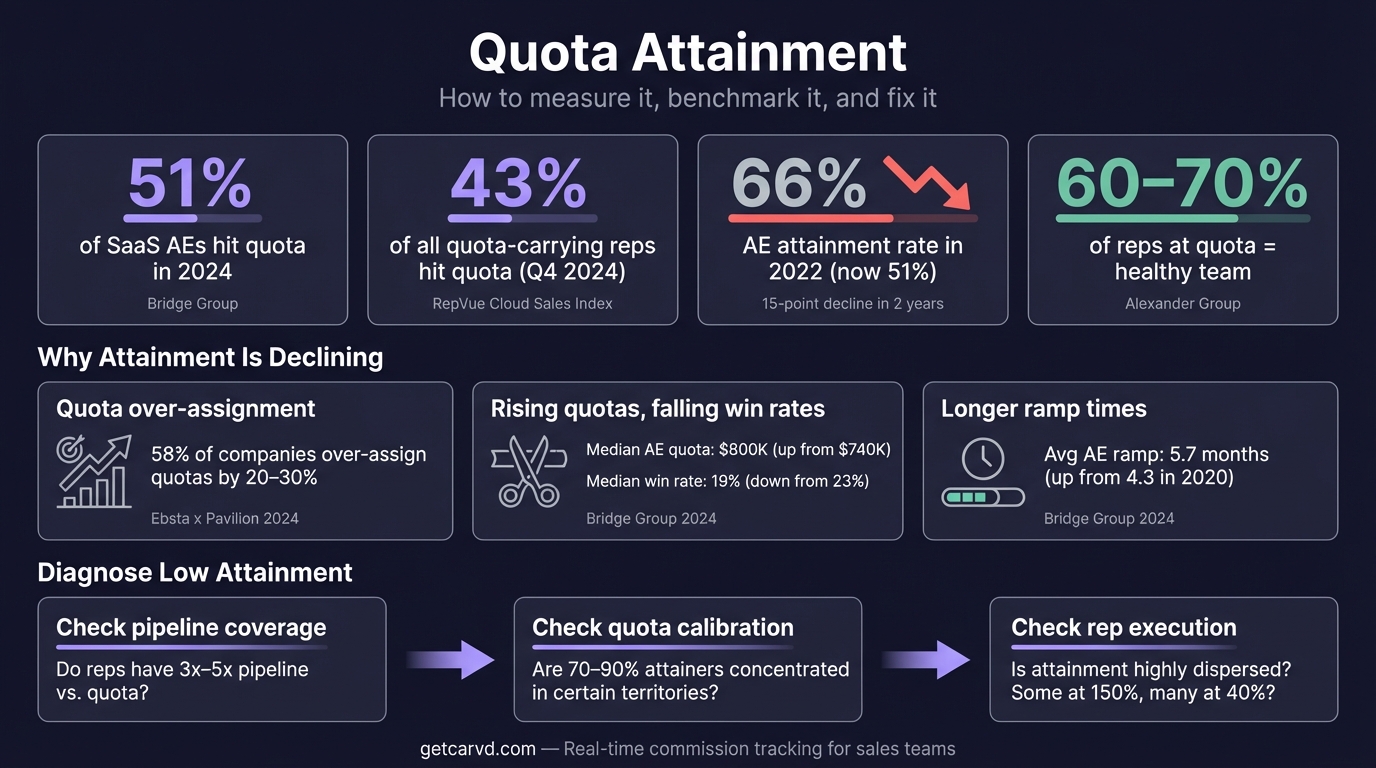
Salesforce's 2024 State of Sales report, which surveyed 5,500 sales professionals across 27 countries, found that 84% of reps missed quota the prior year. The Ebsta x Pavilion 2024 B2B Sales Benchmarks Report, based on analysis of 4.2 million opportunities across 530 companies, found 70% of B2B reps missed quota in 2024.
RepVue's Cloud Sales Index put average quota attainment at 43.14% in Q4 2024 — which sounds alarming until you understand what the benchmarks actually say is healthy.
Forrester analyst Seth Marrs found that company-wide average attainment of around 47-50% is common and not inherently a problem, because quota plans are deliberately designed so that most reps land below 100%. Accelerators above quota concentrate reward in top performers — if everyone hits 100%, quotas were probably set too low.
The more meaningful benchmark is the percentage of reps at or above quota. Alexander Group, which tracks compensation design across industries, benchmarks a healthy plan at 55-65% of reps achieving quota or better. Below 50% consistently signals either unrealistic quota-setting or misaligned incentive design. Above 80% usually means quotas are too easy and top performers aren't earning outsized rewards.
Why attainment distribution matters more than average attainment
Tracking average quota attainment hides the pattern that actually matters: how attainment is distributed across the team.
A team where 20% of reps are hitting 150%+ while 50% are below 50% looks fine on average. The underlying reality is a bimodal distribution — a few stars and a long tail of struggling reps — which almost always traces back to one of two root causes: unequal territory design or a quota-setting process that doesn't account for territory potential.
The attainment breakdown to track:
| Tier | Attainment | What it indicates |
|---|---|---|
| Top performers | 125%+ | Accelerators are working; check territory fairness |
| On-plan | 80-124% | Core of the team; comp plan is motivating |
| Underperforming | 50-79% | Performance issue or quota is too high for their territory |
| At risk | Below 50% | Quota may be unrealistic, or rep is a retention risk |
Alexander Group found that companies with a bimodal distribution — high top-performer attainment paired with high below-50% rates — often saw turnover approach 25% until territory and quota design was fixed. The metric surfaces the problem, but the fix is upstream.
Why reps miss quota
Missed quota has a lot of explanations, not all of them performance issues. The most common root causes, roughly in order of frequency:
Unrealistic quotas. Quotas set based on finance targets rather than market data or territory potential produce low attainment regardless of rep effort. If quota is $1.2M in a territory with $800K of realistic addressable pipeline, attainment will land around 65-70% every quarter. QuotaPath research found 91% of sales teams missed quota, with misaligned compensation and quota-setting cited as primary drivers.
Unequal territory distribution. When one rep has 40% of the addressable market and three others split the remaining 60%, attainment differences reflect territory design, not performance differences. Attainment distributions that cluster by territory or region (not by rep tenure or product expertise) usually point here.
Insufficient pipeline. Low pipeline coverage — under 3x quota — is a leading indicator of attainment problems 60-90 days before they appear in the attainment numbers. Teams managing pipeline coverage proactively catch this earlier than teams that only look at attainment after the quarter closes.
Plan complexity that creates confusion. Reps who can't predict their own commission within a few minutes of closing a deal tend to disengage from the plan mechanics. Running sample deals through a commission calculator during plan rollout helps reps verify their own payouts. If the plan is too complex to self-calculate, it doesn't drive behavior between deals — which is most of the quarter.
How commission plan design affects attainment
The structure of the commission plan directly influences attainment patterns — both how many reps hit quota and where they land relative to it.
Accelerator design. Plans that increase commission rates above 100% attainment (e.g., 8% below quota, 12% above) concentrate motivation in the attainment range reps think they can reach. If accelerators kick in at 100% but most reps are tracking at 70%, they're too far away to influence behavior. A "runway accelerator" that starts at 80% or 85% — closer to where the median rep lands — pulls more reps into the on-plan tier.
Quota over-assignment. ICONIQ Growth data found that 58% of companies over-assign individual quotas by 20-30% above revenue targets, building in a buffer for reps who miss. This is common practice, but it means reps are effectively working against targets that are higher than the company needs. The tradeoff is motivation — too much over-assignment creates unattainable quotas.
Ramping adjustments. New reps typically take six months or more to reach full productivity. The Xactly 2024 Sales Compensation Report, which surveyed 230 companies, found 77% use ramp periods of six months or less for new AEs. Plans that hold new reps to full quota during ramp inflate team-level miss rates and create early attrition. Reduced quotas or modified commission rates during ramp produce more realistic attainment data.
Connecting attainment to the compensation process
Quota attainment drives commission payouts — which means any inaccuracy in how attainment is calculated flows directly into commission errors.
The connection is straightforward: if a rep's CRM data shows $185,000 closed this quarter but the commission calculation pulls from a different data source that shows $172,000, their attainment calculation is wrong, their payout is wrong, and they'll notice when they look at their statement. That's the origin of most commission disputes.
Teams that track commission accuracy rate alongside quota attainment have a way to catch these discrepancies early. If attainment is 88% but commission accuracy is 91%, the math isn't clean — and the 9% error rate is likely to surface as disputes.
For teams using commission software like Carvd, quota attainment is calculated at the deal level from the same data source used for commission calculations — so the number a rep sees in their dashboard matches what goes into their payout, with a full breakdown of which deals counted and why.
How to improve quota attainment
Improving attainment usually comes from one of three levers:
Recalibrate quotas to territory potential. Pull historical closed-won data by territory and compare to quota levels. If the gap between realized opportunity and quota is consistently 25-30% in certain regions, quotas are set for the wrong territory potential. This is an annual exercise most teams skip.
Fix attainment visibility during the quarter. Carvd's rep dashboards show reps their real-time attainment — including which deals count and how far they are from the next accelerator — which drives different closing behavior than waiting for a quarterly statement. Quota attainment tracking that's available mid-quarter is a motivational tool; tracking that's only visible after the quarter closes is a reporting tool. When reporting attainment to the board at quarter-end, Deckary builds the slides.
Design accelerators for where reps actually are. If median attainment is 72%, an accelerator at 100% is out of reach for most of your team most quarters. Model different accelerator thresholds using the commission plan builder before committing — for example, a 10% commission rate at 70-100% and 14% above 100%, rather than a flat rate below quota and a jump only at 100%.
Related reading
Last updated: March 22, 2026