How to Build a Sales Compensation Plan (With Templates)
Learn how to build a sales compensation plan that motivates reps and controls cost. Covers OTE, pay mix, quota, commission structures, and accelerators.
Most sales compensation plans are built backwards. A VP of Sales picks a number they want to pay reps, a finance team decides what they can afford, and the plan gets stitched together from those two constraints. The result is a plan that nobody fully understands, reps don't trust, and ops teams spend hours every quarter recalculating.
Building a comp plan forward — from strategy to structure to mechanics — produces something reps can explain in a sentence and ops can calculate accurately. Here's how to do it.
What a sales compensation plan is
A sales compensation plan is the documented policy that defines how salespeople earn money. It covers:
- Base salary — the guaranteed portion paid regardless of performance
- Variable compensation — commission or bonus paid when targets are hit
- OTE (on-target earnings) — total expected pay when a rep hits 100% of quota
- Quota — the performance threshold that defines "on target"
- Commission rate or formula — how variable pay is calculated
- Accelerators — higher rates paid above quota
- Clawback terms — when previously paid commissions can be recovered
- Pay period — how frequently commissions are calculated and paid
Together, these elements form the rules that translate a rep's performance into a paycheck.
Step 1: Define the role's selling motion
Before writing a single number, answer these questions about the role you're compensating:
What does the rep control? Account executives who prospect, qualify, and close have high control over revenue. Inbound SDRs who book meetings from warm leads have moderate control. Customer success managers who influence renewals have lower control. Control level should drive how much of compensation is variable.
How long is the deal cycle? A rep with a 2-week deal cycle will see commissions on a predictable schedule. A rep with a 9-month enterprise cycle might go two quarters without a payout despite doing everything right. Longer cycles justify higher base or draw structures.
Is the quota individual or team-based? Individual quotas are cleaner to design and easier for reps to understand. Team quotas work for roles like SDRs (where individual attribution is harder) but require more careful design to avoid free-rider problems.
Getting this context right determines the pay mix, not the other way around.
Step 2: Set the pay mix
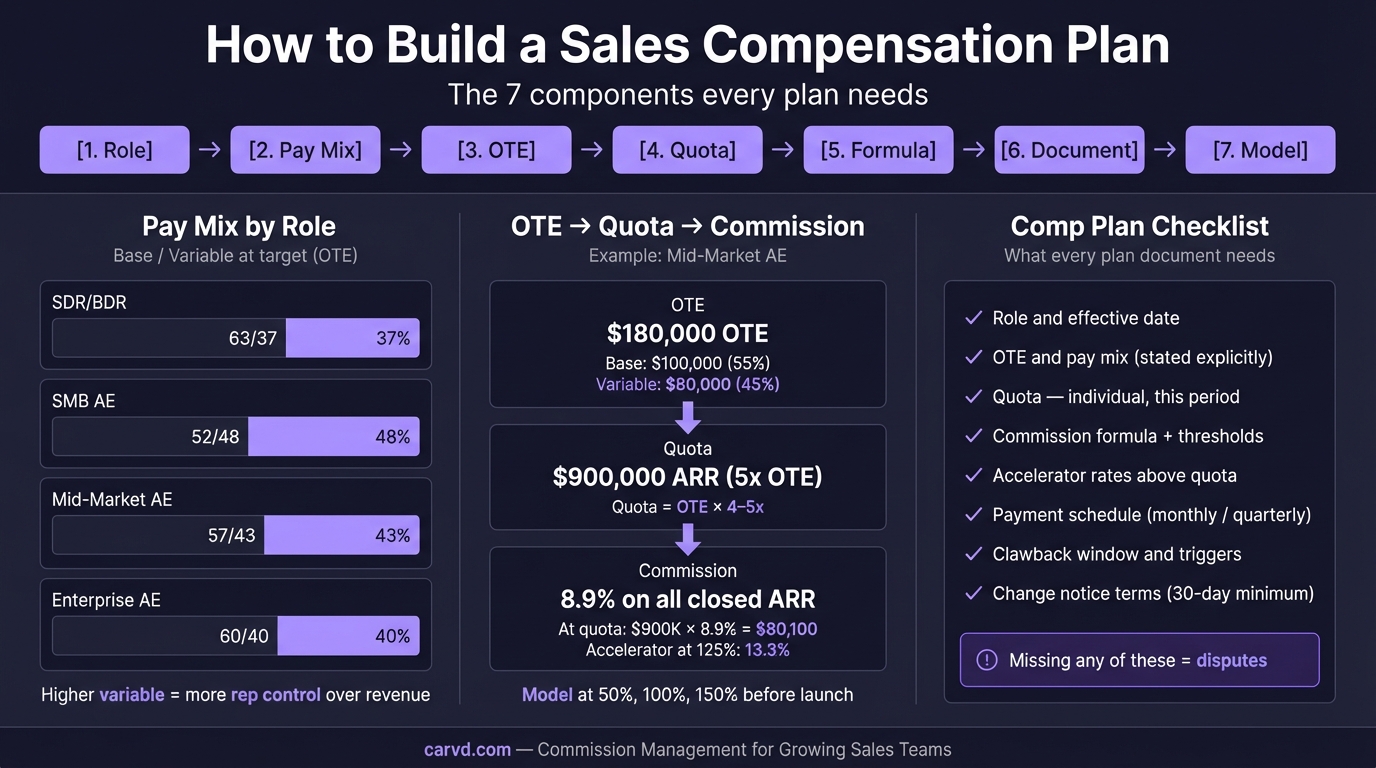
Pay mix is the ratio of base salary to variable compensation at target (OTE). A 60/40 pay mix means 60% base, 40% variable.
Higher variable ratios work for roles where reps have high control over revenue and short feedback loops. Higher base ratios work for longer cycles, lower control, or roles with significant non-selling responsibilities.
B2B SaaS benchmarks by role:
| Role | Typical pay mix (base/variable) | Notes |
|---|---|---|
| SDR / BDR | 60–65 / 35–40 | Lower variable reflects limited closing control |
| SMB AE | 50–55 / 45–50 | Higher variable, shorter cycles |
| Mid-Market AE | 55–60 / 40–45 | Moderate cycle length, direct close ownership |
| Enterprise AE | 55–65 / 35–45 | Longer cycles, larger team involvement |
| Account Manager | 65–70 / 30–35 | Renewal and expansion focused |
These are starting points. In competitive hiring markets, you may need to offer more variable to attract performers. In volatile markets, reps often prefer more base for income stability.
Step 3: Set OTE and derive the components
OTE is the anchor. Set it first, based on market data for the role in your geography, then derive base and variable from the pay mix.
Example:
- Role: Mid-Market AE
- Market OTE: $180,000
- Target pay mix: 55/45
Calculation:
- Base = $180,000 × 55% = $99,000
- On-target variable = $180,000 × 45% = $81,000
The $81,000 in variable pay is what the rep earns when they hit 100% of quota.
If you're setting OTE from scratch without market data, check sources like RepVue (which aggregates verified comp data by role and company), Betts Recruiting's annual benchmarks, and the Bridge Group's SaaS AE Metrics report. Don't set OTE based on what feels affordable — set it based on what's competitive for the talent pool you're hiring from.
Step 4: Set quota
Quota determines what "on target" means in practice. The most common method for B2B SaaS is to set quota as a multiple of OTE — typically 4–5x for account executives.
Example:
- AE OTE: $180,000
- Quota multiple: 5x
- Annual quota: $900,000 in new ARR
The logic behind the multiple: if a rep hits quota, they earn their full variable ($81,000), which represents $81K / $900K = 9% of revenue. That commission-to-revenue ratio needs to fit within your unit economics.
Common quota-setting mistakes:
- Setting quota too high. If fewer than 60% of your reps hit quota in a given period, the quota is probably wrong, not the reps. Over-quota plans demoralize teams and inflate your OTE benchmarks without paying out.
- Setting quota too low. If 90%+ of reps hit quota every quarter, your accelerators become the real base rate, and you've underpriced the role.
- Not adjusting for territory. A rep in a greenfield enterprise territory and a rep in a mature SMB patch shouldn't have the same quota unless you've verified the opportunity is equal.
A healthy attainment distribution has roughly 60–70% of reps at or above quota, with meaningful variance in the distribution — some at 50%, some at 150%.
Step 5: Choose the commission formula
The commission formula defines how variable pay is calculated. The most common structures:
Flat rate
One commission rate applied to all revenue. Simple to calculate, simple to explain.
Example: 9% on all closed ARR. Rep closes $900K, earns $81K. Rep closes $1.1M, earns $99K.
Best for: smaller teams (under 10 reps), early-stage companies, or roles where simplicity outweighs the need for overperformance incentives.
Tiered rate (accelerators)
Higher commission rates kick in above quota thresholds. Motivates overperformance more than a flat rate.
Example:
| Attainment | Rate |
|---|---|
| 0–100% of quota | 9% |
| 100–125% of quota | 13.5% |
| 125%+ of quota | 18% |
At 100% ($900K), the rep earns $81K. At 130% ($1.17M), they earn: $81K + ($270K × 13.5%) + ($0) = $117,450. The accelerator is meaningful enough to motivate the push.
For more on tiered structures, see tiered commission structure design.
Quota bonus (milestone pay)
Instead of a commission rate on all revenue, the rep earns a fixed bonus at quota attainment milestones.
Example:
| Milestone | Payout |
|---|---|
| 75% of quota | $20,000 |
| 100% of quota | $81,000 |
| 125% of quota | $105,000 |
Milestone plans simplify administration but can create cliff effects — reps may slow-play deals once they've hit a milestone and wait for the next period.
Which to choose
| Structure | Best for | Complexity |
|---|---|---|
| Flat rate | Teams under 10, early-stage | Low |
| Tiered | Growth-stage, overperformance matters | Medium |
| Quota bonus | Roles where attribution is indirect (SDR) | Low–Medium |
Step 6: Write the full plan document
A comp plan that exists only in a VP's head is not a comp plan. The written document should include:
- Role and effective date — which roles this plan covers and when it starts
- OTE and pay mix — stated explicitly
- Quota — individual quota for this period, or how it's set
- Commission formula — exact rates, thresholds, and calculation method
- Payment schedule — when commissions are paid and for what period
- Deal crediting rules — what types of deals qualify, how splits work, what deal modifications do to prior payouts
- Clawback policy — under what conditions commissions can be recovered and within what window
- Change terms — how much notice the company provides before modifying the plan
The last point matters more than most companies realize. Changing comp plans mid-year — even for good reasons — destroys trust. Build in a 30-day notice period or a commitment to only change the plan at the start of a new fiscal year.
Step 7: Model the payouts before launching
Before you share the plan with reps, run the numbers at multiple attainment scenarios:
| Attainment | Revenue closed | Commission |
|---|---|---|
| 50% | $450,000 | $40,500 |
| 75% | $675,000 | $60,750 |
| 100% | $900,000 | $81,000 |
| 120% | $1,080,000 | $116,100 |
| 150% | $1,350,000 | $162,000 |
Use the commission plan builder to model different accelerator curves before rolling out to the team, or start in a Stackrows template. Two checks to run:
- Does the 50% payout feel livable alongside the base salary? If a rep at 50% is earning a combined package that's below market, you'll lose them.
- Does the 150% payout feel sustainable for the company? Model your total commission expense as a percentage of revenue at each attainment level.
Surprises at launch — "I didn't realize a rep could earn that much" — are a sign the plan wasn't modeled properly.
Common mistakes in comp plan design
Too many components. If your plan includes base + commission + quarterly bonus + annual MBO + SPIFF + territory multiplier, reps can't calculate their expected earnings. Simplify to base + variable + one accelerator.
Paying on bookings instead of billings. Paying commission when a deal is signed but before cash is collected increases clawback risk and creates a disconnect between comp and company cash flow. Consider aligning at least partial commission to billing triggers for large deals.
No ramp structure for new hires. A new rep on full quota from day one will accumulate draw deficits or miss quota repeatedly in their first 90 days. Build in a ramp quota (25/50/75/100 over four months) or a non-recoverable draw. For a detailed breakdown of how draws work, see draw against commission.
Changing the plan mid-year. If business circumstances change significantly (major product pivot, territory realignment), communicate the change with maximum notice and consider whether affected reps should receive any transition compensation.
Templates: sample plans by role
SDR comp plan template
| Component | Value |
|---|---|
| Base salary | $65,000 |
| On-target variable | $35,000 |
| OTE | $100,000 |
| Quota | 60 qualified meetings / quarter |
| Per-meeting rate | $583 (=$35K / 60) |
| Accelerator | 1.5x per meeting above quota |
| Pay period | Monthly |
SMB AE comp plan template
| Component | Value |
|---|---|
| Base salary | $70,000 |
| On-target variable | $70,000 |
| OTE | $140,000 |
| Quota | $700,000 ARR / year |
| Commission rate (0–100%) | 10% |
| Accelerator (100–125%) | 15% |
| Accelerator (125%+) | 20% |
| Pay period | Monthly |
| Clawback window | 90 days from close |
Mid-Market AE comp plan template
| Component | Value |
|---|---|
| Base salary | $100,000 |
| On-target variable | $80,000 |
| OTE | $180,000 |
| Quota | $900,000 ARR / year |
| Commission rate (0–100%) | 8.9% |
| Accelerator (100–125%) | 13.3% |
| Accelerator (125%+) | 17.8% |
| Pay period | Monthly |
| Clawback window | 90 days from close |
Tracking and administering the plan
A comp plan that exists on paper but can't be accurately tracked in practice creates disputes. Reps maintain their own shadow spreadsheets when they don't trust the official number. Shadow accounting is a sign your tracking infrastructure isn't working — and a clear sign your team needs rep dashboards that give each rep real-time visibility into quota attainment and projected payouts.
For small teams (under 5 reps), a well-maintained spreadsheet can work — but it requires discipline: one authoritative source, clear version control, and someone accountable for updates when deals change.
For growing teams, the overhead of spreadsheet administration becomes the bottleneck. Deals get modified, clawbacks get triggered, territories get realigned, and each change requires manual recalculation. Commission software like Carvd is designed for this: you define the plan rules once, connect your deal data, and reps can see real-time calculations of their earned and projected commissions.
The goal is a system where a rep can verify their own payout at any point in the quarter without needing to ask ops. That transparency reduces disputes and removes the friction of end-of-period reconciliation. When discrepancies do surface, a structured dispute resolution workflow keeps the process clean instead of devolving into email threads.
For a broader view of how commission structures fit together, see our guide to sales commission structures.
Related reading
- Tiered commission structure: how to build one that scales — designing accelerators that motivate without surprising finance
- Draw against commission: how it works — ramp-period compensation for new hires
- Commission clawbacks: when to use them — writing a clawback policy reps will accept
- Base salary plus commission: finding the right split — pay mix benchmarks by role
Last updated: March 21, 2026