Qobra Alternative: Commission Software with Published Pricing
Looking for a Qobra alternative? Compare 6 commission tools on pricing, transparency, and setup time—so you can find the right fit without booking a demo first.
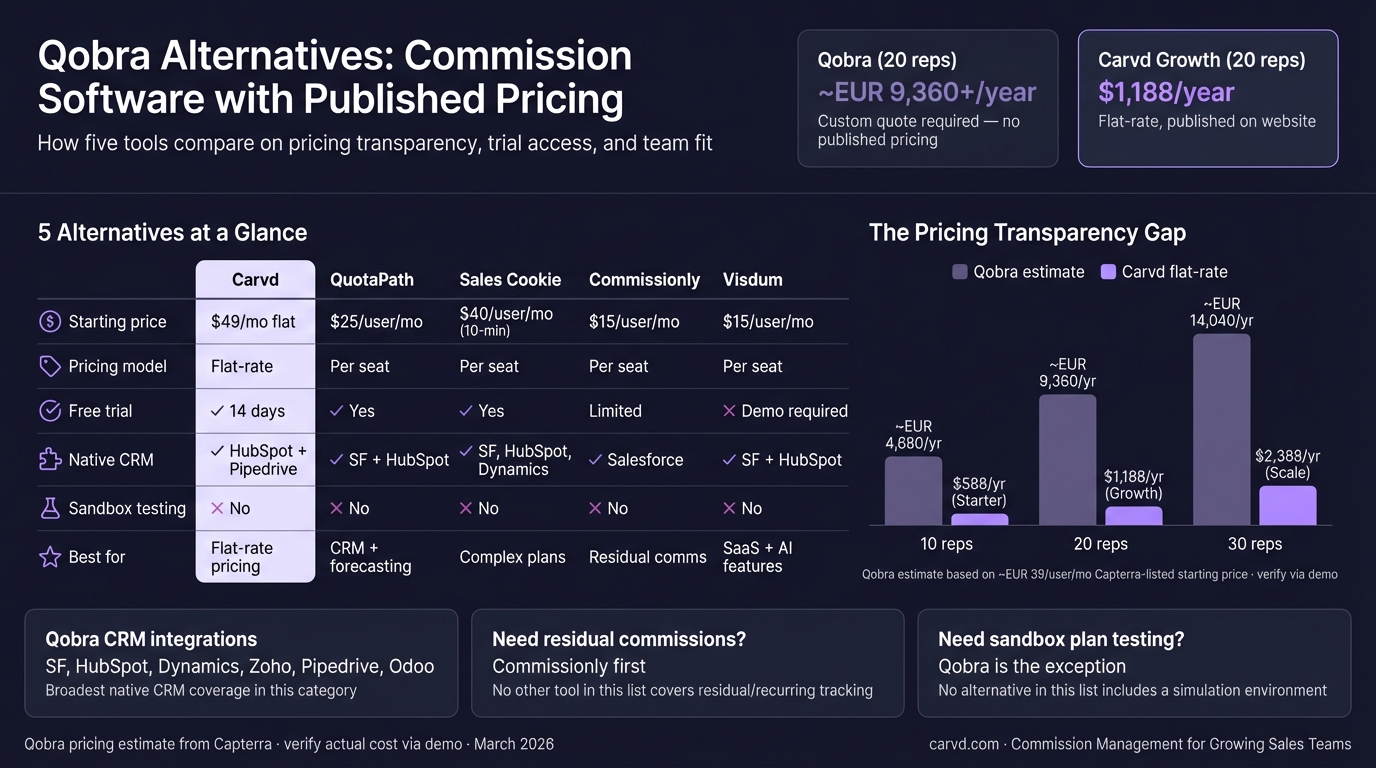
Qobra doesn't publish pricing on its website. To find out what you'd pay, you book a demo. Third-party sources like Capterra list a starting price of approximately EUR 39/user/month—but that's a listing, not a commitment. Actual cost is custom and only confirmed after a sales conversation.
For a 20-rep team at the Capterra-listed starting price, that's approximately EUR 9,360/year before you've had a chance to test the product or compare it against alternatives.
That's the most common reason teams look for Qobra alternatives: they want to see a number before picking up the phone. Here's an honest look at where Qobra does the job well, what typically drives the evaluation, and which alternatives are worth considering.
Where Qobra genuinely excels
Before comparing alternatives, it's worth being clear about what Qobra does well. If these features match your requirements, switching is probably the wrong move.
Deep CRM and data warehouse integrations. Qobra natively connects to Salesforce, HubSpot, Microsoft Dynamics, Zoho, Pipedrive, and Odoo. It also integrates with Snowflake, BigQuery, PostgreSQL, and Amazon Redshift. For RevOps teams with deal data spread across multiple systems, that native connectivity is a genuine differentiator—most SMB commission tools don't support data warehouse integrations at all.
Dedicated CSM for every customer. Qobra assigns a dedicated customer success manager to each account. For teams that want hands-on implementation support and ongoing guidance on plan design, that CSM relationship matters. It's not available in most self-serve tools.
Sandbox testing environment. Qobra includes a simulation environment where teams can test plan changes before deploying them. Seeing how a new accelerator or threshold affects payouts without running it live is a meaningful risk-reduction feature for complex plan structures.
High customer ratings. Qobra holds a 4.9/5 on Capterra from 430+ reviews as of early 2026. Reviewers consistently cite the platform's usability and the quality of customer support.
Gamification and real-time notifications. Qobra includes rep-facing features like gamification elements and real-time earnings notifications. For sales leaders who want motivation tooling built into their commission software, those features are included at no additional cost.
For a detailed side-by-side comparison, see our Carvd vs Qobra comparison page.
Why teams look for alternatives
Teams that evaluate Qobra and move elsewhere typically land on one of three reasons.
No published pricing. Qobra's pricing page doesn't list rates—it routes visitors to a demo request form. For a sales ops manager doing an initial vendor comparison, not knowing the price means Qobra can't be included in a budget-stage evaluation until after the first sales call. Teams that want to shortlist vendors based on cost before engaging a sales process will often evaluate alternatives with published pricing first.
Per-user pricing scales with headcount. Based on the Capterra-listed starting price of ~EUR 39/user/month, Qobra's cost compounds with team size. A team growing from 15 to 30 reps doubles the variable cost. Flat-rate alternatives become more cost-effective as headcount grows.
Implementation timeline expectations. Qobra markets a kickoff-to-launch timeline of under 14 days. In practice, mid-market implementations involving data audits, CRM setup, parallel runs, and validation can take 8-12 weeks. Teams that need commission calculations running in days—not weeks—often look for tools with self-serve setup.
6 Qobra alternatives worth evaluating
1. Carvd
Carvd is commission software for sales teams of 5-200 reps. It connects to HubSpot or Pipedrive directly, or imports deals from a CSV upload. It supports flat, tiered, and per-product commission plans, and generates deal-level statements showing reps exactly how their payout was calculated.
The structural difference from Qobra is pricing transparency and model. Carvd publishes its rates: $49/month for up to 10 reps (Starter), $99/month for up to 25 reps (Growth), or $199/month for unlimited reps (Scale). Flat-rate with no per-seat fees. Carvd's dispute resolution workflow and rep dashboards are included at every tier. A 20-rep team pays $1,188/year on Carvd Growth versus an estimated EUR 9,360+/year on Qobra. No demo required to see the number.
The trade-offs are real. Carvd doesn't offer data warehouse integrations (Snowflake, BigQuery), a dedicated CSM, a sandbox testing environment, or gamification features. If those are part of your evaluation criteria, Qobra or a more feature-complete platform may be the better fit. If you're running flat, tiered, or per-product plans and want commission calculations running today, Carvd offers a 14-day free trial and self-serve setup in under an hour.
Best for: Teams of 5-200 reps on HubSpot or Pipedrive with standard commission structures who want published pricing and no per-seat fees.
2. QuotaPath
QuotaPath is one of the more widely adopted commission tools in the SMB and mid-market segment. It supports Salesforce, HubSpot, Pipedrive, Close, and several other CRMs natively on paid tiers, and holds a 4.5/5 on Capterra from 120+ reviews as of early 2026. Published pricing starts at approximately $25/user/month on Essential.
Unlike Qobra, QuotaPath publishes its pricing without a demo gate. The per-seat model means costs still scale with headcount, but you can run the numbers before engaging sales. QuotaPath's rep-facing experience is well-developed: quota attainment tracking, earnings forecasting, and a real-time view of pacing are core to the product.
QuotaPath doesn't include Qobra's depth of integrations (no data warehouse connections, no Dynamics or Zoho natively on lower tiers), and there's no dedicated CSM. But for teams primarily using Salesforce or HubSpot that want published pricing and a self-serve starting point, QuotaPath is a reasonable middle ground.
Best for: Teams with Salesforce or HubSpot who want per-deal commission tracking, quota attainment visibility, and published pricing without a demo requirement.
3. Visdum
Visdum is built for SaaS companies, with SaaS-specific comp plan templates, an AI copilot trained on SaaS compensation patterns, and a no-code plan designer. It holds a 4.8/5 on G2 from 580+ reviews and has earned G2 badges for Fastest Implementation and Easiest to Use as of early 2026.
Published pricing starts at $15/user/month on Growth (up to 50 sellers, billed annually) and $30/user/month on Dynamic. A 20-rep team pays $3,600/year on Visdum Growth versus an estimated EUR 9,360+/year on Qobra. Pricing is published—no demo required to see it.
The trade-off is the vertical focus. Visdum's template library and AI recommendations are built around SaaS sales motions. Non-SaaS teams will find the tooling less tailored to their plan types. Visdum also doesn't match Qobra's breadth of CRM and data warehouse integrations.
Best for: SaaS teams that want industry-specific templates and AI-assisted plan building with published per-seat pricing.
4. ElevateHQ
ElevateHQ is a commission platform that covers flat, tiered, and split commission structures alongside rep motivation features including leaderboards and behavioral nudges. It holds a 4.7/5 on G2 from 239 reviews as of early 2026.
ElevateHQ publishes pricing: Basic at $30/user/month plus a $250/month platform fee, Professional at $35/user/month plus a $350/month platform fee. The platform fee is the important detail—it applies at every tier. A 20-rep team on Basic pays $10,200/year. That's more than Qobra's estimated annual cost at the Capterra-listed starting price, which means ElevateHQ isn't a cost-reduction alternative to Qobra. It's a transparency alternative: you know the number before talking to anyone.
ElevateHQ doesn't include data warehouse integrations, a sandbox environment, or a dedicated CSM. Its gamification features (leaderboards, nudges) are comparable to Qobra's in that area.
Best for: Teams that want a published price to evaluate upfront and value behavioral nudges and leaderboards, and for whom total cost is a secondary concern.
5. Everstage
Everstage is a sales performance management platform that packages commission calculation, quota management, pipeline visibility, and gamification—including leaderboards and contests—into one product. G2 users rate it 4.8/5 from 1,700+ reviews as of early 2026. Published pricing starts at $30/user/month.
Everstage's feature profile overlaps most with Qobra's in terms of breadth: both include commission automation, rep dashboards, gamification, and dispute workflows. The key difference is pricing structure—Everstage publishes its rates. A 20-rep team pays approximately $7,200/year on Everstage at the listed starting price, compared to Qobra's estimated EUR 9,360+/year.
Everstage doesn't match Qobra's data warehouse integrations and doesn't assign a dedicated CSM to every account.
Best for: Mid-market teams of 20-100 reps that want commission calculations, quota management, and rep gamification in one platform—with published pricing.
6. CaptivateIQ
CaptivateIQ is the highest-rated commission platform on G2 (3,300+ reviews, ranked #1 in Sales Compensation as of early 2026). It handles enterprise-grade compensation structures: territory overlays, multi-step approval workflows, SPIFs, MBO components, multi-currency calculations, and native connections to Salesforce, HubSpot, Workday, Snowflake, BigQuery, and 15+ enterprise systems.
Qobra and CaptivateIQ are targeting similar buyer profiles—RevOps and Finance teams at mid-market to enterprise companies—but CaptivateIQ is the heavier platform. Typical annual spend based on third-party procurement data runs $20,000-$120,000+ with implementation taking 8-12 weeks. Pricing is custom and also requires a sales conversation.
Teams evaluating Qobra for its data warehouse integrations and complex plan support may find CaptivateIQ the better fit if compensation structures involve territory hierarchies, multi-layered approvals, or large team sizes. Teams moving away from Qobra because of pricing opacity won't find relief here—CaptivateIQ is equally opaque on cost.
Best for: Enterprise and upper-mid-market teams (50+ reps) with compensation complexity that mid-market tools can't reliably handle.
How to choose
The right alternative depends on what's driving the evaluation.
If pricing opacity is the issue: Qobra requires a demo before you see a number. Every other tool in this list except CaptivateIQ publishes pricing. If you want to run cost comparisons before booking a call, Carvd, QuotaPath, Visdum, ElevateHQ, and Everstage all let you do that without a sales conversation.
If data warehouse integrations are required: Qobra connects to Snowflake, BigQuery, PostgreSQL, and Amazon Redshift—capabilities that most SMB commission tools don't offer. CaptivateIQ matches this depth. If your commission data lives in a warehouse and you need native connectivity, Qobra and CaptivateIQ are the relevant options. The others in this list don't currently support data warehouse integrations.
If a dedicated CSM matters: Qobra's dedicated CSM model is uncommon at this price tier. Most self-serve tools (Carvd, QuotaPath, Visdum) don't include it. Everstage includes CSM support on higher tiers. If hands-on implementation guidance is a requirement, Qobra is the strongest option in the SMB-mid-market segment for that feature.
If you need to start calculating commissions quickly: Qobra's marketing claims under 14 days to launch, but full mid-market implementations often run 8-12 weeks. Carvd's self-serve setup runs in under an hour — upload deals via CSV deal import and run your first calculation the same day. QuotaPath and Visdum also support self-serve onboarding. If the priority is getting calculations running fast, those three are worth starting with.
If your team is outside Europe: Qobra's customer base and go-to-market is primarily European. Support hours and CSM availability reflect that. For North American teams, QuotaPath, Everstage, and Carvd are all US-headquartered with US-based support.
Most teams evaluating Qobra alternatives are either trying to see pricing before a demo, looking for a faster self-serve path, or scaling headcount in a way that makes per-seat costs hard to predict. For those teams, the evaluation comes down to which features they actually use and whether Qobra's integration depth and CSM model is worth the pricing opacity.
Carvd offers a 14-day free trial. Connect your HubSpot or Pipedrive account or upload a CSV of closed deals, and commission calculations are running in under an hour—pricing published, no demo required.
Related reading
Last updated: March 22, 2026