Core Commissions Alternative: Commission Software for Teams That Don't Need the Rule Engine
Looking for a Core Commissions alternative? Compare 6 commission tools on pricing, plan complexity, integrations, and fit—so you can stop paying for features you don't use.
Core Commissions has been in the commission management space since 2005. Twenty years of development built something real: a drag-and-drop rule engine called RuleBots that breaks complex compensation structures into individual, manageable calculation steps. It's backed by SOC 2 Type II certification on the Enterprise tier, ASC-606 compliance tools, and AI-powered rule building (CoreBot) that lets admins describe commission logic in plain English and have it converted into rules automatically.
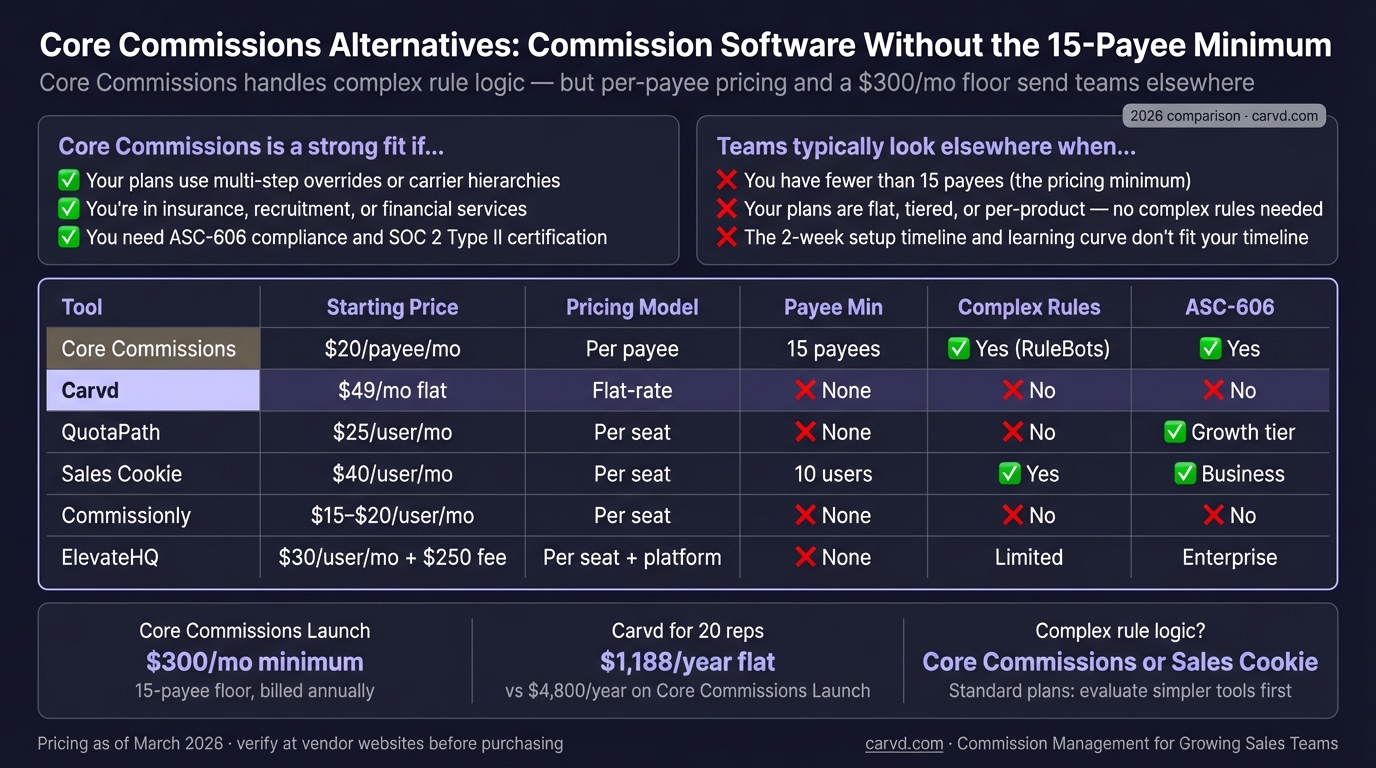
It also comes with a 15-payee minimum and pricing that starts at $20/payee/month, billed annually—meaning new customers pay at least $300/month before running a single calculation. The Launch plan caps at 5 commission rules; additional rules cost $0.50/payee/rule/month on top of that. Implementation takes approximately 2 weeks for moderately sized plans.
Teams with complex commission logic—insurance agencies, recruitment firms, organizations with multi-step override hierarchies—often find that complexity worthwhile. Teams with standard flat, tiered, or per-product commission structures often find they're paying for a rule engine they don't need.
Here's an honest look at where Core Commissions excels, what drives teams to look elsewhere, and which alternatives fit different situations.
Where Core Commissions genuinely excels
Before considering alternatives, it's worth being direct about what Core Commissions does well. Switching tools when the original is the right fit is a waste of time.
Advanced rule complexity through RuleBots. Core Commissions' proprietary rule designer lets administrators configure multi-step commission logic through a drag-and-drop visual interface. Rules can chain together conditions, thresholds, overrides, caps, and splits without writing code. For industries with genuinely complex commission structures—carrier hierarchies in insurance, override trees in recruitment—this is the kind of configurability that generic commission tools can't match.
AI-assisted rule building. CoreBot, Core Commissions' AI suite, allows admins to describe a commission rule in plain English and have it translated into the system's rule format. For teams with commission plans written in legal documents or comp plan prose, that translation step can reduce setup time meaningfully.
SOC 2 Type II certification and ASC-606 compliance. The Enterprise tier holds SOC 2 Type II certification. All tiers include ASC-606 compliance tools for commission expense recognition. For finance teams with compliance requirements, these aren't nice-to-haves—they're table stakes that many SMB commission tools don't offer.
Insurance and recruitment track record. Core Commissions has earned a Gold Medal from SoftwareReviews for sales compensation for four consecutive years through 2025. Its customer base includes a meaningful portion of insurance agencies and recruitment firms, industries where commission logic runs significantly more complex than flat or tiered SaaS sales plans.
Integration breadth. As of March 2026, Core Commissions connects to Salesforce, HubSpot, Microsoft Dynamics, QuickBooks, Sage, Intacct, Paychex, Bullhorn, and others—a wider integration set than most SMB commission tools at the same price tier.
For a detailed side-by-side comparison, see our Carvd vs Core Commissions comparison page.
Why teams look for alternatives
Teams that evaluate Core Commissions and choose something else—or switch after using it—typically cite one of four reasons.
The 15-payee minimum. Every Core Commissions customer pays for at least 15 payees regardless of team size. At $20/payee/month on Launch, that's a $300/month floor. A team with 8 reps pays the same as a team with 15. For smaller teams, that minimum skews the cost-per-rep calculation significantly.
Per-payee pricing at scale. As headcount grows, Core Commissions' cost grows with it. At $20/payee/month, a 30-rep team pays $7,200/year on the Launch plan and $12,600/year on Enterprise. For teams that don't need the full rule complexity, alternatives with flat-rate pricing eliminate that scaling equation.
Steep learning curve. User reviews consistently flag Core Commissions as initially overwhelming. The RuleBots system is powerful, but building rules requires understanding its logic framework before you can configure even basic commission plans. For sales ops teams without dedicated RevOps support, that setup investment creates real friction.
5-rule cap on Launch. The Launch plan includes 5 commission rules. Most teams have at least a few plan variations across product lines, rep tiers, or quota thresholds. Additional rules cost $0.50/payee/rule/month on top of the base price. A team with 20 payees and 8 rules pays $20/payee + $0.50 × 20 payees × 3 extra rules = $50/payee/month on Launch—$12,000/year before upgrading to Enterprise.
6 Core Commissions alternatives worth evaluating
1. Carvd
Carvd is commission software for growing sales teams. It connects to HubSpot or Pipedrive directly (no Zapier, no middleware), or imports deals from a CSV upload. It supports flat, tiered, and per-product commission plans, and generates deal-level statements showing reps exactly how their payout was calculated.
The main difference from Core Commissions: flat-rate pricing with no per-seat or per-payee fees, and no minimum headcount. Carvd charges $49/month for up to 10 reps (Starter), $99/month for up to 25 reps (Growth), or $199/month for unlimited reps (Scale). A 20-rep team pays $1,188/year on Carvd Growth compared to $4,800/year on Core Commissions Launch.
The trade-offs are real. Carvd doesn't support multi-step rule logic, AI-assisted rule building, or ASC-606 compliance tools. There's no SOC 2 Type II certification. If your commission structures require RuleBot-style chaining, or if compliance certification is a requirement, Core Commissions is the better fit. If you're running flat, tiered, or per-product plans and want to be calculating commissions in under an hour, Carvd is worth the 14-day trial. The commission calculator runs your numbers instantly without any rule engine setup.
Best for: Teams of 5-200 reps on HubSpot or Pipedrive with standard commission plans who want flat-rate pricing and setup in under an hour.
2. QuotaPath
QuotaPath is one of the most widely used commission tools in the SMB and mid-market segment—4.5/5 on Capterra from 120+ reviews and a well-regarded HubSpot Marketplace integration as of early 2026. It supports Salesforce, HubSpot, Pipedrive, Close, and 8+ CRMs natively on paid tiers.
QuotaPath also charges per seat. At approximately $25/user/month (Essential) as of early 2026, it costs slightly more than Core Commissions' Launch plan per payee—but without the 5-rule cap and with a more polished rep experience. QuotaPath doesn't match Core Commissions' rule complexity for intricate compensation logic, but it handles standard tiered plans, quota attainment tracking, and rep earnings forecasting that Core Commissions doesn't offer natively.
For teams that left Core Commissions because of the learning curve but still want solid CRM connectivity and a modern UI, QuotaPath is a common landing point.
Best for: Teams with HubSpot or Salesforce who want per-deal commission tracking, quota visibility, and rep earnings forecasting without the rule engine overhead.
3. ElevateHQ
ElevateHQ is a commission management platform built for SMB and mid-market teams. It includes a no-code plan designer, real-time rep dashboards, approval workflows, and native integrations with Salesforce, HubSpot, Pipedrive, and several others. G2 reviewers give ElevateHQ 4.7/5 from 150+ reviews, frequently citing the plan builder's flexibility and responsive support.
Pricing isn't publicly listed as of March 2026, but ElevateHQ sits in a comparable per-seat range to QuotaPath and Commissionly based on third-party data. It doesn't match Core Commissions' rule engine depth, but for teams that want flexible plan configuration without a 2-week implementation or a 15-payee floor, ElevateHQ is worth evaluating.
Best for: Teams of 15-100 reps that want strong CRM integrations, a modern rep-facing experience, and a plan builder that handles more edge cases than basic tools.
4. Sales Cookie
Sales Cookie is a commission automation tool built to handle plan complexity without the implementation overhead of enterprise platforms. It supports tiered rates, splits, overrides, draws, and product-based rates—a broader plan type coverage than some SMB alternatives. Pricing starts at $20/user/month (published).
For teams that need plan logic more complex than flat or simple tiered structures but don't need Core Commissions' full RuleBot framework, Sales Cookie covers the middle ground at similar per-seat pricing. The user experience is less polished than newer tools, but the plan builder handles overrides and splits that some alternatives skip.
Best for: Teams with moderate commission complexity (overrides, splits, product-specific rates) who don't need a full rule engine and want published pricing.
5. Everstage
Everstage is a sales performance management platform that includes commission calculation, quota management, pipeline visibility, and rep gamification in one product. G2 users rate it 4.8/5 from 1,700+ reviews as of early 2026. Pricing starts at $30/user/month (published).
A 20-rep team pays approximately $7,200/year—more than Core Commissions' Launch plan. But Everstage includes quota attainment tracking and leaderboard features that pure commission tools don't offer. Teams leaving Core Commissions because of the learning curve who also want quota management in the same platform have fewer places to look, and Everstage is one of them.
Best for: Mid-market teams (20-100 reps) that want commission calculations plus quota management in a single platform and are willing to pay for the broader feature set.
6. CaptivateIQ
CaptivateIQ is the highest-rated commission platform on G2 (3,300+ reviews, ranked #1 in Sales Compensation as of early 2026). It handles complex compensation structures—territory overlays, multi-step approval workflows, SPIFs, MBO components, and multi-currency calculations—with native connections to Salesforce, HubSpot, Workday, Snowflake, BigQuery, and 15+ enterprise systems.
Where Core Commissions serves insurance agencies and recruitment with deep rule logic, CaptivateIQ serves enterprise sales organizations with complex territory hierarchies and finance team workflows. Third-party procurement data (Vendr, as of March 2026) puts typical annual spend at $20,000-$120,000+, with implementation taking 8-12 weeks. Teams leaving Core Commissions for cost reasons won't find relief here, but teams that have grown into enterprise-level plan complexity will.
Best for: Enterprise and upper-mid-market teams (50+ reps) with compensation structures too complex for SMB tools to handle reliably.
How to choose
The right alternative depends on what's driving the evaluation.
If cost is the issue: The 15-payee minimum and per-payee pricing scale predictably against headcount. Carvd's flat-rate model removes that equation—a team growing from 10 to 25 reps pays the same $99/month on Growth. For teams without complex rule requirements, the cost difference is significant.
If the learning curve is the issue: Core Commissions' RuleBots system is powerful but requires upfront investment to use correctly. QuotaPath and ElevateHQ have plan builders with gentler onboarding curves. Carvd's comp plan builder is the most opinionated—it supports fewer plan types but can be configured in under an hour.
If the 5-rule cap is the issue: The Launch plan's 5-rule limit hits teams with multiple products, rep tiers, or quota thresholds faster than expected. Upgrading to Enterprise ($35/payee/month) resolves this but raises the per-seat floor. QuotaPath, ElevateHQ, and Carvd don't have rule count limits.
If you actually need the rule engine: Core Commissions is one of a small number of tools with drag-and-drop rule complexity suited to insurance and recruitment compensation models. CaptivateIQ handles comparable complexity at enterprise scale. Switching to a simpler tool like QuotaPath, Sales Cookie, or Carvd means leaving that capability behind. If your commission logic depends on multi-step chaining and override hierarchies, evaluate that trade-off carefully before migrating.
Most SaaS sales teams—running flat percentages, tiered accelerators, or per-product rates—don't use Core Commissions' most complex capabilities. For those teams, the per-payee pricing and minimum commitment are harder to justify relative to alternatives built around simpler plan types. To see how your rates compare to the market, check the commission rate benchmarks.
Carvd offers a 14-day free trial. Connect your HubSpot or Pipedrive account, or upload a CSV of closed deals, and you'll have commission calculations running in under an hour.
Related reading
Last updated: March 22, 2026