QuotaPath vs Commissionly: Which Commission Tool Fits Your Team?
QuotaPath starts at ~$25/user/month with deep CRM integrations. Commissionly charges $15-20/user/month with residual commission and multi-currency support. Here's how they compare.
QuotaPath starts at approximately $25/user/month with a platform fee and deep CRM integrations on every paid tier. Commissionly charges $15-20/user/month with no platform fee, but trades CRM breadth for residual commission tracking and multi-currency support. Both automate commission calculations—but they're built for different industries and different plan types.
QuotaPath targets SaaS and tech sales teams that run commissions from their CRM data — check how your rates compare using the commission rate benchmarks tool. Commissionly targets insurance, financial services, and merchant services companies where reps earn residuals on renewals and recurring payments. If your team falls clearly into one of those categories, the decision is straightforward. If it doesn't, the comparison is worth working through.
Here's how they stack up as of March 2026.
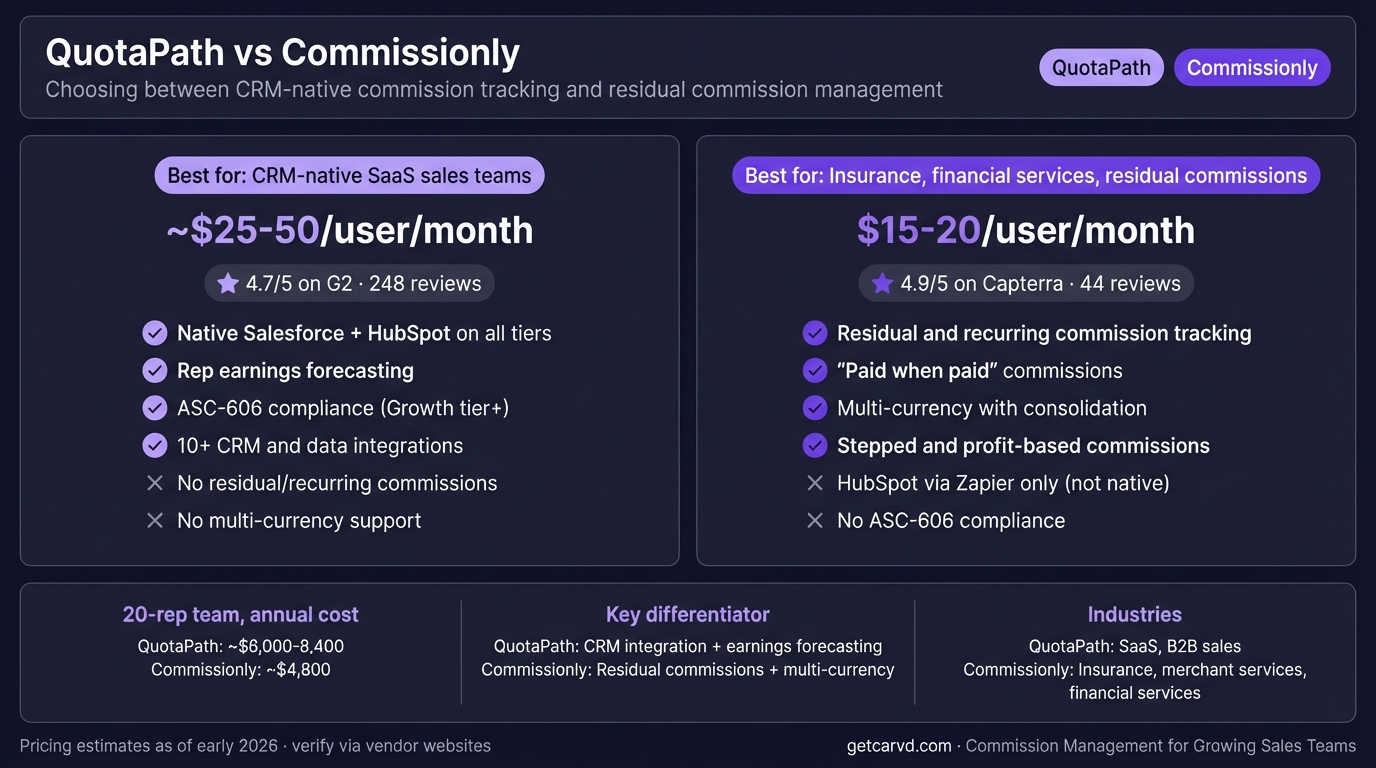
Quick comparison
| QuotaPath | Commissionly | |
|---|---|---|
| Pricing | ~$25-50/user/month + platform fee (annual billing) | $15-20/user/month |
| Pricing transparency | Published | Published |
| Target industry | SaaS, tech, B2B sales | Insurance, financial services, merchant services, B2B |
| Residual commissions | Not a highlighted feature | Yes — core feature |
| Multi-currency | Not a highlighted feature | Yes |
| Native CRM integrations | Salesforce, HubSpot, Pipedrive, 8+ more | Salesforce; others via Zapier |
| ASC-606 compliance | Yes (Growth tier and above) | Not a highlighted feature |
| Rep earnings forecasting | Yes (pipeline-based) | No |
| Implementation | 2-6 weeks | Not publicly specified |
| G2 / Capterra rating | 4.7/5 (248 G2 reviews) | 4.9/5 (44 Capterra reviews) |
Where QuotaPath wins
CRM integrations on all tiers. QuotaPath's CRM connections aren't a premium add-on—they're available from the Essential tier up. Salesforce, HubSpot, Pipedrive, Close, Copper, Zoho, Stripe, Chargebee, and QuickBooks are all supported. For a SaaS sales team where every deal lives in the CRM, that eliminates the CSV-export-and-import workflow entirely. Commissionly's native connector covers Salesforce; most other CRM connections go through Zapier.
Rep earnings forecasting. QuotaPath gives reps a self-serve dashboard to model open pipeline and project expected commission before a period closes. If a rep wants to know how much they'll earn if three mid-cycle deals close this week, they can see it without calling Finance. Commissionly offers a rep self-service portal for viewing current earnings, but pipeline-based forecasting isn't a feature it highlights.
ASC-606 compliance. For SaaS companies that need to capitalize and amortize commission costs under ASC 606, QuotaPath's Growth tier includes compliant reporting. Commissionly doesn't feature this prominently, which matters less to insurance or merchant services businesses but is a real gap for a public or VC-backed SaaS company with a finance team tracking commission expense recognition.
Plan flexibility for standard SaaS structures. QuotaPath handles tiered plans, accelerators, draws, SPIFFs, splits, and MBO components. For the compensation structures common in B2B SaaS—base plus accelerated commission above quota, split credit for overlay reps—QuotaPath is well-suited. Model your plan first with the free commission plan builder to see if your structure genuinely requires this level of flexibility. Its AI-powered plan builder also reduces configuration time for teams designing plans from scratch.
Where Commissionly wins
Residual and recurring commission tracking. Commissionly's differentiator is paying commissions on recurring revenue—insurance policy renewals, merchant services processing fees, SaaS subscription renewals where the rep earns a residual for the life of the account. QuotaPath is built around closed-deal commissions. If your comp plan includes "paid when paid" residuals that recur over months or years, Commissionly handles that natively. QuotaPath doesn't.
Multi-currency support. Commissionly supports multi-currency payout with consolidation into a chosen base currency. For companies with reps in different countries earning commissions in local currencies, that removes a significant manual reconciliation problem. QuotaPath doesn't list multi-currency support as a feature.
Lower cost per user at the base tier. Commissionly's admin-and-rep tier runs $20/user/month with no platform fee. For a 15-rep team with rep portal access, that's $3,600/year. QuotaPath's Essential tier charges a $250/month platform fee (covering the first 5 users) plus ~$25/user beyond that—a 15-rep team pays roughly $5,500-$6,000/year. If your commission plans are straightforward and you're cost-sensitive, Commissionly's pricing model is simpler to reason about.
Industry-specific fit. Commissionly is used across insurance, financial services, telecom, and education alongside traditional B2B sales. Its feature set reflects the complexity of those industries: stepped commission structures, "paid when paid" tracking, and multi-currency consolidation are features those markets require. QuotaPath is more narrowly optimized for SaaS and tech go-to-market teams.
Pricing compared for a 20-rep team
Neither tool publishes a single-line price that tells the whole story.
QuotaPath charges a platform fee plus per-seat rates. On the Essential tier, the platform fee runs approximately $250/month and covers the first 5 users; additional users are ~$25/month each. A 20-rep team pays roughly $625/month, or $7,500/year. Moving to Growth (to get ASC-606 compliance and the dispute workflow) raises both the platform fee and per-seat rate, pushing the same team toward $10,000-$12,000/year. These are estimates—QuotaPath's actual platform fee structure varies, so confirm with them directly before budgeting.
Commissionly at the $20/user/month tier for 20 reps costs $4,800/year. The admin-only tier ($15/user/month) drops it to $3,600/year if reps don't need portal access—but the rep self-service portal is usually worth including.
For standard plan types without residuals, a 20-rep team on Commissionly pays meaningfully less than QuotaPath. The gap narrows if Commissionly requires Zapier subscriptions to fill integration gaps that QuotaPath covers natively.
Who should choose QuotaPath
QuotaPath fits better if:
- Your team runs on Salesforce, HubSpot, or another major CRM and wants commissions to calculate automatically from closed deals without CSV exports
- Your reps want earnings forecasting based on open pipeline before the period closes
- ASC-606 commission accounting is a compliance requirement for your finance team
- Your plan structures include accelerators, draws, or MBO components that you want to configure and automate
- You need commission discrepancy workflows where reps can flag disputes with an audit trail (available on Growth tier)
For a full side-by-side of QuotaPath vs Carvd, see our Carvd vs QuotaPath comparison.
Who should choose Commissionly
Commissionly fits better if:
- You pay residual or recurring commissions — insurance renewals, merchant processing fees, subscription revenue sharing, or any structure where commission continues past the initial sale
- Your reps operate in multiple currencies and you need automatic consolidation
- Your team is in insurance, financial services, or merchant services where Commissionly's feature set reflects industry norms
- You use Salesforce and want a native integration without the cost structure of QuotaPath
- Budget is a primary concern and your commission plans don't require CRM sync or ASC-606 support
For a full side-by-side of Commissionly vs Carvd, see our Carvd vs Commissionly comparison.
When neither fits
Both QuotaPath and Commissionly serve specific use cases well, but there's a gap they both miss: smaller B2B sales teams with standard flat, tiered, or per-product commission plans who want a fast setup and predictable pricing.
QuotaPath's realistic annual cost for a 15-20 rep team lands between $6,000 and $12,000 depending on tier. Commissionly is cheaper on paper, but its CRM connectivity depends on Zapier for most integrations outside Salesforce.
Teams with simpler needs have lighter options worth evaluating:
- Carvd is flat-rate at $99/month for up to 25 reps ($1,188/year) with native HubSpot and Pipedrive integrations, a built-in dispute resolution workflow, and setup under an hour. It doesn't support residual commissions, ASC-606 compliance, or pipeline-based earnings forecasting—so it's not right for teams that need those features. But for a 10-25 rep SaaS team on a flat or tiered plan, it's substantially simpler and less expensive than either QuotaPath or Commissionly.
- ElevateHQ is built for growth-stage teams with a simpler plan builder and published pricing.
- Everstage ($30/user/month) adds gamification features and quota management for mid-market teams.
For a broader comparison of options, see our commission software for small business guide and the best commission software roundup.
The bottom line
QuotaPath and Commissionly don't compete directly as much as they serve adjacent markets.
If your team sells SaaS or B2B products from a CRM and wants earnings forecasting, ASC-606 compliance, and native integrations without Zapier middleware, QuotaPath is the more capable tool despite the higher cost.
If your reps earn residuals on recurring revenue—or you operate in insurance, financial services, or merchant services—Commissionly's industry-specific features make it the more logical fit. Multi-currency support and "paid when paid" tracking aren't afterthoughts in Commissionly; they're the core use case.
The decision usually reduces to one question: are your commissions one-time (paid on deal close) or recurring (paid across multiple periods)? That answer points to the right tool faster than any feature comparison will.
Related reading
- QuotaPath Alternative: Commission Software Beyond the Basics
- Commissionly Alternative: Commission Software for Teams Beyond Residual Tracking
- Carvd vs QuotaPath: Full Side-by-Side
- Carvd vs Commissionly: Full Side-by-Side
- Commission Software for Small Business: 2026 Guide
- Best Commission Management Software: 2026 Comparison
Last updated: March 22, 2026