Commissionly Alternative: Commission Software for Teams Beyond Residual Tracking
Looking for a Commissionly alternative? Compare 6 commission tools on pricing, integrations, plan types, and which fits teams that don't need residual tracking.
Commissionly is a cloud-based commission platform targeting small and mid-size businesses with 10-500 employees. It handles flat, tiered, stepped, revenue-based, and profit-based commission structures—and it does one thing that most SMB commission tools don't: residual and recurring commission tracking. For teams in insurance, merchant services, financial services, or any business where reps earn ongoing commissions from renewals and subscriptions, that's a meaningful differentiator.
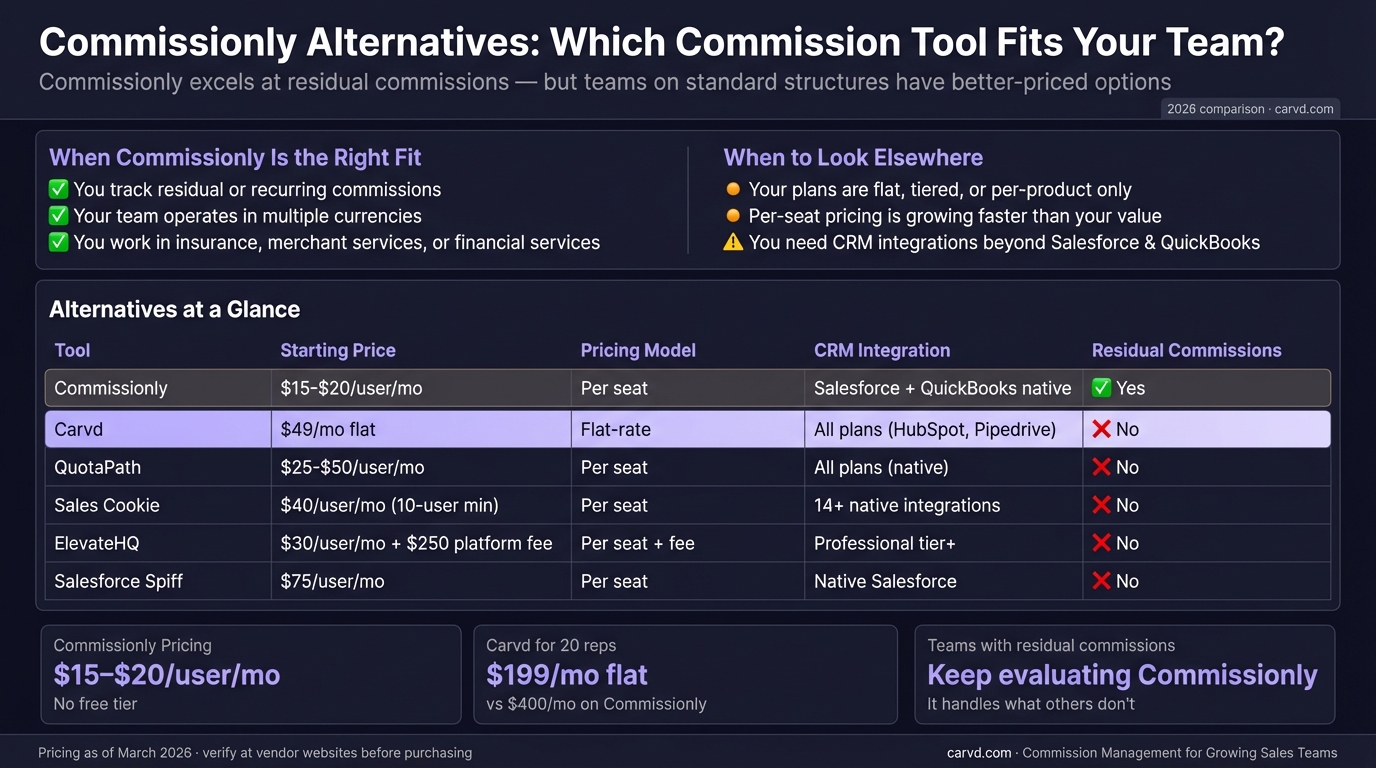
It's also per-seat. At $15-$20/user/month as of March 2026, a 20-rep team pays $3,600-$4,800/year. Most of Commissionly's CRM connections—HubSpot, Pipedrive, Xero, and others—run through Zapier rather than native integrations. Teams that don't need the recurring commission capabilities often find they're paying for complexity they don't use.
Here's an honest look at where Commissionly genuinely excels, why teams look elsewhere, and which alternatives fit different situations.
Where Commissionly genuinely excels
Before covering alternatives, it's worth being direct about what Commissionly does well. Choosing an alternative when the original tool fits your needs is a waste of time.
Residual and recurring commission tracking. This is Commissionly's clearest strength. Most SMB commission tools are built around per-deal calculations: a rep closes a deal, earns a commission, done. Commissionly's data model handles ongoing commission accrual from renewals, subscriptions, and multi-year contracts. If your reps earn monthly residuals from merchant accounts, insurance renewals, or SaaS subscription bookings, that structure requires a different calculation approach—and Commissionly supports it natively.
"Paid when paid" commission tracking. Some commission structures only pay reps when the customer pays—not when the deal closes. Commissionly tracks payment-based commissions explicitly. For businesses where cash collection timing affects when reps get paid, this is a specific capability that generic commission tools skip.
Multi-currency support. Commissionly handles transactions in multiple currencies and consolidates payouts into a base currency for reporting. For international sales teams where reps close deals in euros, pounds, or other currencies, that consolidation step would otherwise require manual reconciliation.
Customer support quality. Commissionly holds a 4.9/5 rating on Capterra based on 44 reviews as of early 2026, with reviewers consistently mentioning responsive support as a factor in their satisfaction. For a team without a dedicated RevOps resource, accessible support is genuinely valuable during setup and plan changes.
For a detailed side-by-side comparison, see our Carvd vs Commissionly comparison page.
Why teams look for alternatives
Teams that evaluate Commissionly and choose something else—or switch after using it—typically cite one of four reasons.
Per-seat pricing at scale. Commissionly's $20/user/month tier (which includes rep portal access) adds up. A 10-rep team pays $2,400/year. A 20-rep team pays $4,800/year. A 30-rep team pays $7,200/year. For teams growing headcount where flat-rate alternatives exist, the per-seat model creates a predictable cost-scaling problem.
Limited native CRM integrations. As of March 2026, Commissionly's native integrations are Salesforce and QuickBooks Online. HubSpot, Pipedrive, Xero, and other popular tools connect through Zapier. Zapier adds another monthly cost, another point of failure, and another maintenance dependency. Teams on HubSpot or Pipedrive that want deals to flow directly into commission calculations without middleware have fewer options with Commissionly.
CSV-heavy workflows. Without a native HubSpot or Pipedrive connector, most deal data enters Commissionly via CSV upload or Zapier automation. Tools with native CRM sync or a streamlined CSV deal import reduce that friction. For teams that want to close a deal in their CRM and have it appear in commission calculations without manual steps, Commissionly's workflow creates friction.
No residual structures means fewer compelling reasons to choose it. Commissionly's residual commission tracking is its strongest differentiator. Teams with flat, tiered, or per-product plans—which describes the majority of SaaS and software sales teams—often find they're paying for capabilities that don't apply to their comp structure. Without the residual use case, Commissionly competes primarily on price and support, where alternatives match or beat it.
6 Commissionly alternatives worth evaluating
1. Carvd
Carvd is commission software for growing sales teams. It imports deals directly from HubSpot or Pipedrive (no Zapier required), or from a CSV upload. It applies flat, tiered, or per-product commission plans and generates deal-level statements showing reps exactly how their payout was calculated.
The main difference from Commissionly: flat-rate pricing with no per-seat fees. Carvd charges $49/month for up to 10 reps (Starter), $99/month for up to 25 reps (Growth), or $199/month for unlimited reps (Scale). A 20-rep team that pays $4,800/year on Commissionly pays $1,188/year on Carvd Growth.
The trade-offs are real. Carvd doesn't support residual or recurring commission structures. It doesn't integrate with Salesforce. Multi-currency support isn't available. If your team runs Salesforce and pays residual commissions, Commissionly is the better fit. If you're on HubSpot or Pipedrive with standard commission structures and want predictable monthly costs, Carvd is worth the 14-day trial.
Best for: Teams of 5-200 reps on HubSpot or Pipedrive with flat, tiered, or per-product commission plans who want flat-rate pricing and fast setup.
2. QuotaPath
QuotaPath is one of the most widely used commission tools in the SMB market—4.5/5 on Capterra from 120+ reviews and the most-installed commissions app in the HubSpot Marketplace as of early 2026. It connects to Salesforce, HubSpot, Pipedrive, Close, and 8+ other CRMs natively on all paid tiers.
QuotaPath also charges per seat. At approximately $25/user/month (Essential tier) as of early 2026, it's slightly more expensive than Commissionly's admin-only tier. Unlike Commissionly, QuotaPath doesn't support residual or recurring commission structures—it's built around per-deal calculations. But it has better native CRM connectivity, a rep earnings forecasting feature, and a polished rep experience.
For teams on HubSpot or Pipedrive who want native integrations and don't need residual tracking, QuotaPath is often a more natural fit than Commissionly.
Best for: Teams with HubSpot or Salesforce at the center of their workflow who want per-deal commission tracking plus rep earnings forecasting.
3. ElevateHQ
ElevateHQ is a commission management platform for SMB and mid-market teams. It offers a no-code plan designer, real-time rep dashboards, approval workflows, and native integrations with Salesforce, HubSpot, Pipedrive, and several others.
Pricing is not published publicly as of March 2026. Based on positioning and third-party data, ElevateHQ sits in a comparable price range to Commissionly and QuotaPath. G2 reviewers give ElevateHQ 4.7/5 from 150+ reviews, frequently citing the flexible plan builder and responsive support.
Teams that need more CRM integration depth than Commissionly offers—and don't need residual commission tracking—will find ElevateHQ's native connectivity more convenient.
Best for: Teams of 15-100 reps that want strong CRM integrations, flexible plan configuration, and a modern rep experience without enterprise pricing.
4. Sales Cookie
Sales Cookie is a commission automation tool with a focus on handling complex plan types without a complex implementation. It supports tiered rates, splits, overrides, draws, and product-based rates. Pricing starts at $20/user/month (published).
Sales Cookie supports a broader range of plan types than Commissionly for non-residual structures, and it costs roughly the same per seat. The rep experience and overall UX are less polished than newer tools, but the plan builder handles more edge cases. For teams with non-standard commission structures—overrides, splits, multi-rep credit—it's a practical option.
Best for: Teams with complex commission logic (overrides, splits, product-specific rates) who don't need residual tracking and want published per-seat pricing.
5. Everstage
Everstage is a sales performance management platform that combines commission calculation with quota management, pipeline visibility, and performance dashboards. G2 users rate it 4.8/5 from 1,700+ reviews as of early 2026.
Pricing starts at $30/user/month (published). A 20-rep team pays approximately $7,200/year—more than Commissionly and QuotaPath, but Everstage includes quota attainment tracking and gamification features that pure commission tools don't.
Teams that want more than commission calculations—and want a single platform for commissions, quota tracking, and rep performance visibility—should evaluate Everstage seriously.
Best for: Mid-market teams (20-100 reps) that want commission tracking plus quota management in one platform and are willing to pay for the broader feature set.
6. CaptivateIQ
CaptivateIQ is the highest-rated commission platform on G2 (3,300+ reviews, ranked #1 in Sales Compensation). It handles complex compensation structures—territory overlays, multi-step approval workflows, SPIFs, MBO components—and connects to Salesforce, HubSpot, Workday, Snowflake, BigQuery, and 15+ enterprise systems.
It's also expensive. Third-party procurement data (Vendr, as of March 2026) puts typical annual spend at $20,000-$120,000+. Implementation takes 8-12 weeks. Teams looking for a Commissionly alternative because of cost won't find relief here—but teams leaving Commissionly because they've grown into genuine plan complexity will.
Best for: Mid-market and enterprise teams (50+ reps) with compensation structures too complex for SMB tools to handle reliably.
How to choose
The right alternative depends on what's driving the switch.
If cost is the issue: Carvd's flat-rate model eliminates per-seat scaling. A 20-rep team pays $1,188/year on Carvd Growth compared to $4,800/year on Commissionly with rep access. If team size is growing, that gap widens fast. Use the commission calculator to model what your team's payouts look like before committing to a tool.
If you need better CRM connectivity: Commissionly's limited native integrations (primarily Salesforce and QuickBooks Online) push most teams toward Zapier middleware. QuotaPath, ElevateHQ, and Carvd all offer direct HubSpot and Pipedrive integrations without Zapier.
If you need more than basic commission tracking: Everstage adds quota management and performance visibility. CaptivateIQ handles enterprise-grade plan complexity. These are worth the higher price only if the additional functionality addresses a real problem. Carvd's payroll export and dispute resolution cover the most common needs beyond basic calculation.
If you actually need residual commissions: Don't switch. Commissionly is one of the few SMB tools built for that data model. Switching to a per-deal tool like Carvd, QuotaPath, or ElevateHQ means giving up that capability.
Most sales teams—particularly in SaaS—run flat, tiered, or per-product commission structures without residual components. For those teams, Commissionly's strongest feature doesn't apply, and the per-seat pricing becomes harder to justify relative to flat-rate alternatives.
Carvd offers a 14-day free trial. Connect your HubSpot or Pipedrive account, or upload a CSV of closed deals, and you'll have commission calculations in under an hour.
Related reading
Last updated: March 22, 2026