Commission vs Bonus: How They Differ in Structure, Law, and Accounting
Commissions and bonuses are taxed the same way. The real differences are how they're earned, when they're legally owed, and how they're treated under ASC 606.
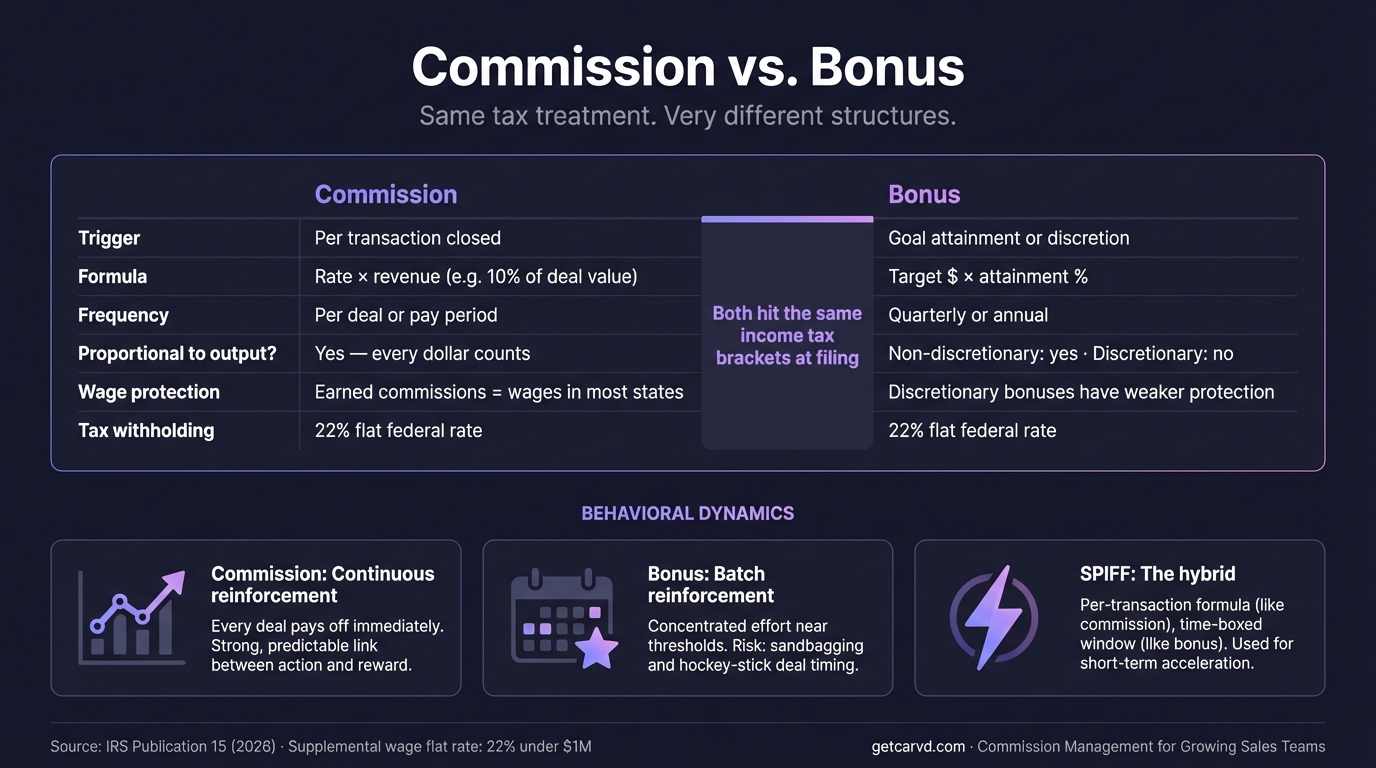
Commissions and bonuses are taxed at exactly the same federal rate. The IRS classifies both as supplemental wages and applies a 22% flat withholding to both when paid on a separate check. If you assumed bonuses were somehow taxed less — or more — than commissions, that's a common misconception the IRS clears up in Publication 15.
The meaningful differences between commission and bonus aren't about taxes. They're about how each type of pay is earned, when it's legally owed, and how your accounting team needs to treat it.
For a full overview of how commissions interact with federal and state taxes, see how are commissions taxed.
The tax question: same withholding, same brackets
Under IRS Publication 15 and Publication 15-T, commissions and bonuses are both supplemental wages. When paid on a separate check from regular salary, employers apply the same optional flat withholding rate: 22% federal for amounts up to $1 million per year, and 37% mandatory on any supplemental wages above $1 million.
Neither commissions nor bonuses change your actual tax bracket. Both are ordinary income, pooled with salary at year-end and taxed at the same marginal rates as any other earnings. What varies is withholding in the pay period — not the final tax owed.
The same FICA rules apply to both. W-2 commission income and W-2 bonus income are both subject to Social Security (6.2%, up to the $184,500 wage base in 2026) and Medicare (1.45%, no cap). An Additional Medicare Tax of 0.9% applies to both above $200,000 for single filers.
So if someone tells you "bonuses are taxed less than commissions" or vice versa, the tax code doesn't support that. The paycheck arithmetic is identical.
Where commission and bonus actually differ
How they're calculated
A commission is a formula applied to each transaction. You close a deal worth $80,000 at a 10% rate, you earn $8,000. It recurs with every closed deal and varies directly with deal size and volume. Most commission plans are defined in writing before the period starts.
A bonus is a fixed amount or percentage of salary paid when a cumulative threshold is hit. You hit 100% of quota for the quarter and earn a $5,000 kicker. Or the company hits its annual revenue target and everyone on the sales team gets 15% of salary. Bonuses can be pre-defined (non-discretionary) or left to employer judgment (discretionary).
| Commission | Bonus | |
|---|---|---|
| Trigger | Individual deal/sale | Cumulative threshold or milestone |
| Calculation | % of deal or revenue value | Fixed amount or % of salary |
| Frequency | Ongoing — each deal | Periodic — typically quarterly or annual |
| Variability | Fluctuates with deal flow | More predictable if pre-established |
| Discretion | None — formula-driven | Can be discretionary or contractual |
Motivation mechanics
Commissions create immediate, direct feedback between selling and earning. Close a deal today, see it on the next paycheck. That loop reinforces individual deal behavior — speed, deal size, close rate.
Bonuses operate on a longer cycle. A quarterly target bonus motivates consistent performance across the period, not just individual transactions. A team-wide bonus can align sales with company outcomes (revenue, retention, margin) that no single rep controls.
Neither is better universally. Many sales comp plans use both: a base commission rate per deal, plus accelerators or bonus kickers above certain quota attainment levels. The commission drives activity; the bonus drives performance across the period. The commission plan builder lets you model how different commission-plus-bonus combinations affect total comp at various attainment levels before you roll them out.
Legal status: commissions are wages, bonuses vary
This is the most practically significant difference — and the one finance and HR teams get wrong most often.
Commissions are wages under federal law. The Fair Labor Standards Act classifies commissions as wages. Once a rep fulfills whatever condition triggers commission — typically closing and collecting on a deal — the employer is legally obligated to pay it. You can't claw it back arbitrarily, delay it indefinitely, or forfeit it as a condition of employment termination (though well-drafted commission plans can include clawback provisions for specific circumstances like early customer churn).
California goes further: earned commissions must be paid at least twice per month, and the commission calculation method must be disclosed in writing.
Bonuses depend on how they're structured.
Under 29 CFR § 778.211, the FLSA distinguishes between discretionary and non-discretionary bonuses:
-
A discretionary bonus is one where both the decision to pay and the amount are determined at the employer's sole discretion, near the end of the period, with no prior commitment. These are excluded from the regular rate of pay for overtime calculations — meaning they don't inflate the overtime base.
-
A non-discretionary bonus is any bonus promised in advance, tied to a formula, or announced to employees before the period ends. Courts treat pre-announced bonuses as contractual commitments. Once the criteria are met, the employer is legally obligated to pay.
In practice, most performance bonuses designed to motivate sales teams are non-discretionary — they're announced as part of the comp plan, with defined criteria. Calling a pre-announced quota bonus "discretionary" doesn't make it discretionary under the FLSA. If a rep meets the stated criteria, they're owed the payment.
ASC 606: where the accounting treatment diverges
For finance teams managing commission expense recognition, the commission-vs-bonus distinction has real balance sheet implications under ASC 606 (codified as ASC 340-40).
Commissions tied to a specific contract can often be capitalized as "incremental costs of obtaining a contract." If your company pays a $10,000 commission to close a 24-month contract, that $10,000 qualifies for deferral and is amortized over the contract term — $417/month. This is mandatory if the amortization period would exceed one year. (If the contract is 12 months or under, a practical expedient allows immediate expensing.)
Bonuses generally don't qualify for the same treatment. Deloitte's ASC 606 guidance addresses this directly: discretionary annual bonuses tied to overall profitability, company-wide performance, and individual evaluation fail the "incremental cost" test because they don't depend solely on obtaining any individual contract. They're compensation for services rendered, expensed under ASC 710 in the period earned.
Non-discretionary quota bonuses face the same issue. If a rep earns a $5,000 bonus for hitting 100% of Q1 quota, that bonus depends on 12 or 20 closed deals, not any single contract. It can't be attributed to obtaining one specific contract, so capitalization isn't available.
The practical implication: companies that pay larger bonuses and smaller commissions may recognize more expense earlier, compared to companies that weight compensation toward deal-based commissions. If you're choosing between commission-heavy and bonus-heavy plan structures, your CFO will want the ASC 606 treatment modeled out — Carvd's commission calculator tracks deal-level payouts that map directly to the capitalization schedules finance needs. See commission accounting for the full accounting treatment.
Designing a plan that uses both
Most mature sales comp plans layer commissions and bonuses together:
Base commission — a fixed percentage on every deal. Provides income predictability for reps and ensures activity pays regardless of quota attainment.
Accelerators — higher commission rates above quota thresholds. Technically a commission structure variant, not a bonus, since they're still per-deal percentages. A rep earns 8% on the first $500K and 13% above $500K.
Quota attainment bonuses — a fixed lump sum paid at 100% quota attainment, sometimes with additional amounts at 110%, 125%, etc. Rewards consistent full-period performance, not just individual deal activity.
Club or President's Club qualifications — an annual milestone bonus (cash, travel, recognition) for reps who hit a full-year target. High symbolic value, lower total cost than ongoing accelerators. Tools like Qobra and ElevateHQ track both commissions and bonus milestones, though many teams at the 5-to-25-rep scale find a simpler tool covers both without the overhead.
The right mix depends on what behaviors you're trying to reinforce. If deal size and deal pace matter most, weight toward commissions with accelerators. If pipeline consistency and retention of top performers matters most, weight toward quota bonuses and annual milestones.
Carvd handles commission calculations — the per-deal percentages, tiered rates, and accelerators. For quota bonus payouts, you'll want a process that tracks period-end attainment and triggers the payment. Many teams run the quota bonus calculation manually at period close, even if they automate per-deal commissions.
Quick reference
| Commission | Bonus | |
|---|---|---|
| Federal withholding | 22% flat (supplemental) | 22% flat (supplemental) — identical |
| Tax brackets | Ordinary income | Ordinary income — identical |
| FICA | Yes — same as salary | Yes — same as salary |
| Legal status | Wage — earned and owed when deal closes | Discretionary = no obligation; non-discretionary = enforceable |
| FLSA overtime | Included in regular rate | Discretionary: excluded; Non-discretionary: included |
| ASC 606 | Often capitalizable, amortized over contract | Generally expensed immediately |
| Timing | Per-deal | Periodic (quarterly, annual) |
For more on commission taxes, see commission tax rate and is commission taxed differently. For comp plan structures, see sales compensation plan and variable compensation.
Last updated: March 22, 2026