Variable Compensation: Types, Structures, and Best Practices
Variable compensation is the part of pay tied to performance. Here's how different types work, how to set pay mix, and what separates plans that motivate from plans that frustrate.
Variable compensation is the portion of pay tied to performance. For sales roles, it's usually the biggest number in the offer letter — and the one with the most conditions attached to it.
Most salespeople think of variable comp as synonymous with commission. It's broader than that. Commission is one form. Bonuses, SPIFFs, profit sharing, and accelerators are others. Knowing which type fits which role — and how to design each — determines whether a comp plan motivates the behavior you want or creates the problems you're trying to avoid.
What variable compensation is (and isn't)
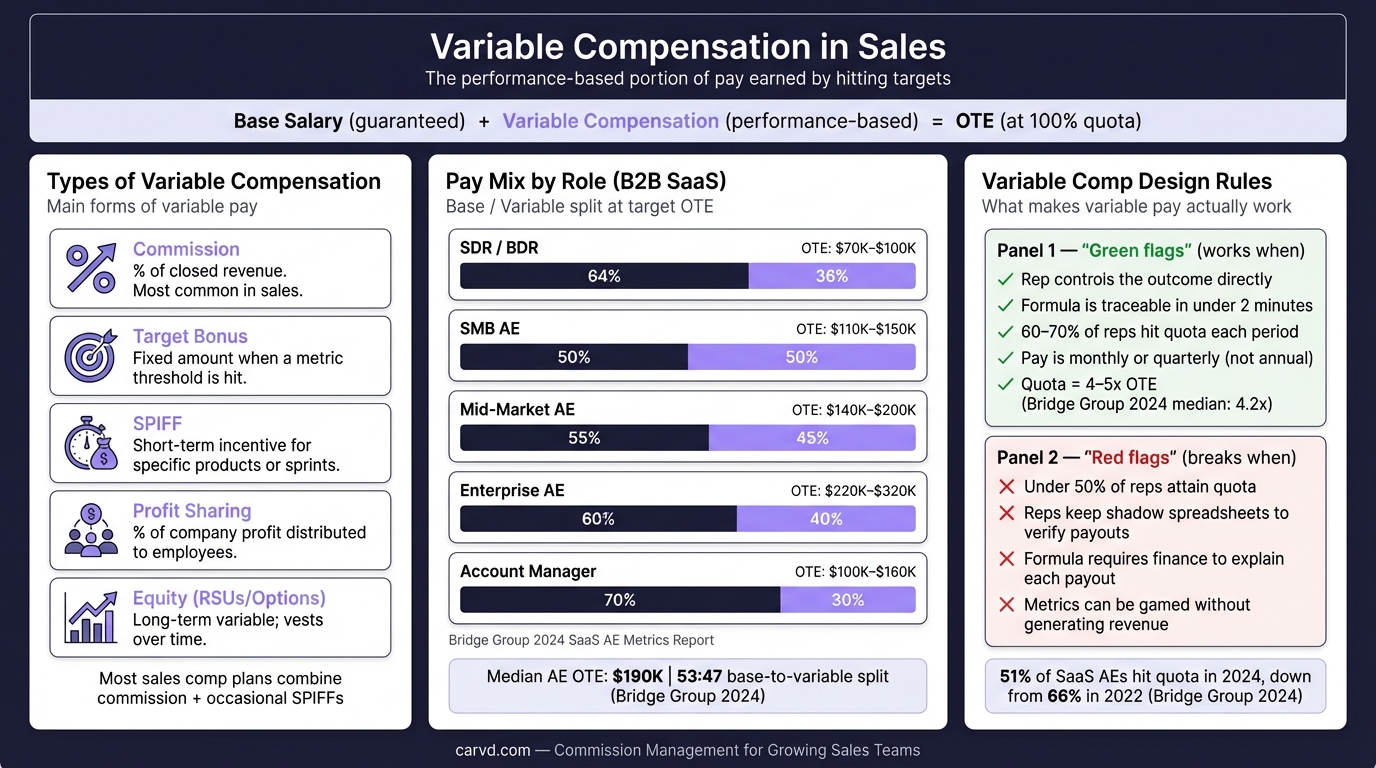
Variable compensation is any pay that changes based on performance. The fixed portion — what you earn regardless of results — is base salary. Everything else is variable.
The ratio of base to variable is called pay mix. A 50/50 pay mix means half your total compensation is base, half is variable. A 70/30 mix means the job is more stable but has less upside.
Pay mix isn't just a math choice. It signals how much risk the employer expects the employee to absorb. High variable means the company pays for results, not time. High base means the role has less direct line-of-sight to revenue — or the company is signaling competitive stability to attract candidates in a tight market.
Types of variable compensation
Commission
Commission ties pay directly to revenue. The most common structure in sales: a percentage of every deal closed. Bridge Group's 2024 benchmark of 170+ B2B SaaS companies puts the median commission rate at 11.5% of Annual Contract Value for SaaS AEs — you can check how your rate compares using the commission rate benchmarks tool.
Commission scales with output. Close more, earn more. That's what makes it the right choice for closing roles where individual impact on revenue is measurable. It's the wrong choice for roles where the revenue connection is indirect — support, engineering, most management layers.
Commission comes in several sub-types:
- Flat commission — same rate on every dollar, regardless of deal size or total revenue
- Tiered commission — rate increases after hitting revenue thresholds ($500K at 8%, above $500K at 12%)
- Per-product commission — different rates for different products, used when margins or strategic priority vary by product line
- Residual commission — ongoing payments on recurring revenue, common in insurance and subscription businesses
Bonuses
Bonuses are lump-sum payments tied to hitting specific goals. Unlike commission, they don't compound per deal — they pay out when a threshold is reached.
Common bonus structures:
- MBO bonuses — tied to management-by-objective goals (close X accounts in Q3, expand in a specific vertical, hit an NPS target)
- Quarterly or annual cash bonuses — tied to company revenue or profit performance
- Signing or retention bonuses — tied to tenure rather than performance (these are technically variable but not performance-based)
Bonuses work well for SDRs and managers where the link between individual output and closed revenue is harder to draw as a straight commission line. A pipeline generation target or a team quota attainment bonus creates incentive without requiring a per-deal commission formula.
Per Gusto's analysis of 400,000+ U.S. businesses, end-of-year bonuses averaged $2,503 in 2024 — about 2% higher than 2023, though 2% fewer workers received bonuses overall as companies concentrated variable pay among fewer employees.
SPIFFs
A SPIFF (Sales Performance Incentive Fund) is a short-term cash incentive for selling a specific product or hitting a specific goal in a defined window. Run a SPIFF on your new product line for 30 days. Pay $500 per unit over 10 units sold this quarter.
SPIFFs accelerate attention on strategic priorities. They work because they're concrete and short-cycle. The downside: too many SPIFFs dilute each other and pull focus from the main quota. Use them occasionally, not constantly.
Profit sharing
Profit sharing distributes a portion of company profits to employees — typically quarterly or annually. It's more common in manufacturing and private equity-backed businesses than in venture-backed SaaS, where growth reinvestment leaves little reported profit.
For sales specifically, profit sharing adds a shared accountability layer: the whole team benefits when the business performs. The tradeoff is that any individual rep's impact on total company profit is diffuse, which reduces the direct motivation effect compared to commission.
Accelerators
Accelerators are rate multipliers that kick in above quota. A rep earning 11% commission below 100% quota might earn 16.5% (1.5x multiplier) between 100–120%, and 22% (2x multiplier) above 120%.
Accelerators are technically a component of commission structure, not a separate pay type — but they're worth treating as a distinct design element. They're the primary lever for retaining top performers. Reps who close 130% of quota need a materially higher commission rate on the excess revenue, or they'll find a plan that offers one.
Alexander Group's 2024 Sales Compensation Trends Survey found 91% of companies updated their plan designs to increase pay-for-performance levers — accelerators are the most direct way to do that.
Pay mix by role
The right pay mix depends on how much the role controls revenue outcomes.
| Role | Typical pay mix | Why |
|---|---|---|
| SDR/BDR | 65:35 or 70:30 | Generates pipeline, doesn't close; indirect revenue link |
| Mid-market AE | 50:50 or 55:45 | Directly accountable for closed revenue |
| Enterprise AE | 50:50 or 40:60 | Large deals, longer cycles; higher variable exposure reflects upside |
| Sales manager | 60:40 | Team accountability, not individual quota |
| Customer success | 70:30 or 80:20 | Expansion and retention goals, not direct new revenue |
Source: Bridge Group 2024 SaaS AE Metrics & Compensation Benchmark Report; Bridge Group 2023 SDR Metrics Report.
A higher variable percentage motivates harder but requires more trust in the quota-setting process. If quota is set arbitrarily or unfairly high, high variable exposure feels like compensation risk rather than opportunity. The motivational effect inverts.
Structuring a variable compensation plan
Five decisions that determine whether a variable comp plan works:
1. Set OTE from market data, not spreadsheet math
Start with what's competitive for the role in your market. Bridge Group's 2024 data puts median SaaS AE OTE at $190,000. That's not a mandate — it's an anchor. Your stage, geography, and total compensation package (equity, benefits) shift where you land.
2. Choose pay mix based on role type and market signals
50/50 is standard for closing AEs in SaaS. Deviating in either direction should be intentional: higher base to attract candidates in a risk-averse market, higher variable to attract top performers who believe in their own ability to close.
3. Set quota at 4–5x variable target
If your variable target (the commission a rep earns at 100% quota) is $95,000, quota should fall between $380,000–$475,000. Bridge Group's 2024 data puts the median quota-to-OTE ratio at 4.2x. Ratios above 5x are typically a sign of aspirational quota setting — the plan advertises higher OTE than the math can actually deliver.
4. Make accelerators meaningful above 100%
A 1.1x multiplier at 100% quota attainment isn't enough to retain a rep who just closed 140% of quota. A 1.5x–2x multiplier makes overperformance genuinely worth staying for.
5. Ensure 60–70% of reps can hit OTE
A plan where only 20% of the team earns the stated OTE is an aspirational marketing document, not a comp plan. If quota attainment data shows fewer than half of reps hitting target consistently, the quota is wrong — not the rep. Use the OTE calculator to validate whether your quota-to-OTE ratio produces realistic targets.
Bridge Group's 2024 benchmark found only 51% of SaaS AEs hit quota, down from 66% in 2022. That's a market-wide issue with over-assignment, not a representative target.
Common variable compensation mistakes
Commission rate without quota math
Setting a commission rate (say, 10%) before validating the implied quota and OTE creates misaligned expectations. The rate should fall out of OTE and quota decisions — not be chosen independently.
Paying variable on the wrong metrics
Paying commission on bookings when cash collection is uncertain creates disputes and clawbacks. Paying bonuses on activity metrics instead of output metrics dilutes the performance signal. Match the variable pay trigger to what you actually want to happen.
Capped plans
Hard commission caps remove the incentive for top performers to push past them. A rep at $850,000 in a $900,000 quota year will slow down in December if there's a ceiling on what they can earn. Uncapped plans retain top performers. See uncapped commission: pros, cons, and when it makes sense.
Complexity that obscures the formula
If a rep can't calculate their own commission in under 5 minutes, the plan is too complex. Opacity creates shadow accounting — reps tracking their own numbers in parallel spreadsheets because they don't trust what finance is reporting. Transparency is a feature of comp design, not an optional enhancement.
For teams tracking commissions manually, tools like Carvd calculate deal-by-deal breakdowns so reps can see exactly how their variable pay was derived through rep dashboards — which eliminates the manual recalculation problem at the source.
Does variable compensation actually motivate?
It does, with conditions.
McKinsey's research on performance management found 54% of employees at companies where compensation is meaningfully differentiated rate their performance system as effective. At companies where pay isn't differentiated based on performance, only 16% give the same rating. The differentiation has to be material — McKinsey's research suggests the premium needs to be 15–20% above median before it changes behavior.
Variable compensation works when the link between behavior and reward is clear, the targets are achievable, and the payout formula is transparent. It fails when quotas are set without territory validation, formulas are opaque, or the plan changes mid-year.
Related reading: On-Target Earnings: The Complete Guide · OTE vs Base Salary: What's the Difference? · Sales Compensation Plan: How to Build One · Tiered Commission Structure: How It Works
Last updated: March 22, 2026