SDR Salary: What Sales Development Reps Earn (2026 Data)
SDR median base is $60K with $85K OTE nationally. Full benchmarks by company stage, segment, and market — plus how SDR variable comp is actually structured.
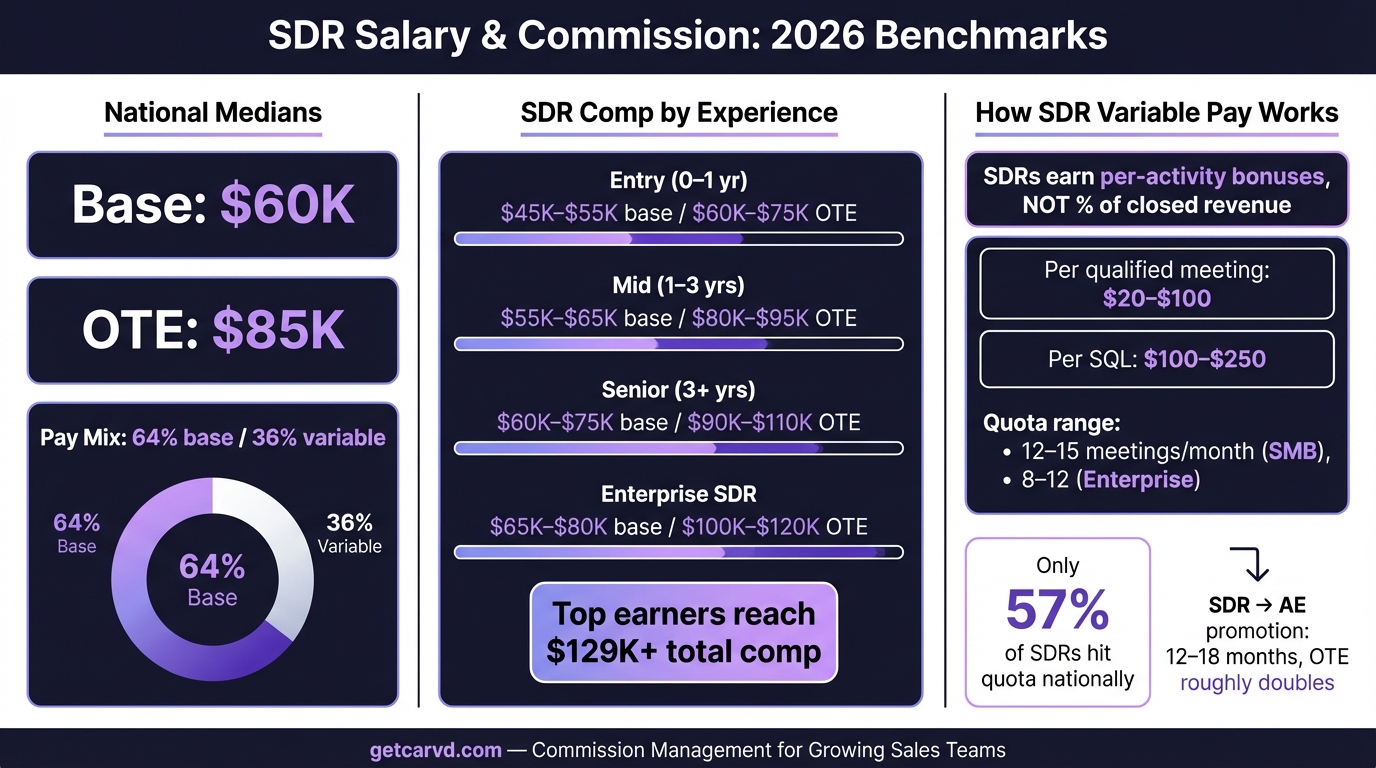
The national median for SDR salary is $60,000 base and $85,000 OTE, according to RepVue's March 2026 data. But that median obscures a wide range: an SDR at an early-stage startup in the Midwest might earn $65K OTE, while an enterprise SDR at Microsoft or Salesforce can exceed $155K OTE.
The compensation structure itself is also different from every other sales role. SDRs don't earn commissions on closed revenue — they earn bonuses on pipeline activity. Understanding that difference is the starting point for evaluating any SDR offer or building an SDR comp plan.
What SDRs earn: base, OTE, and pay mix
SDR compensation is more base-heavy than AE compensation. The median pay mix is 64% base / 36% variable, per Bridge Group's SDR Metrics research across 400+ B2B companies — compared to roughly 50/50 for account executives.
National benchmarks (RepVue, March 2026; Bridge Group; Betts Recruiting 2025):
| Level | Base salary | OTE |
|---|---|---|
| Entry-level (0–1 year) | $45,000–$55,000 | $60,000–$75,000 |
| Mid-level (1–3 years) | $55,000–$65,000 | $80,000–$95,000 |
| Senior SDR (3+ years) | $60,000–$75,000 | $90,000–$110,000 |
| Enterprise SDR | $65,000–$80,000 | $100,000–$120,000 |
| National median | $60,000 | $85,000 |
Top earners on RepVue hit $129K+ in total comp — typically senior SDRs consistently beating quota at companies with aggressive accelerators.
Geographic premiums are real. Seattle SDRs see a median OTE near $100K; San Francisco and San Diego SDRs average around $90K. Remote roles using national median pay typically land at $75K–$80K OTE.
How SDR variable comp is structured
This is where SDR compensation differs fundamentally from AE comp. SDRs aren't credited when deals close — they're credited when pipeline is created. The most common variable structures are:
Per-meeting bonus: $20–$50 per meeting booked, $50–$100 per meeting held and qualified. This is the most common model.
Per-SQL bonus: $100–$250 per sales-qualified lead. More common at companies where the AE or sales leader formally accepts and grades the opportunity.
Pipeline credit model: 0.5%–4% of closed-won revenue from SDR-sourced deals. Less common, but aligns SDR incentives more closely with deal quality than volume.
Hybrid model: splits variable across multiple metrics — for example, 40% on meetings booked, 30% on qualified opportunities, 30% on pipeline influenced. Useful for managing gaming of single-metric plans.
Most plans include SPIFs on top of the base structure: a $500 bonus for hitting 150% of monthly quota, $200 for the highest SQL-to-meeting conversion in a given week, or $100 per meeting with a named target account.
Accelerators are less common in SDR plans than AE plans, but they exist. Typical structure: if you hit 120% of quota, your per-meeting bonus rate steps up by 25%. The commission plan builder lets you model SDR accelerator tiers and see projected payouts at different attainment levels.
Threshold: the majority of SDR plans require hitting 80% of quota before any variable pays out. Below that floor, there's no check.
Benchmarks by company stage
Early-stage companies pay less cash and compensate with equity. Enterprise companies pay more cash with less equity. This pattern is consistent across sales roles, but the spread is especially pronounced at the SDR level.
| Company stage | Base range | OTE range | Notes |
|---|---|---|---|
| Seed / pre-Series A | $45,000–$55,000 | $65,000–$80,000 | Equity upside; 70/30 base-variable split common |
| Series A | $50,000–$60,000 | $75,000–$90,000 | Formalizing comp plans |
| Series B–C | $55,000–$65,000 | $80,000–$95,000 | More structured; 65/35 split |
| Enterprise / public | $65,000–$80,000 | $90,000–$120,000 | Defined tiers, SPIFs, accelerators |
Ravio's 2026 startup salary data shows a roughly 15–20% base premium from seed to Series C+ for equivalent sales roles. At the enterprise level (Backbase, Microsoft, Salesforce), top-paying SDR roles exceed $150K OTE per RepVue.
Quota expectations and the attainment reality
One number that should inform any SDR comp plan design: only 57% of SDRs nationally reach or exceed their quota, per RepVue's 2026 data. Everstage and RepVue's Cloud Sales Index puts average attainment at 53.2% as of Q4 2024.
If your SDR comp plan assumes 85% or 90% attainment as the baseline, your modeling is wrong. The realistic attainment distribution means most SDRs will earn somewhere between their base salary and OTE — not at OTE.
Typical monthly quota by segment:
| Segment | Monthly meeting quota |
|---|---|
| SMB SDR | 12–15 qualified meetings |
| Inbound SDR (warm leads) | 20–25 meetings |
| Mid-market SDR | 10–15 qualified meetings |
| Enterprise SDR | 8–12 meetings (higher quality bar) |
Pipeline-based quotas are becoming more common: the median SDR generates around $3M in pipeline annually, per Tenbound's 2024 research. Companies using pipeline-dollar quotas are trying to align SDR incentives with deal quality rather than meeting volume.
Healthy quota-to-OTE ratio for SDRs: 4:1 to 6:1. An SDR earning $85K OTE should be expected to generate $340K–$510K in qualified pipeline annually. Below 4:1 is overpaying for pipeline; above 6:1 is setting SDRs up to miss.
SDR to AE: the career progression and salary jump
The SDR role is a training ground. Most SDRs are hired with the expectation of a 12–18 month path to an AE seat.
Promotion timelines:
- Typical: 12–18 months
- High performers: 6–12 months
- Extended (enterprise or larger orgs): 18–24 months
Salary jump at promotion:
| Destination | Base range | OTE range | OTE increase |
|---|---|---|---|
| SMB AE | $60,000–$80,000 | $100,000–$140,000 | ~60–75% OTE increase |
| Mid-market AE | $75,000–$100,000 | $140,000–$180,000 | ~80–110% OTE increase |
| Enterprise AE | $100,000–$150,000 | $200,000–$350,000+ | ~150%+ OTE increase |
The OTE roughly doubles at the SDR-to-AE transition. More importantly, the comp structure flips: SDRs earn for creating pipeline; AEs earn for closing it. Understanding how AE commissions work before making that jump — accelerators, clawbacks, draw periods — matters.
For the full AE compensation picture, see tech sales salary benchmarks by role.
What moves your SDR number
Five factors explain most of the spread between a $65K-OTE SDR offer and a $100K-OTE SDR offer:
1. Company stage. As covered above: 15–20% base premium from seed to Series C+. Early-stage pays with equity.
2. Inbound vs. outbound. Inbound SDRs work warmer leads and carry higher quotas. Outbound SDRs do harder prospecting and typically earn a slight base premium (5–10%) to compensate.
3. Geography. Seattle, San Francisco, and NYC carry a 20% premium over national medians. Remote roles using geo-banded pay have narrowed this spread, but it hasn't disappeared.
4. Industry within tech. Cybersecurity, infrastructure, and enterprise data tools pay above median. MarTech, HR tech, and SMB SaaS tend to pay below.
5. Whether quota is achievable. OTE is a projection, not a guarantee. Before accepting an offer, ask: "What percentage of SDRs hit quota last year?" If the answer is below 40%, the OTE figure is largely theoretical.
Evaluating an SDR offer
The headline OTE is one number. What actually determines take-home pay:
- Quota achievability. What's the team's actual attainment rate? Aim for a team where 60–70% of reps hit quota.
- Threshold. At what percentage of quota does variable pay start? 80% is standard; anything higher punishes moderate miss months heavily.
- Accelerator structure. Does the plan reward blowout months? A 1.5x multiplier above 120% of quota meaningfully changes upside.
- SPIF frequency. Are there monthly or quarterly SPIFs on top of base structure? These can add $3K–$10K annually.
- Promotion criteria. What exactly is required to get to an AE seat? Get it in writing.
For reps who want to model their commission earnings at every attainment level, the commission calculator handles the math instantly. For teams looking to build transparent SDR comp plans, Carvd's rep dashboards show every rep the full payout breakdown by deal and period.
For how SDR compensation fits into the broader sales compensation picture, see on-target earnings: the complete guide and variable compensation: types and structures.
Salary data sourced from RepVue Sales Salary Guide (March 2026), Bridge Group SDR Metrics & Compensation Research, Betts Recruiting 2025 Tech SDR Compensation Trends, Seattle Corporate Search 2025 SaaS Sales Salary Benchmarks, Everstage Variable Compensation Benchmarks 2025, Tenbound 2024 SDR Report, and Ravio 2026 Startup Salary Data. Benchmarks reflect US market conditions and should be adjusted for industry, geography, and company stage.
Last updated: March 22, 2026