OTE in Sales: How It's Set, Paid, and Negotiated
OTE in sales is the total pay a rep earns at 100% quota. Learn how companies set it, how commissions are paid out, and what's actually negotiable before you sign.
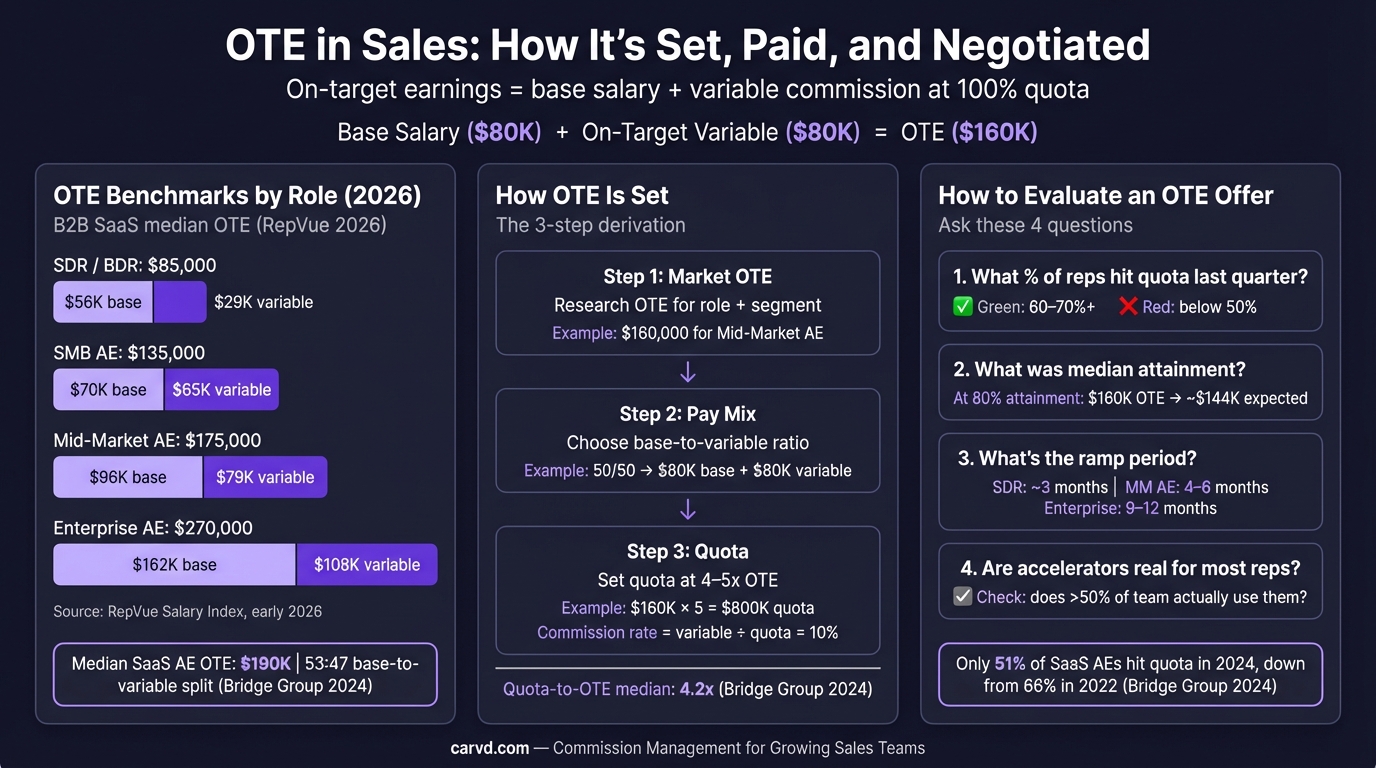
OTE in sales is the total annual pay a sales rep earns when hitting 100% of quota. It combines base salary and variable commission into one number — the figure that shows up in job postings and offer letters.
At a 50/50 pay mix with $190,000 OTE, your base is $95,000 and your variable target is $95,000. You earn the second half by closing your quota.
That's the definition. The harder questions are how that number gets built, when you actually receive the commission portion, and what's worth pushing back on before you sign.
How companies set OTE in sales
OTE isn't a number companies pick to sound attractive. For plans that are internally consistent, it follows a sequence:
Step 1: Benchmark by role and market. Companies start with what competing employers pay for the same role in the same geography. Bridge Group's 2024 report of 172 B2B SaaS companies puts median AE OTE at $190,000, up from $167,000 in 2022.
Step 2: Determine pay mix. Pay mix is the ratio of base to variable. The Bridge Group 2024 data puts median SaaS AE pay mix at 53% base, 47% variable — close to 50/50. SDRs run heavier base (70/30) because they're generating pipeline, not closing full-cycle deals. Enterprise AEs sometimes run 50/50 or higher variable because deal sizes support it.
Step 3: Set quota at 4–5x the variable target. This is where most inconsistently designed plans go wrong. If the variable portion is $89,000, a well-calibrated quota is $375,000–$445,000 — which produces a commission rate of roughly 20–24%. Bridge Group's 2024 data puts the median quota-to-OTE ratio at 4.2x: a $190,000 OTE rep carries an $800,000 annual quota.
Step 4: Commission rate falls out of that math. With $89,000 variable at $800,000 quota, the commission rate is 11.1%. The rate isn't chosen in isolation — it's the result of OTE and quota decisions. Bridge Group's 2024 benchmark puts median commission rates at 11.5% of ACV. To run these numbers for your own plan, try the OTE calculator.
Plans that skip step three — setting a revenue target from a board model first, then announcing OTE as the sum — often produce OTE numbers that look reasonable but are structurally difficult to hit.
OTE benchmarks by role (2024–2025)
| Role | Base | OTE | Pay Mix |
|---|---|---|---|
| SDR/BDR | $55K–$75K | $70K–$95K | 70:30 |
| Mid-Market AE | $75K–$100K | $140K–$180K | 50:50 |
| SaaS AE (median) | ~$101K | $190K | 53:47 |
| Enterprise AE | $100K–$140K | $180K–$250K+ | 50:50 |
| Sales Manager | ~$135K | $160K–$250K | 60:40 |
Sources: Bridge Group 2024 SaaS AE Metrics & Compensation Benchmark; Seattle Corporate Search 2025 SaaS Salary Benchmarks.
These are medians across a wide range of companies. OTE varies by stage, geography, and product complexity — a $190K median at Series B SaaS doesn't mean that's what the role pays at a pre-PMF startup or a Fortune 500.
How OTE commissions are actually paid
OTE is an annual number, but commission is paid throughout the year as deals close. The structure depends on how heavily weighted the variable portion is.
Most SaaS companies with a 50/50 pay mix pay commissions monthly as deals close, reconciled quarterly. Plans with a heavier base (75/25 or higher) typically pay quarterly. Very base-heavy plans (85/15) sometimes pay semi-annually.
For individual contributors carrying annual quotas, most SaaS companies break the quota down quarterly and measure against that quarterly target. A rep with an $800,000 annual quota carries a $200,000 quarterly target. Commission is paid monthly on closed deals, then trued up at the end of each quarter if the plan has quarterly accelerators or SPIFs.
The principle behind payout timing: the sooner the reward follows the action, the more motivating it is. Monthly commission payments for a rep closing 6-week deals are more effective than quarterly checks.
Ramp and what it means for year-one earnings
OTE assumes a fully ramped rep. Most new AEs aren't fully productive for 5–6 months.
Bridge Group's 2024 data puts average SaaS AE ramp time at 5.7 months — up from 4.3 months in 2020. A rep hired in January is often not at full productivity until June or July. First-year actual cash earnings are therefore below stated OTE for most reps.
Companies handle ramp earnings in three ways:
Guaranteed draw. The company pays full OTE or a percentage of it during months 1–2 regardless of what closes. This acts as an advance against future commissions — sometimes recoverable (repaid if you leave early), sometimes non-recoverable (forgiven if you don't earn it back).
Reduced quota with standard rate. A rep in ramp carries 50% of full quota but the same commission rate, so winning deals still pay at the full percentage.
Graduated quota. Quota scales up each month — 25% in month one, 50% in month two, 75% in month three, full in month four. Commission rate stays constant.
When evaluating an offer, ask which ramp structure applies and whether the draw is recoverable. A recoverable draw that you're expected to pay back if pipeline dries up in month three is a different offer than a non-recoverable advance.
OTE and quota attainment reality
OTE assumes 100% attainment. Most reps don't hit that.
Bridge Group's 2024 benchmark found only 51% of SaaS AEs hit quota — down from 66% in 2022 and 74% in 2012. RepVue's Q4 2024 Cloud Sales Index puts average quota attainment across all reps at 43%. By segment: Enterprise AEs averaged 38% attainment, Mid-Market AEs 40%, SDRs 53%.
At 43% average attainment, a rep with $190,000 OTE earns closer to $130,000–$140,000 in a typical year. That's still meaningful, but it's not the number on the job posting. The commission calculator lets you model actual take-home at any attainment level.
This doesn't make OTE meaningless. It tells you the upside if you perform at quota and the plan is achievable. But it's a ceiling, not a prediction.
One structural reason attainment rates hover around 50%: Forrester has documented that companies intentionally over-assign quotas by 20–30% so that even if only half the team hits their number, the company still hits its revenue plan. A 50% attainment rate across the team is often designed in, not a sign that the product or territory doesn't support the OTE.
What's actually negotiable in an OTE offer
Most candidates focus on the OTE number itself. The more useful levers are:
Base salary. The most negotiable element. Shifting from a 50/50 to a 60/40 split means you earn 60% of OTE even at zero revenue. Base increases your floor regardless of what the market does to your quota.
Quota level. Negotiable if you can show the territory or book of business doesn't support the stated quota. The question to ask: "How was this quota set — historical territory performance, market potential, or a top-down revenue target from the board?"
Ramp structure and duration. A longer or more generous ramp is worth negotiating for complex products or long sales cycles. Getting six months at 50% quota rather than three months is a meaningful first-year income difference.
Accelerator thresholds. High performers earn above OTE when accelerators kick in above 100% quota. The threshold (100% vs. 110%) and rate (1.5x vs. 2x) are sometimes negotiable. Plans that cap commission at a ceiling limit upside for top performers and are a common reason strong AEs leave.
What's rarely negotiable at offer stage: commission rate and the fundamental structure of how the plan is calculated. Those are typically standardized across the team.
The most important due-diligence question before accepting any OTE offer: what percentage of reps hit 100% of quota last year? The honest answer tells you more about the achievability of the stated OTE than any other single data point.
Tracking OTE against actual commissions
Once hired, the ongoing frustration for most sales reps is not knowing whether their running commission total matches what they'll actually get paid.
At companies still running commission calculations in spreadsheets, reps often maintain their own shadow tracking — a personal record of every deal closed and what it should pay. Bridge Group's 2023 survey found shadow accounting is common at companies where reps don't trust the commission calculation process.
The solution is a system where reps can see exactly how each deal contributes to their payout — not just the total, but the deal-by-deal breakdown. Carvd's rep dashboards give reps a real-time earnings view updated as deals close, so the commission number on payday isn't a surprise.
For a deeper look at how OTE fits into a full compensation plan — including how to set accelerators, SPIFs, and ramp structures — see How to Build a Sales Compensation Plan.
Related reading: What Does OTE Mean? · Base Salary Plus Commission: Finding the Right Split · Uncapped Commission: Pros, Cons, and When It Makes Sense · On-Target Earnings: The Complete Guide
Last updated: March 22, 2026