Tiered Commission Structure: How to Build One That Scales
Learn how tiered commission structures work, how to set breakpoints and rates, and when they outperform flat commission plans. Includes real examples.
Most sales commission plans start as a single percentage. It's simple and it works — until you have reps who consistently blow out their number and others who coast at 70%, both earning the same rate per dollar of revenue.
That's the core problem a tiered commission structure solves. By paying a higher rate above quota, you reward overperformance financially and give top performers a reason to keep closing deals after hitting their target.
According to ICONIQ Growth's 2023 sales compensation survey of 236 B2B SaaS executives, 82% of SaaS startups use accelerators in their commission plans. The structure is standard practice — but execution varies widely.
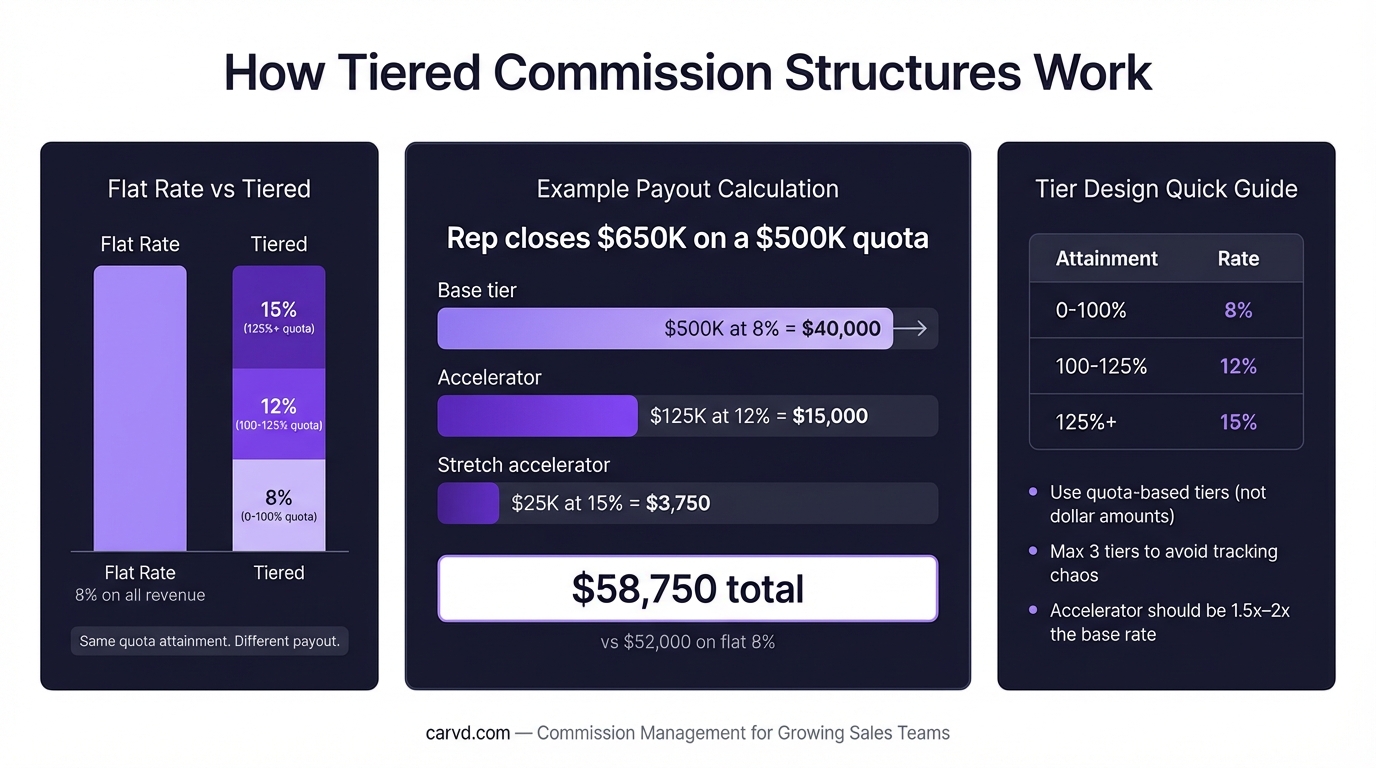
What is a tiered commission structure?
A tiered commission structure pays different commission rates across defined performance thresholds. As a rep closes more revenue, their commission rate increases for deals above each tier boundary.
Unlike a flat commission plan — where the same rate applies to every dollar regardless of performance — tiered plans create a variable payout that scales with attainment. The higher the attainment, the higher the effective rate earned on incremental revenue.
The tiers only apply to deals at or above each threshold, not retroactively to all revenue. If a rep earns 8% on deals up to quota and 12% above quota, the 12% rate applies only to the deals closed after quota is hit — not to the full book.
How tiered commission works: a concrete example
A SaaS company sets an AE's annual quota at $600,000 in new ACV. Their commission plan has three tiers:
| Attainment | Rate |
|---|---|
| 0–100% of quota (up to $600K) | 8% |
| 100–125% of quota ($600K–$750K) | 12% |
| Above 125% of quota (above $750K) | 16% |
A rep who closes $720,000 for the year earns:
- $600,000 × 8% = $48,000
- $120,000 × 12% = $14,400
- Total: $62,400
Their effective blended rate is 8.67% — above the base 8%, but well below the 12% accelerator rate. This is by design. Accelerators reward overperformance at the margin while keeping total commission cost manageable.
Compare that to a rep who closes $820,000:
- $600,000 × 8% = $48,000
- $150,000 × 12% = $18,000
- $70,000 × 16% = $11,200
- Total: $77,200
Their effective blended rate is 9.4%. The company pays more per dollar — but only for revenue above quota, which is incremental gross margin the business wouldn't have otherwise.
How to set tier breakpoints
The three design decisions in a tiered plan are where tiers start, how wide each tier is, and what rate applies in each tier.
First tier: start at 100% quota attainment. The first accelerator should kick in when a rep has fully delivered their target — not at 80% or 90%. Setting accelerators below quota rewards partial performance and signals that quota isn't the real target.
Tier width: 20–50 percentage points. A Tier 1 from 100% to 120% works well for enterprise AEs with large deal sizes and longer cycles. A Tier 1 from 100% to 150% is more appropriate for SMB or mid-market reps with shorter cycles and more frequent closes.
Number of tiers: 2 to 4. Most effective plans have two or three tiers. Beyond four tiers, reps can't track their position in real time — and an incentive structure they can't mentally calculate doesn't change behavior. Keep the design simple enough that a rep can estimate their commission on a deal in their head.
Rate multiplier per tier: 1.5x to 2x the base rate. If your base rate is 8%, a Tier 1 accelerator of 12% is a 1.5x multiplier. A Tier 2 of 16% is a 2x multiplier. Going beyond 3x in any tier can create payout spikes that distort cost structure — particularly if a few reps have outsized quarters. Use a commission plan builder to model the cost impact of different multiplier levels at 80%, 100%, and 120% attainment before locking in your plan.
Tiered vs. flat commission: when each makes sense
Neither structure is better in all cases. According to Bridge Group's 2024 SaaS AE benchmark across 170 B2B SaaS companies, the median commission rate at 100% quota attainment is 11.5% of ACV. That figure is often a flat rate at smaller companies and a base tier rate at companies with accelerators.
Flat commission makes sense when:
- Your team is small (under 5 reps) and performance variance is low
- Deals are complex enough that quota attainment is a trailing indicator rather than a real-time signal
- You want maximum simplicity in plan administration and rep communication
- All reps are on identical plan types with identical quotas
Tiered commission makes sense when:
- You have meaningful performance variance — some reps consistently at 60% quota, others at 140%
- You want to retain your top 20% without restructuring base salaries
- You've noticed that reps stop closing aggressively after hitting quota
- Your average attainment rate is well below 100% (RepVue's Cloud Sales Index shows average attainment at 43.14% in Q4 2024 across 42,000 SaaS reps) — meaning accelerators only cost you money on your best performers
A flat plan treats a rep at 101% of quota identically to a rep at 65%. If that feels wrong for your team, a tiered structure is the fix.
Common mistakes
Retroactive tiers. Some plans pay the higher rate on all revenue once a rep crosses into a new tier (instead of only on revenue above the breakpoint). This creates large, unpredictable payout spikes and incentivizes reps to hold deals to cross tier boundaries in ideal timing. Always apply tiers marginally, not retroactively.
Too many tiers. Four tiers sounds more motivating than two. In practice, it creates confusion and reduces the clarity that makes accelerators behaviorally effective. Start with two tiers and add a third only if the data shows consistent performance clustering above Tier 1.
Setting Tier 1 too high. A first accelerator at 120% of quota is demotivating for the 80% of reps who won't reach it. If RepVue data shows average attainment at 43%, and Salesforce's State of Sales finds only 24.3% of individual reps exceed their yearly quota, an accelerator at 100% is already aspirational for most of the team. Setting it higher turns the incentive into a perk for your top 2 reps.
Not communicating the math. Reps who can't model their own earnings stop trusting the plan. Before rolling out a tiered structure, show each rep a worked example with their specific quota and realistic deal sizes. Rep dashboards that show tier progress deal-by-deal make the plan self-documenting.
Calculating tiered commission payouts
Tiered commission math is straightforward but tedious at scale. For a team of 5 reps, it's manageable in a spreadsheet. Build tiered structures in a Stackrows template before moving to software. For a team of 20+ reps on multiple plan types, tracking which deals pushed which rep into which tier — across rolling months or quarters — becomes error-prone quickly.
Carvd calculates tiered commissions automatically from deal data. Import from HubSpot, Pipedrive, or CSV, and the engine applies your plan's tier structure deal by deal, with a full breakdown showing each rep exactly how their payout was calculated. That breakdown matters: reps who can audit their own number don't dispute it.
The design checklist
Before rolling out a tiered commission plan:
- First accelerator triggers at exactly 100% quota attainment
- No more than 3–4 tiers
- Tiers apply marginally (not retroactively)
- Tier 1 multiplier is 1.5x–2x the base rate
- Each rep has a worked example showing their expected payout at 80%, 100%, and 130% attainment
- Plan is documented in writing with an effective date
A tiered structure rewards the reps you most want to keep and gives everyone a reason to close deals past quota. The design decisions are straightforward — the execution is where most plans go wrong.
For a side-by-side comparison of how Carvd handles tiered plans versus enterprise ICM tools, see how Carvd compares to Xactly.
Related reading: Sales Commission Structure: Types, Examples & How to Choose · Commission Clawbacks: When to Use Them · How to Calculate Sales Commission
Last updated: March 21, 2026