How to Calculate OTE for Any Sales Role
Learn how to calculate on-target earnings for SDRs, AEs, and sales managers. Includes the OTE formula, worked examples, and a quota consistency check.
The formula for OTE is straightforward: base salary plus the variable commission you'd earn at 100% quota attainment. What's trickier is working backwards — figuring out whether a stated OTE is internally consistent, or checking what commission rate falls out of a given quota and pay structure.
This guide covers OTE calculation from every direction: starting with base and commission rate, setting OTE from scratch, and checking whether the math holds together.
The OTE formula
OTE = base salary + variable target at 100% quota
That's it. The variable target is the commission you'd earn if you closed exactly 100% of your assigned quota.
If your base is $80,000 and your quota is $600,000 at an 11% commission rate, your variable target is $66,000. OTE = $80,000 + $66,000 = $146,000.
The pieces you need to know:
- Annual base salary
- Commission rate (percentage of revenue)
- Annual quota
With all three, OTE calculates directly.
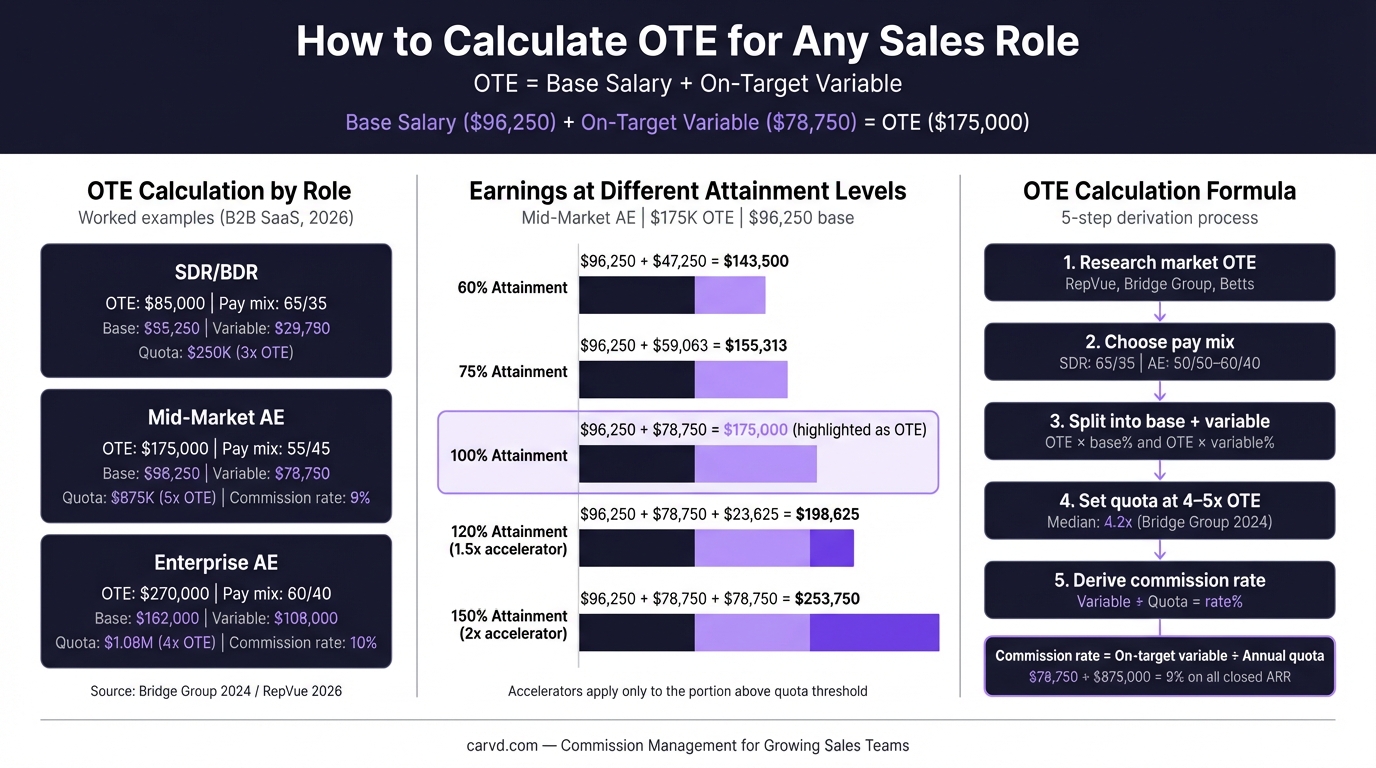
How to calculate OTE from pay mix
Most job postings state OTE and pay mix, not commission rate and quota. Pay mix is the ratio of base to variable — a 60/40 mix means 60% base, 40% variable.
Step 1: Calculate the variable target
Variable target = OTE × variable percentage
Example: $150,000 OTE at a 40/60 pay mix (60% variable) Variable target = $150,000 × 0.60 = $90,000
Example: $190,000 OTE at a 53/47 pay mix (47% variable) Variable target = $190,000 × 0.47 = $89,300
Step 2: Calculate the base salary
Base = OTE × base percentage
At $190,000 OTE with 53% base: Base = $190,000 × 0.53 = $100,700
Step 3: Derive the commission rate from the expected quota
Commission rate = variable target ÷ quota
If variable target is $89,300 and quota is $800,000: Commission rate = $89,300 ÷ $800,000 = 11.2%
This step is the consistency check. If the commission rate that falls out of the math seems wrong — above 20% or below 5% for a SaaS AE — it's a signal the quota or pay mix may not be internally consistent. The commission calculator runs this math instantly for flat, tiered, and split plans.
Worked examples by role
SDR with activity-based quota
SDRs are usually measured on meetings booked or pipeline generated, not revenue closed. Variable comp is typically tied to those activity metrics, not a revenue commission rate.
- OTE: $85,000
- Pay mix: 65/35 (65% base, 35% variable)
- Base: $85,000 × 0.65 = $55,250
- Variable target: $85,000 × 0.35 = $29,750
At 100% of activity quota (say, 40 qualified meetings per quarter), the SDR earns the full $29,750 variable. Calculating the implied "rate" doesn't apply here the same way.
Mid-market account executive
- OTE: $160,000
- Pay mix: 50/50
- Quota: $700,000 ACV
Base = $160,000 × 0.50 = $80,000 Variable target = $160,000 × 0.50 = $80,000 Commission rate = $80,000 ÷ $700,000 = 11.4%
Quota-to-OTE ratio = $700,000 ÷ $160,000 = 4.4x — within the normal range.
Enterprise account executive
- OTE: $240,000
- Pay mix: 50/50
- Quota: $1,200,000 ACV
Base = $240,000 × 0.50 = $120,000 Variable target = $240,000 × 0.50 = $120,000 Commission rate = $120,000 ÷ $1,200,000 = 10%
Quota-to-OTE ratio = $1,200,000 ÷ $240,000 = 5.0x — on the high end of the normal range.
Sales manager
Sales managers typically earn OTE through a combination of personal quota (where applicable) and team quota performance. The variable portion is often smaller relative to base.
- OTE: $200,000
- Pay mix: 70/30
- Variable target: $200,000 × 0.30 = $60,000
The $60,000 variable might be structured as: $30,000 tied to team quota attainment, $20,000 tied to specific reps hitting their numbers, and $10,000 in quarterly MBOs.
The quota-to-OTE ratio check
If you're designing a comp plan rather than evaluating an offer, this ratio tells you whether the numbers are internally consistent.
Quota-to-OTE ratio = annual quota ÷ OTE
Bridge Group's 2024 benchmark of 172 B2B SaaS companies puts the median at 4.2x for account executives. A rep with $190,000 OTE carries an $800,000 quota.
| Ratio | Interpretation |
|---|---|
| Below 3x | OTE is high relative to quota; plan may be unaffordable |
| 3x–5x | Normal SaaS range |
| Above 5x | Quota is high relative to OTE; may be structurally hard to hit |
A quota-to-OTE ratio above 5x doesn't automatically mean the plan is bad — enterprise AEs with large deal sizes and long cycles can support higher ratios. But it's the first thing to check if quota attainment rates are poor.
Calculating accelerators and overperformance
OTE is defined at 100% attainment, but high performers earn above OTE through accelerators. Calculating overperformance earnings requires knowing the accelerator structure.
Common accelerator example:
- 0–99% of quota: 8% commission rate (base rate)
- 100–125%: 12%
- Above 125%: 16%
For an AE with $800,000 quota who closes $1,000,000:
- First $800,000 at 8% = $64,000 (up to 100%)
- Next $200,000 at 12% = $24,000 (100%–125%)
- Total variable = $88,000
Compare to variable target at flat 11.2% rate: $89,600. The accelerator structure in this example doesn't kick in meaningfully until the rep closes well above quota, which is intentional — conserving commission budget for the majority of reps while rewarding overperformance.
The rep's total comp = $100,700 base + $88,000 variable = $188,700. Slightly below stated $190K OTE because the base commission rate (8%) is below the effective rate implied by OTE math. This is normal for plans with accelerators — the average rate across the full quota period is designed to land near OTE at exactly 100%.
OTE calculation when quota is hit partway through the year
OTE is annual, but deals close throughout the year. To estimate earnings mid-year:
Estimated annual earnings = base + (deals closed YTD ÷ annual quota × annual variable target)
If 60% of the year has passed and a rep has closed 55% of quota: Estimated variable = 55% × $89,300 = $49,115
Annualized rate suggests this rep finishes at ~92% of quota — below OTE.
This is exactly the type of real-time calculation that takes sales ops 20 minutes in a spreadsheet and happens automatically in commission software. Carvd's rep dashboards update earnings as deals close, so both reps and managers can see projected OTE versus actual trajectory throughout the quarter.
Calculating year-one OTE with ramp
OTE assumes a fully productive rep. Bridge Group's 2024 data puts average SaaS AE ramp time at 5.7 months. A rep hired in January earning full OTE from day one is unrealistic — and usually not what the comp plan actually pays.
To estimate year-one actual earnings:
Ramp-adjusted year-one OTE = base + (months at full productivity ÷ 12 × annual variable target)
For a rep ramping at 50% quota for months 1–3 and full quota in months 4–12:
Variable from ramp period (months 1–3):
- 50% quota × 3 months = 1.5 "quota months" of production
- Variable earned = 1.5 ÷ 12 × $89,300 = $11,163
Variable from full quota period (months 4–12):
- 9 months × 100% = 9 quota months
- Variable earned = 9 ÷ 12 × $89,300 = $66,975
Total year-one variable = $11,163 + $66,975 = $78,138 Total year-one earnings = $100,700 base + $78,138 variable = $178,838
That's about 94% of stated OTE — a more realistic estimate for the first year than the headline number.
Common OTE calculation mistakes
Calculating commission rate independently. Commission rate should fall out of OTE and quota decisions, not be set first. Picking 10% because it's a round number, then announcing an OTE based on an unrelated revenue target, produces plans where the implied quota is either too easy or structurally impossible.
Ignoring ramp in year-one math. A fully ramped OTE is not what new hires earn. Always calculate ramp-adjusted earnings when modeling headcount costs or evaluating compensation.
Conflating OTE with average earnings. At 43% average attainment (RepVue Q4 2024), most reps earn well below OTE. Design compensation and model cost-of-sales using expected attainment distributions, not OTE.
Setting quota in isolation. If quota doubles but OTE stays flat, the commission rate halves. Plan changes that feel like quota adjustments are actually comp reductions — and reps notice. Use the comp plan builder to stress-test quota changes before publishing them.
For the full context on how OTE fits into overall sales compensation design — including pay mix tradeoffs, accelerator structures, and ramp — see OTE in Sales: How It's Set, Paid, and Negotiated. For a tool that calculates OTE automatically from your inputs, try the OTE calculator.
Related reading: What Does OTE Mean? · OTE Salary: Base + Variable Explained · OTE vs Base Salary · On-Target Earnings: The Complete Guide
Last updated: March 22, 2026