Sales Rep Agreement Template: Commission Terms & Clauses
A sales rep agreement template covers more than commission rates. Here's the full clause set for independent and W-2 reps—territory, tail commissions, and state-specific rules.
A sales commission agreement covers how reps get paid. A sales rep agreement covers everything else too—and getting the non-commission clauses wrong is where most disputes actually start.
The distinction matters because a rep who sells on your behalf has authority, territory, and customer relationships that need to be clearly defined before they start working. The commission section is important; so are the sections on exclusivity, tail commissions, product scope, and what happens at termination.
Here's a template covering the full clause set, with specific language for independent (1099) reps—the context where sales rep agreements are most critical.
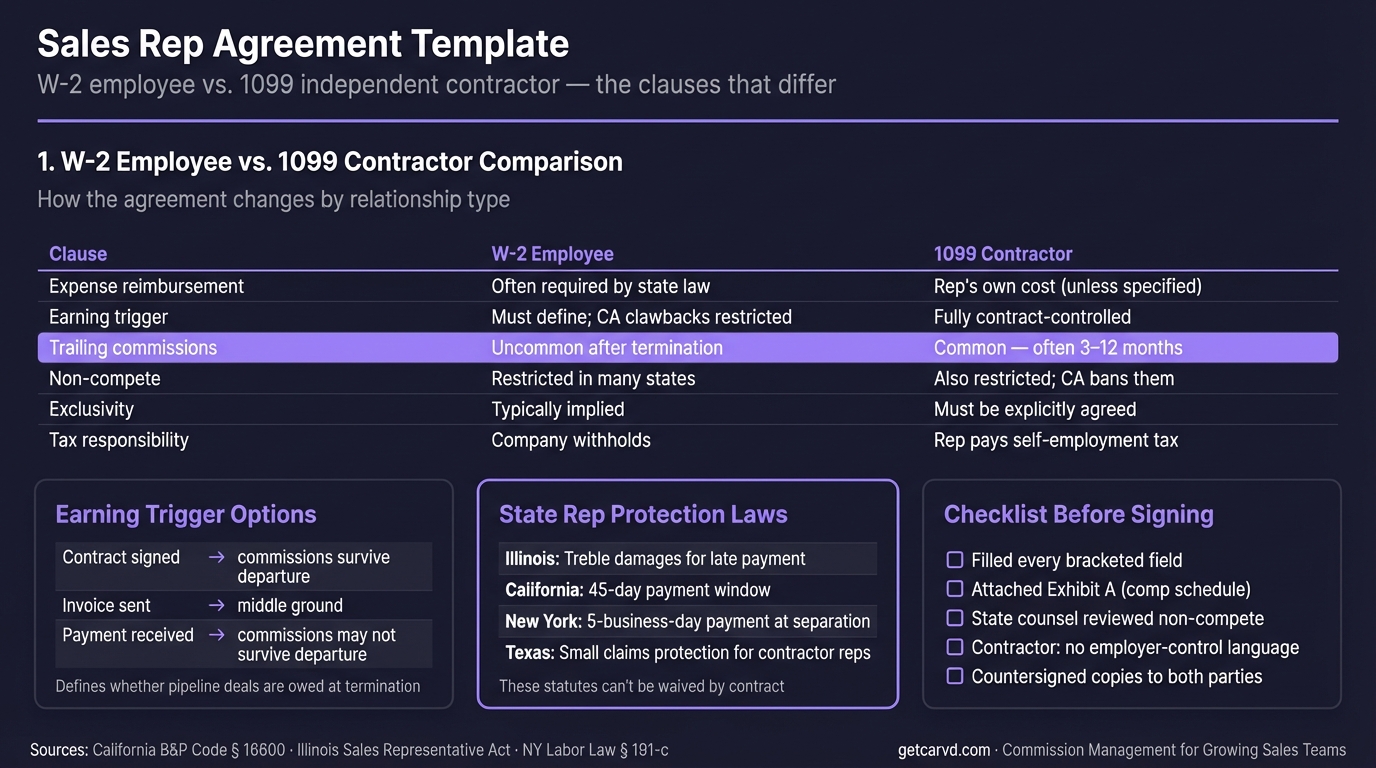
Sales rep agreement vs. commission agreement: what's different
A sales commission agreement is focused on pay mechanics: rate, calculation basis, payment schedule, clawbacks, and what happens to commissions when a deal falls apart. It works for W-2 employees where the employment relationship itself establishes the other terms.
A sales rep agreement is the primary (often only) governing document for independent reps. It has to cover:
- What the rep is authorized to sell — product lines, services, bundles
- Where they can sell it — defined territory or named accounts
- Whether that coverage is exclusive — can the company sell direct or appoint other reps in the same territory?
- What authority the rep has — can they quote prices, sign contracts, or commit delivery timelines on the company's behalf?
- Commission terms — same detail required as a standalone commission agreement
- Post-termination obligations — tail commissions, non-compete, return of materials, customer list ownership
For W-2 employees, the sales rep agreement is typically an addendum to the offer letter or comp plan. For 1099 independent contractors, it's a standalone contract that is the entire basis of the legal relationship.
The legal baseline: 35 states have independent rep protection statutes
Before drafting any clause, understand the floor. As of 2026, 35 U.S. states and Puerto Rico have enacted independent sales representative protection statutes. These laws generally require:
- A written agreement specifying commission rate and calculation method
- Timely payment of all earned commissions after termination, regardless of what the contract says
- The company to provide the rep a signed copy of the agreement
State payment deadlines after termination vary significantly:
- Illinois: 13 days after termination
- Indiana: 14 days after the commission would have been due under the contract
- North Carolina: 30 days after termination; 15 days for commissions that become due post-termination
- Texas: 30 working days after termination
- Virginia: No more than 30 days from termination date
The penalties for missing these deadlines are real. Wisconsin allows up to 200% of unpaid commissions plus all attorney's fees. Illinois has similar multiplier damages.
Minnesota is the most stringent: the Termination of Sales Representatives Act requires 90 days' written notice before terminating an agreement without cause, a 60-day cure period for the rep, and continued commission payment through the notice period. Statutory protections override contract terms if the contract is less favorable to the rep.
The implication: a well-drafted agreement doesn't eliminate these protections—it defines the terms within which they apply. Without a clear agreement, the rep's attorney gets to argue for the most favorable interpretation of every undefined term.
Sales rep agreement template
This template is structured for independent (1099) sales reps. Key differences from W-2 employee agreements are noted in each section.
INDEPENDENT SALES REPRESENTATIVE AGREEMENT
This Agreement is entered into as of [DATE], between [COMPANY NAME], a [STATE] [ENTITY TYPE] ("Company"), and [REP NAME / BUSINESS NAME] ("Representative").
1. Appointment and product scope
Template language:
The Company appoints Representative as an independent sales representative for the following products/services ("Products"):
[LIST OF PRODUCTS OR PRODUCT LINES]
Representative is authorized to solicit orders for Products within the Territory defined in Section 3. Representative is not authorized to sell, represent, or quote on any product or service not listed above without prior written approval from [TITLE].
Commentary: Scope creep is a common problem in rep relationships. A rep who starts quoting unlisted products or negotiating on custom services creates liability and margin risk. Define what they can sell before they start.
2. Independent contractor status
Template language:
Representative is an independent contractor, not an employee, partner, or agent of the Company. Representative has no authority to bind the Company to any contract, commitment, or obligation without express written authorization. Representative is solely responsible for all self-employment taxes, income taxes, and expenses incurred in performing services under this Agreement.
Nothing in this Agreement creates an employment relationship. The Company will not withhold income taxes, Social Security, or Medicare from payments to Representative.
Commentary: This clause is necessary but not sufficient to establish contractor status. Classification is determined by the actual nature of the working relationship—specifically, the IRS Economic Reality test updated in January 2024. If the company controls how, when, and where the rep works, a court or the IRS may override the label regardless of what the agreement says. When in doubt, consult an employment attorney before classifying a rep as 1099.
3. Territory
Template language:
Representative is assigned the following territory ("Territory"):
[Option A — Geographic]: The following states/counties: [LIST]
[Option B — Named accounts]: The accounts listed in Exhibit A, as updated by mutual written agreement
[Option C — Industry segment]: Prospects with primary operations in the [INDUSTRY] sector, as defined in Exhibit A
The Territory assignment is [exclusive / non-exclusive]. If exclusive, the Company will not appoint other representatives or sell direct within the Territory during the term of this Agreement, except for House Accounts listed in Exhibit B. If non-exclusive, the Company retains the right to sell direct or appoint other representatives within the Territory without additional compensation to Representative.
Commentary: "Exclusive" and "non-exclusive" have significant economic implications. A rep who expects exclusivity but gets a non-exclusive agreement will eventually discover the difference at the worst time—when a house account generates a large commission that they expected to receive. Define it in writing and attach the account list as an exhibit.
4. Commission structure
Template language:
The Company will pay Representative a commission of [X]% of [Net Invoiced Revenue / Collected Cash] on all orders accepted from the Territory during the term of this Agreement.
"Net Invoiced Revenue" means the invoice amount, excluding applicable taxes, shipping, and any discounts exceeding [X]% not approved in writing by [TITLE].
Excluded sales: No commission is owed on (a) House Accounts listed in Exhibit B, (b) orders below $[MINIMUM], (c) international orders outside the Territory, or (d) sales made directly by Company employees where Representative had no documented involvement.
Where tiered rates apply, the following schedule governs:
- First $[THRESHOLD]: [X]% commission
- $[THRESHOLD] to $[THRESHOLD]: [X]% commission
- Above $[THRESHOLD]: [X]% commission
Thresholds reset [annually] on [DATE].
Commentary: The "excluded sales" clause prevents one of the most common disputes in rep relationships: the company closes a deal in the rep's territory that the rep had no involvement in, and the rep claims commission. House accounts and direct sales carve-outs need to be explicit—and attached as exhibits so they can be updated without requiring a new agreement. When reps inevitably challenge an exclusion, a dispute resolution workflow provides the structured process to investigate and respond within the timeline defined in the agreement.
5. When commission is earned
Template language:
Commission is "earned" at the later of: (a) the Company's written acceptance of a purchase order or execution of a binding contract with the customer, and (b) the customer's first payment equaling at least [X]% of the contract value.
Commission is not earned on orders that are cancelled, rejected by the Company, or where the customer fails to remit payment within [90] days of invoice, except as provided in Section 6.
Commentary: This clause determines whether your tail commission and clawback provisions are enforceable. "Earned" commissions are legally different from advances in most state statutory frameworks—and you cannot claw back an earned commission by calling it something else. Keep the earning event tied to something the rep influenced, not administrative timing within the company's control.
6. Clawback provisions
Template language:
If a commission has been paid on an order that is subsequently cancelled or returned, or where the customer fails to pay within [90] days of the invoice date, the Company may recover commissions as follows:
(a) Full recovery: Cancellation or return within [30] days of order acceptance (b) Pro-rated recovery: Between [31–90] days, recovery equals commission × (1 – days elapsed / 90) (c) No recovery: After [90] days, earned commissions are final
Recovery will be made by deduction from future commission payments. If the Agreement terminates before full recovery, the Company may invoice the remaining balance.
Commentary: Unlike W-2 employee agreements, this clause is generally enforceable for 1099 contractors without the California Labor Code Section 221 restrictions that apply to employees. Still, tie clawback triggers to events the rep can verify—customer non-payment data, cancellation notices—not internal company decisions the rep has no visibility into.
For more on structuring clawback provisions, see our commission clawback guide.
7. Payment schedule
Template language:
Earned commissions will be paid within [30] calendar days of the end of each calendar month in which the commission was earned, accompanied by a written statement detailing the orders included, rates applied, and calculation method.
Payments will be made via [ACH / check] to the account or address provided by Representative. Representative is responsible for updating payment information at least [10] business days before the end of any pay period.
Commentary: Check the state deadlines noted above before setting your payment window. If you have reps operating in Illinois, Indiana, or Texas, "30 days" may not be compliant in all circumstances. The written statement requirement creates an audit trail—it also reduces disputes because reps can catch errors before they compound. The payroll export ensures the commission amounts sent to payroll match the statements reps receive, closing the gap between what's communicated and what's paid.
8. Post-termination tail commissions
Template language:
Upon termination of this Agreement for any reason:
(a) Commissions on orders accepted by the Company before the termination date will be paid on the regular schedule
(b) Commissions on orders accepted within [30 / 60] days after the termination date, where Representative can document that they initiated the sales contact before termination, will be paid at [X]% of the standard rate
(c) No commissions will be paid on orders accepted more than [30 / 60] days after the termination date, regardless of when the sales contact was initiated
Commentary: This is the most frequently litigated clause in independent rep agreements. Courts will read "silence" on tail commissions as an entitlement—if your agreement says nothing about post-termination commissions, the rep can argue they're owed commissions on every deal that closed out of their pipeline, with no time limit.
A 30–60 day tail window is standard. Some industries with longer sales cycles (capital equipment, complex software) use 90-day windows. Define it explicitly. If you want no tail, state it: "No commissions will be paid on orders accepted after the termination date, regardless of when Representative initiated contact." The commission plan builder lets you define tail commission rules alongside the primary plan structure, so the agreement language and the calculation logic stay in sync.
9. Termination
Template language:
Either party may terminate this Agreement with [30 / 60] days written notice to the other party.
The Company may terminate this Agreement immediately, without notice, for cause, including: (a) Representative's material breach of this Agreement; (b) Representative's commission of fraud, theft, or misrepresentation; (c) Representative's engaging in direct competition with the Company; or (d) Representative's conviction of a crime involving moral turpitude.
Upon termination, Representative will promptly return all Company materials, customer lists, price books, and confidential information. Customer lists and contact data collected during the term remain the Company's property.
Commentary: Minnesota requires 90 days' notice for non-cause terminations and a 60-day cure period—verify state requirements before setting your notice period. The customer list ownership clause is important regardless of state law: reps sometimes argue that contacts they developed are their personal relationships. Making ownership explicit prevents that argument.
10. Confidentiality and IP
Template language:
Representative agrees to maintain in confidence all Company proprietary information, including pricing, product roadmaps, customer lists, sales strategies, and financial information ("Confidential Information"), and will not disclose or use Confidential Information for any purpose other than performing services under this Agreement.
All marketing materials, customer relationships, sales tools, and data developed in connection with this Agreement are the property of the Company.
These obligations survive termination of this Agreement for [2] years with respect to Confidential Information, and indefinitely with respect to customer data and proprietary materials.
11. Non-compete and non-solicitation
Template language:
During the term of this Agreement and for [12] months following termination, Representative agrees not to:
(a) Represent or sell products or services that directly compete with the Products in the Territory
(b) Solicit the Company's customers or prospects, where "prospects" means any person or entity that Representative had material contact with during the last [12] months of the Agreement
(c) Recruit, solicit, or hire any Company employee or other sales representative
Commentary: Non-compete enforceability varies significantly by state. California prohibits nearly all non-competes. Minnesota significantly restricted enforcement as of 2023. Illinois courts apply a reasonableness standard. Before including restrictive covenants, consult an attorney for each state where the rep works—an unenforceable clause isn't just useless, it can create ambiguity about which other provisions are enforceable.
12. Governing law and dispute resolution
Template language:
This Agreement is governed by the laws of [STATE], without regard to conflicts of law principles. Any dispute arising under this Agreement that is not resolved through good-faith negotiation will be submitted to binding arbitration under [AAA / JAMS] rules in [CITY, STATE].
COMPANY Signature: ________________________ Name: ____________________________ Title: ____________________________ Date: ____________________________
REPRESENTATIVE Signature: ________________________ Name: ____________________________ Date: ____________________________
Commentary: Choose governing law carefully if the rep works in a state with strong independent rep protections. Attempting to apply a less protective state's law may not hold up if a court determines the rep primarily worked in the more protective state. Many state statutes explicitly prohibit choice-of-law clauses that reduce rep protections below the state minimum.
Key differences from a W-2 employee agreement
For W-2 employees, several of the clauses above work differently:
Section 2 (Contractor status): Doesn't apply. The employment relationship is established through the offer letter and onboarding.
Section 4 (Excluded sales): Still relevant, but house account definitions and direct-sale carveouts are typically handled in the comp plan rather than the employment agreement.
Section 6 (Clawbacks): California Labor Code Section 221 limits clawback enforcement for employees. Clawbacks must be structured as recovery of advances on commissions not yet earned—not recovery of wages already paid.
Section 8 (Tail commissions): Still applies, but post-termination earned commissions are protected as wages in most states. The agreement can define the pipeline window, but cannot deny earned commissions.
Section 11 (Non-compete): Non-competes for employees face increasing legal restriction. The FTC's 2024 non-compete rule—while blocked in federal court as of late 2024—signals the regulatory direction. Review enforceability before including.
Tracking commission calculations alongside the agreement
The agreement defines the terms; the commission process applies them. Most teams keep these in separate systems—a PDF agreement and a spreadsheet—which means discrepancies accumulate quietly and disputes arrive after the fact.
Carvd stores plan terms alongside deal-by-deal commission calculations, so reps can see exactly how each payout was derived and flag discrepancies before they escalate. The agreement sets the rules; the software runs the math.
For the clause-by-clause guide specific to commission payment mechanics, see our sales commission agreement template. For the broader legal framework, see sales commission agreement: what every plan should include.
Related reading:
Last updated: March 22, 2026