Sales Commission Agreement Template (Free Download)
A free sales commission agreement template with clause-by-clause language for W-2 employees and 1099 contractors. Download and customize for your sales team.
A commission agreement is only as good as its language. Generic templates downloaded from the internet leave out the clauses that matter most—the ones that prevent disputes over split credit, post-termination payouts, and clawback recovery.
Here's a template you can actually use, with the specific language each clause needs and commentary on where companies typically leave gaps.
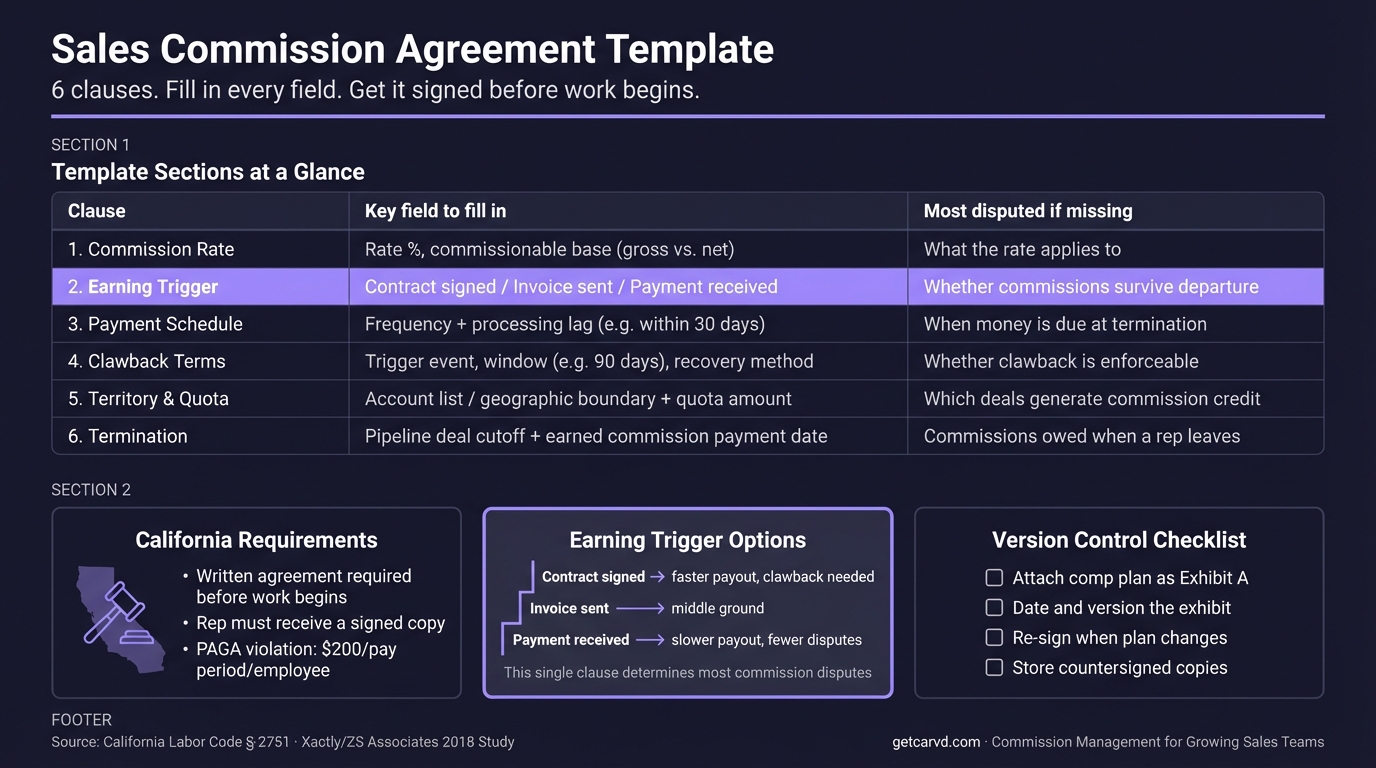
How this template is structured
The template below covers W-2 employees. Key variations for 1099 independent contractors are noted in each section where the language differs. Before using any template, have legal counsel review it for the states where your reps work—California and New York have statutory requirements that affect specific clause language.
Sales commission agreement template
SALES COMMISSION AGREEMENT
This Sales Commission Agreement ("Agreement") is entered into as of [DATE], between [COMPANY NAME], a [STATE] [ENTITY TYPE] ("Company"), and [REP NAME] ("Representative").
1. Commission structure
Template language:
The Company will pay Representative a commission of [X]% of [Net Invoiced Revenue / Gross Revenue / Collected Cash] for each sale closed during the term of this Agreement.
"Net Invoiced Revenue" means the total invoice amount, excluding applicable taxes, shipping, installation fees, and any discounts exceeding [X]% that were not approved in writing by [TITLE].
Where tiered rates apply, the following schedule governs:
- [THRESHOLD 1]: [X]% commission
- [THRESHOLD 2]: [X]% commission
- [THRESHOLD 3]: [X]% commission
Thresholds reset [monthly / quarterly / annually] on [DATE].
Commentary: "Commission on revenue" isn't enough. Specify what revenue means. When a rep negotiates a 20% discount on a $100K deal, is their commission calculated on $100K or $80K? If your agreement says "revenue," courts will typically apply the definition most favorable to the rep. Before finalizing the agreement language, run sample deals through the commission calculator to verify that the structure produces the payouts you intend at different deal sizes and discount levels.
2. When commission is earned
This is the single clause that determines whether your clawback provisions are enforceable and whether post-termination terms hold up.
Template language:
Commission is "earned" at the later of: (a) execution of a binding written contract with the customer, and (b) receipt by the Company of a deposit equal to or greater than [X]% of the contract value.
Commission is not earned on deals that are cancelled, reversed, or where the customer fails to remit payment within [X] days of invoice, except as provided in Section 4 (Clawbacks).
Commentary: Avoid "Commission is earned when paid"—courts in several states, including Illinois, have struck down this language when companies used it to delay or deny commissions on deals where payment timing was within the company's control. Tie the earning event to something the rep influenced.
For 1099 contractors, this clause can be more employer-favorable without the same legal risk, since contractors aren't protected by state wage payment laws.
3. Payment schedule
Template language:
The Company will pay earned commissions within [30 / 45] calendar days of the end of each calendar month in which the commission was earned.
Payments will be made via [direct deposit / check] to the account or address provided by Representative. Representative is responsible for updating payment information at least [10] business days before the end of any pay period.
Each commission payment will include a written statement detailing the deals included, the commission rate applied, and the calculation method.
Commentary: California requires commissions to be paid at least twice monthly. New York requires payment within five business days of becoming payable. If you have reps in those states, "monthly" payment schedules may not be compliant. The statement requirement is good practice regardless—it's the fastest way to catch errors before they become disputes.
4. Clawback provisions
Template language:
If a commission has been paid on a deal that is subsequently cancelled, reversed, or unpaid within [90 / 180] days of the original invoice date, the Company may recover the commission paid as follows:
(a) Full recovery: If cancellation occurs within [30] days of deal close (b) Pro-rated recovery: If cancellation occurs between [31–90] days, recovery equals commission × (1 – days elapsed / 90) (c) No recovery: If cancellation occurs after [90] days
Recovery will be made via deduction from future commission payments. If Representative's employment ends before full recovery, the Company may invoice the remaining balance directly.
This Section applies only to commissions that are not yet "earned" under Section 2.
Commentary: The last line—"only to commissions that are not yet earned"—is critical in California. Labor Code Section 221 prohibits reclaiming earned wages. To recover commissions in California, you must structure the payment as an advance on commissions not yet fully earned, not as a clawback of wages already paid. The language in Sections 2 and 4 must work together.
For a full breakdown of clawback structures by state, see our commission clawback guide.
5. Territory and account definitions
Template language:
Representative is assigned the following territory / account set ("Territory"):
[Option A — Geographic]: The following states/counties: [LIST]
[Option B — Named accounts]: Accounts listed in Exhibit A, as updated by mutual written agreement
[Option C — Hybrid]: New business prospects with headquarters in [STATE/REGION], excluding the named accounts in Exhibit B
This Territory assignment is [exclusive / non-exclusive]. If non-exclusive, the Company retains the right to sell, assign other representatives, or sell directly within the Territory.
Commentary: "The Southeast" is not a territory definition. "Georgia, Alabama, Mississippi, Tennessee, South Carolina, North Carolina, and Florida" is. When two reps overlap on an account and split-credit disputes arise, vague territory language is the cause 90% of the time.
6. Split-credit allocation
Template language:
Where more than one Representative contributes to a single closed deal, commission will be allocated as follows:
[Option A — Fixed splits by role]:
- Account Executive (primary owner): [X]%
- Sales Development Representative (opportunity creator): [X]%
- Sales Engineer (technical evaluation): [X]%
- Channel Partner Manager (partner-sourced): [X]%
[Option B — Manager discretion]: Split allocation will be determined by [TITLE] within [10] business days of deal close, based on documented contribution. Representative may dispute the allocation via Section 8.
Commentary: Fixed splits by role prevent most disputes. Manager-discretion splits create them. If you use Option B, document contributions throughout the sales process—not after the dispute starts.
7. Post-termination commissions
Template language:
Upon termination of this Agreement for any reason:
(a) Commissions earned prior to the termination date, as defined in Section 2, will be paid on the regular payment schedule.
(b) Commissions on deals in active pipeline at termination will [be paid if closed within [30] days of termination / not be paid after the termination date / be paid at a reduced rate of [X]% if closed within [30] days of termination].
(c) Representative must be employed on the payment date to receive payment, except where the commission was earned on a deal that closed before the termination date. This clause does not apply to earned commissions as defined in Section 2.
Commentary: Courts interpret post-termination silence as entitlement to earned commissions. The most expensive commissions are the ones you forgot to address. If you want Option B (pipeline commissions not paid after termination), state it explicitly—courts won't assume it.
8. Dispute resolution
Template language:
If Representative disputes a commission calculation, they must submit a written dispute notice to [TITLE/EMAIL] within [30] calendar days of receiving the disputed payment statement.
The Company will investigate and respond in writing within [15] business days. If the dispute is not resolved within [30] days of the Company's response, the parties will submit to binding arbitration under [AAA / JAMS] rules in [CITY, STATE].
Commission payment will not be paused during dispute resolution unless the disputed amount exceeds [X]% of total quarterly earnings.
Commentary: The payment-not-paused clause matters for rep trust. Disputes that freeze all commission payments—even while unrelated deals proceed—drive reps to update their LinkedIn before the dispute is resolved. A dispute resolution workflow that isolates the disputed amount while continuing payment on undisputed deals puts this clause into practice without manual tracking.
9. Modification
Template language:
The Company may modify commission rates or structure with [30] days written notice to Representative. Modifications apply prospectively only—deals in active pipeline at the time notice is given will be paid under the terms in effect when the deal was sourced, unless Representative agrees otherwise in writing.
Material modifications require Representative's written acknowledgment before taking effect. Continued employment after the notice period constitutes acknowledgment for non-material changes.
Commentary: Define what "material" means. Changing the commission rate is material. Adding a new product to the comp plan might not be. Leaving it undefined means reps can argue any change is material and requires their explicit consent.
10. Governing law and signatures
Template language:
This Agreement is governed by the laws of [STATE], without regard to conflicts of law principles. Any disputes not resolved under Section 8 will be resolved in [COUNTY], [STATE].
COMPANY Signature: ________________________ Name: ____________________________ Title: ____________________________ Date: ____________________________
REPRESENTATIVE Signature: ________________________ Name: ____________________________ Date: ____________________________
Representative acknowledges receipt of a signed copy of this Agreement.
Commentary: California Labor Code Section 2751 requires that the rep receive a signed copy of the agreement before work begins. The acknowledgment line protects the company in audits and disputes. Use a dated digital signature system (DocuSign, HelloSign) that creates a timestamped record.
Key variations for 1099 contractors
For independent contractors, several clauses need adjustment:
Section 2 (Earned): Commission is typically earned at contract execution, with no payment protections under wage law. You have more flexibility to define earning milestones, but being clear still prevents disputes.
Section 3 (Payment): No statutory payment frequency requirements. Monthly or net-30 terms are standard.
Section 4 (Clawbacks): California's Section 221 restrictions don't apply to contractors. Full recovery clauses are generally enforceable if the agreement is clear.
Section 9 (Modification): Contractors can typically be given shorter notice periods and have less legal protection against retroactive changes—but be careful. Courts increasingly look at contractor agreements for indicia of an employment relationship if terms are too employer-favorable.
Additional clause for 1099: Add a contractor status clause explicitly stating the relationship is independent contractor, that the contractor controls their work method, and that no employment relationship is created.
What to watch for in generic templates
Generic commission agreement templates—the ones that rank on Google and offer instant downloads—frequently have three problems:
Missing "earned" definition: Templates describe the commission structure but skip the definition of when commission is earned. This is the clause that makes the rest of the agreement work. The commission plan builder forces you to define earning triggers as part of plan setup — which makes it harder to accidentally omit them from the agreement.
Boilerplate clawback language: Generic clawbacks say "the company may recover commission" without specifying the trigger, window, or method. Unenforceable in California, ambiguous everywhere else.
No state-specific language: California and New York have specific statutory requirements that a generic template from a national legal site won't include. If a rep in California doesn't have a compliant agreement, you're exposed under PAGA—which allows representative lawsuits on behalf of all similarly situated employees.
After the agreement is signed
The agreement defines the rules; your commission process applies them. For most teams, the agreement is a PDF and the commission calculation is a spreadsheet—which means discrepancies accumulate quietly and disputes happen after the fact.
Carvd stores plan terms alongside deal-by-deal calculations, so reps can see exactly how each payout was derived. The agreement defines the framework; the software runs the math.
For the complete clause-by-clause guide covering all commission agreement types—including multi-rep comp plans, draw agreements, and territory overlays—see our full commission agreement template guide.
Related reading:
Last updated: March 22, 2026