Commission Agreement Template: Free Download + Clause-by-Clause Guide
Free commission agreement template with clause-by-clause language for W-2 employees and 1099 contractors. Covers rates, clawbacks, territory, and state law.
A commission agreement without clear clause language is more risk than protection. When a deal falls through, a rep leaves, or two reps claim credit for the same account, the agreement either resolves the dispute or becomes the center of it.
According to a 2023 QuotaPath survey of 450+ revenue leaders, 22% of sales reps have at least one commission dispute per year. 65% of companies have lost at least one rep because of a commission dispute. And the average cost to replace a sales rep runs around $115,000, according to Everstage's 2025 compensation data.
Most of those disputes trace back to the same gaps: no definition of when commission is "earned," vague clawback language, missing post-termination terms. The template below addresses all of them.
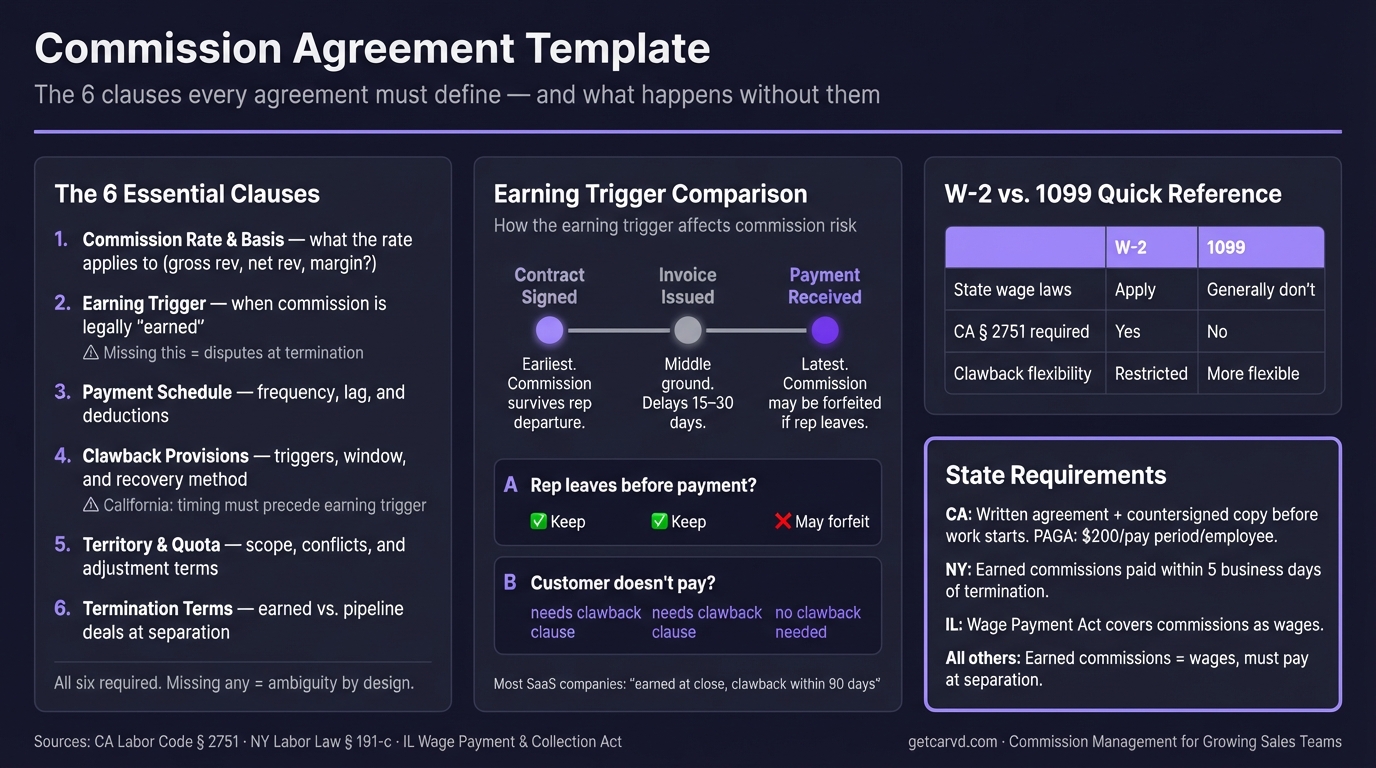
What this guide covers
This is the pillar resource for commission agreements at Carvd. It includes:
- A complete template for W-2 sales employees
- 1099 contractor variations for each clause
- State-specific requirements (California and New York in particular)
- Common drafting gaps and how to close them
For a focused clause-by-clause commentary without the template text, see our sales commission agreement guide. For a deep dive on contract language specifically for the template download format, see our sales commission agreement template post.
When a commission agreement is legally required
Two states have statutory requirements:
California (Labor Code Section 2751): Effective January 1, 2013, any employer paying commissions to employees working in California must have a written agreement specifying how commissions are computed and when they're paid, and must obtain a signed copy before work begins. California's Private Attorneys General Act (PAGA) allows reps to file claims on behalf of co-workers—making a single missing signature a class-action-scale exposure.
New York (Labor Law Section 191): Written commission agreements are required, and commissions must be paid within five business days of becoming payable.
In all other states, written agreements are not legally required—but commission disputes are governed by whatever written evidence exists. Verbal agreements, email threads, and offer-letter language all become evidence in a dispute. A signed agreement eliminates most of that ambiguity.
Commission agreement template (W-2 employees)
SALES COMMISSION AGREEMENT
This Sales Commission Agreement ("Agreement") is entered into as of [DATE], between [COMPANY NAME], a [STATE] [ENTITY TYPE] ("Company"), and [REPRESENTATIVE NAME] ("Representative").
1. Commission structure
The Company will pay Representative a commission of [X]% of [Net Invoiced Revenue / Gross Revenue / Collected Cash] for each qualifying sale closed during the term of this Agreement.
"Net Invoiced Revenue" means the total invoice amount, excluding applicable taxes, shipping, installation fees, and any discounts exceeding [X]% that were not approved in writing by [TITLE].
Where tiered rates apply, the following schedule governs:
- $0–$[THRESHOLD 1]: [X]%
- $[THRESHOLD 1]–$[THRESHOLD 2]: [X]%
- Above $[THRESHOLD 2]: [X]%
Accelerators: Upon achieving [X]% of quarterly quota, the applicable rate increases to [X]% on all revenue earned that quarter, applied retroactively from dollar one.
What to customize: Specify the revenue basis exactly. "8% of revenue" creates disputes on every deal with a discount or implementation add-on. If you use tiered rates, state whether thresholds reset quarterly or annually. The commission plan builder lets you model flat, tiered, and accelerator structures before codifying them in the agreement — so you know the economics work before reps sign.
1099 variation: The structure clause is largely identical for independent contractors. However, also specify: "All commissions under this Agreement constitute the total compensation due Representative for services rendered. No employment benefits, expense reimbursements, or other compensation applies unless separately stated in writing."
2. When commission is earned
Commission is deemed earned when [CHOOSE ONE]:
Option A (Invoice-based): The customer's invoice has been paid in full and the payment has cleared.
Option B (Contract-based): The customer has signed a binding contract and the deal has been entered as Closed-Won in the Company's CRM system.
Option C (Milestone-based): The customer has accepted delivery of [PRODUCT/SERVICE] as documented by [ACCEPTANCE CRITERIA].
Why this matters more than any other clause: The "earned" definition determines whether your clawback is enforceable, whether post-termination commissions are owed, and how courts interpret disputes. In Illinois, courts have struck down employer-favorable definitions that made earning depend on administrative timing the rep had no control over—effectively treating unpaid commissions as earned wages.
Choose Option A if you pay commission at invoice payment and have no clawback. Choose Option B if you pay at close but have a clawback window. Option C works for services businesses where delivery is the logical commission trigger.
1099 variation: No change to the clause itself. But note that for independent contractors, there is no wage protection floor—the contract definition of "earned" is the full extent of the rep's rights.
3. Payment schedule
The Company will process commission payments within [X] calendar days of the close of each [weekly / bi-weekly / monthly / quarterly] payment period.
Payment periods close on [SPECIFIC DATE(S)]. Commissions from deals closed or invoices paid after the cutoff date will be included in the following period.
The Company will provide a commission statement detailing the deals included in each payment within [X] business days of payment processing.
State minimums to know: California requires commissions to be paid at least twice monthly. New York requires payment within five business days of the date commissions become payable. If you have reps in either state, verify your payment cycle meets these requirements.
1099 variation: Replace "payment period" language with "invoice terms." Standard structure: "Representative will invoice the Company within [X] days of meeting the commission trigger. The Company will pay within [NET 30 / NET 15] of receiving a valid invoice."
4. Clawback provisions
If a commission-triggering event is reversed within [X] days of the original commission payment due to [customer cancellation / non-payment within [X] days / contract reversal / mutual agreement], the Company may recover the commission paid by [CHOOSE ONE]:
Option A (Future deduction): Deducting the amount from the Representative's next commission payment, with a maximum deduction of [X]% of any single payment.
Option B (Direct repayment): Requesting direct repayment within [X] days of written notice.
Clawbacks do not apply to cancellations caused by Company product failure, service issues, or breach of the Company's obligations under the customer contract.
California-specific requirement: California Labor Code Section 221 prohibits recovering earned wages. To have an enforceable clawback in California, structure it as recovery of an advance on commissions that were ultimately not earned—which requires the "earned" definition in Section 2 to place earning after the clawback trigger. If commissions are "earned at contract signature" but you want to claw back on customer cancellation, those two clauses conflict. California reps can challenge the clawback under Section 221.
1099 variation: Clawbacks are governed by pure contract law for independent contractors—no wage protection applies. The clause can be simpler: "If a commission payment is made on a deal that is subsequently reversed within [X] days, Representative agrees to refund the commission within [X] days of written notice."
5. Territory and account definition
Representative is assigned the following territory: [GEOGRAPHIC DESCRIPTION — e.g., "the states of California, Oregon, and Washington" or "named accounts as listed in Exhibit A"].
This territory assignment is [exclusive / non-exclusive]. [If exclusive:] No other representative or direct channel will be credited for deals sourced from this territory during the term of this Agreement.
Any account not included in the territory definition above requires written approval before Representative pursues it. Commission on unapproved accounts will not be paid without prior written authorization.
Why specifics matter: Vague territory definitions ("the West Coast," "enterprise accounts") are the most common source of split-credit disputes. When two reps work the same account, the agreement is the first document finance reviews. If it doesn't answer the question, the dispute takes weeks.
6. Split-credit rules
For deals involving multiple representatives or sales roles, credit will be allocated as follows:
- SDR/BDR sourced deals: [X]% to SDR, [X]% to Account Executive
- Co-sell deals (two AEs): [X]% each, or as agreed in writing before deal close
- Overlay/specialist involvement: [X]% to primary AE, [X]% to specialist
All split agreements must be documented in the CRM before the deal closes. Disputes over split credit must be raised within [X] business days of commission payment and will be resolved by [MANAGER TITLE] in accordance with Section 9.
1099 variation: Same language applies. For multi-contractor deals, also specify: "Split credit agreements must be documented in a written amendment to this Agreement, signed by all parties, before the deal closes."
7. Post-termination commissions
Upon termination of this Agreement (voluntary or involuntary), the following terms apply:
Commissions on closed deals: All commissions earned under Section 2 on deals closed before the termination date will be paid on the normal payment schedule.
Pipeline commissions: [CHOOSE ONE]
Option A (No pipeline commissions): Representative is not entitled to commission on deals that close after the termination date, regardless of pipeline contribution.
Option B (Partial pipeline commissions): Representative is entitled to commission on deals that close within [X] days of termination, at [X]% of the standard rate, provided Representative was the primary rep of record at termination.
Minimum tenure: To receive commissions on deals closed in the final [X] days of the term, Representative must have been employed or engaged for a minimum of [X] days.
Courts interpret silence as entitlement. When post-termination language is missing, courts in most states default to the interpretation most favorable to the rep. If you intend to pay nothing on pipeline deals that close after departure, that must be explicit.
1099 variation: The same logic applies. Also add: "This clause constitutes the complete agreement on post-termination compensation. Representative waives any claim to prospective commissions not explicitly covered above."
8. Dispute resolution
Representative may formally dispute a commission calculation by submitting written notice to [TITLE] within [X] business days of receiving the commission statement.
The Company will respond in writing within [X] business days with either a corrected calculation or a written explanation of the original calculation.
If the dispute is not resolved within [X] business days of the Company's response, either party may escalate to [MEDIATION / ARBITRATION / LEGAL ACTION] in [JURISDICTION].
Pending resolution of a dispute, commission payments not in dispute will be paid on the normal schedule. Payment of disputed amounts may be held pending resolution.
9. Modification and amendment
The Company may modify commission rates, territories, or plan structure with [30] calendar days' written notice. Modifications apply prospectively only—commissions earned under prior terms are paid on the original schedule.
Material changes require Representative's written acknowledgment before taking effect. Continued work after the notice period constitutes acceptance of the modified terms.
10. Governing law
This Agreement is governed by the laws of the State of [STATE]. Any disputes arising under this Agreement will be resolved in [COUNTY, STATE], unless applicable state law requires otherwise.
If Representative works primarily in a state other than [STATE], the mandatory wage and commission laws of Representative's state of work supersede this Agreement to the extent they provide greater protections.
Critical: Choosing your home state's law doesn't override California or New York's mandatory commission statutes for reps working in those states. You can designate governing law, but California reps still get California protections.
11. Entire agreement
This Agreement, together with any attached exhibits, constitutes the entire agreement between the parties regarding commission compensation and supersedes all prior verbal or written representations. Amendments require written signatures from both parties.
SIGNATURES
Company: _________________________________ Date: __________ Name: [NAME] Title: [TITLE]
Representative: _____________________________ Date: __________ Name: [NAME]
(California only: I acknowledge receipt of a copy of this Agreement.)
W-2 vs 1099: The key differences
| Clause | W-2 Employees | 1099 Contractors |
|---|---|---|
| When earned | Courts apply wage law; vague language favors rep | Contract definition is final |
| Payment timing | State minimums apply (CA: twice monthly; NY: 5 days) | Invoice-based; net 30/15 standard |
| Clawbacks | Must be structured as advances, not wage deductions | Pure contract law; straight repayment permitted |
| Post-termination | Earned wages must be paid; silence favors rep | Contract definition governs entirely |
| Dispute resolution | State labor boards available as alternative | Contract arbitration/mediation only |
One additional 1099 risk: any agreement that defines working hours, requires specific methods, provides equipment, or creates economic dependence can support a misclassification claim. If your contractor agreement starts to look like an employment agreement, that's a legal problem independent of commissions.
State-specific requirements summary
California: Written agreement required before work begins. Twice-monthly payment minimum. Clawbacks must be structured as advances. PAGA exposure on missing signatures.
New York: Written agreement required. Payment within five business days of becoming payable. Commissions are wages—deductions require explicit written authorization.
Illinois: No statutory written agreement requirement, but Illinois courts have struck down employer-favorable "earned" definitions that made payment depend on factors outside the rep's control. The Illinois Sales Representative Act also provides for punitive damages up to three times the commissions owed, plus mandatory attorney fees, for willful non-payment.
Texas: No statutory commission agreement requirement, but the Texas Sales Representative Act protects independent contractors—commissions owed at termination must be paid within 30 days, and violations trigger treble damages and attorney fees.
All states: If your reps work across multiple states, the governing law clause should specify which state applies—but cannot override mandatory protections in the state where the rep actually works. Get multi-state agreements reviewed by employment counsel.
Common gaps that turn agreements into liabilities
No "earned" definition: Drafting a detailed clawback provision without defining when commission becomes earned is like building a clawback on no foundation. The two clauses must work together. A dispute resolution workflow helps when reps challenge clawbacks, but it can't fix a gap in the agreement itself — the "earned" definition has to be airtight before any disputes arise.
Gross vs. net ambiguity: "Commission on revenue" without specifying whether discounts, taxes, or partner fees are excluded means two people reading the same agreement will calculate different payouts from the same deal.
Missing California signature: The statute requires the rep to sign and receive a copy. Companies that implement agreements by email acknowledgment—rather than signed copy—lose their statutory compliance.
No modification notice period: Plans change. Without a required notice period, companies are exposed to claims that midcycle changes were implemented without adequate notice.
Territory described informally: "The Southeast" or "enterprise accounts" in a territory clause creates guaranteed disputes when two reps overlap. Tools like Visdum or ElevateHQ offer territory-aware commission tracking, but for most teams the fix starts with precise language in the agreement itself.
Using software to track agreement terms alongside calculations
An agreement defines the rules. Commission software applies them. When these two things live in separate systems—a signed PDF somewhere and a spreadsheet with the actual math—discrepancies accumulate silently.
Carvd stores plan terms alongside deal-by-deal calculations, so reps can see exactly how their payout was derived from the rules in their agreement. When a rep disputes a calculation, the audit trail shows which plan version applied, which deals were included, and how the math was done—before the dispute escalates to the agreement itself.
For teams that have outgrown spreadsheets, that's where commission disputes stop.
Related reading:
- Sales Commission Agreement: What Every Plan Should Include
- Sales Commission Agreement Template (Free Download)
- Sales Rep Agreement Template: Commission Terms & Clauses
- Commission Clawbacks: When to Use Them (And When Not To)
- Sales Commission Structure: Types, Examples & How to Choose
- Draw Against Commission: How It Works (With Examples)
Last updated: March 22, 2026