Sales Commission Agreement: What Every Plan Should Include
A sales commission agreement protects both reps and companies—but only if it covers the right clauses. Here's what every agreement needs, plus state-specific requirements.
Most commission disputes don't happen because someone did the math wrong. They happen because no one wrote down the rules before the deal closed.
A sales commission agreement is the written contract that defines how variable pay works: what triggers a commission, how it's calculated, when it's paid, and what happens when something goes sideways. Without one, you're relying on verbal agreements, email threads, and shared assumptions—none of which hold up when a rep disputes a number or a company tries to claw back a payment.
Here's what every sales commission agreement needs to include, and where companies typically leave gaps that turn into expensive problems.
What a sales commission agreement is (and isn't)
A sales commission agreement is a binding contract between a company and a sales rep that governs variable compensation. It doesn't replace the offer letter or employment agreement—it supplements them with the specific terms of how commissions are earned and paid.
It's different from an offer letter, which states OTE. Different from a comp plan document, which describes the structure in general terms. The commission agreement is the legally operative document that a rep signs before they start working a territory or closing deals.
In California, that distinction matters legally. California Labor Code Section 2751—effective since January 1, 2013—requires employers to provide a written commission agreement describing both the method by which commissions are calculated and paid, and to obtain a signed copy before work begins. New York Labor Law Section 191 has parallel requirements. Missing this step in either state exposes companies to wage claims from day one.
The core clauses every agreement needs
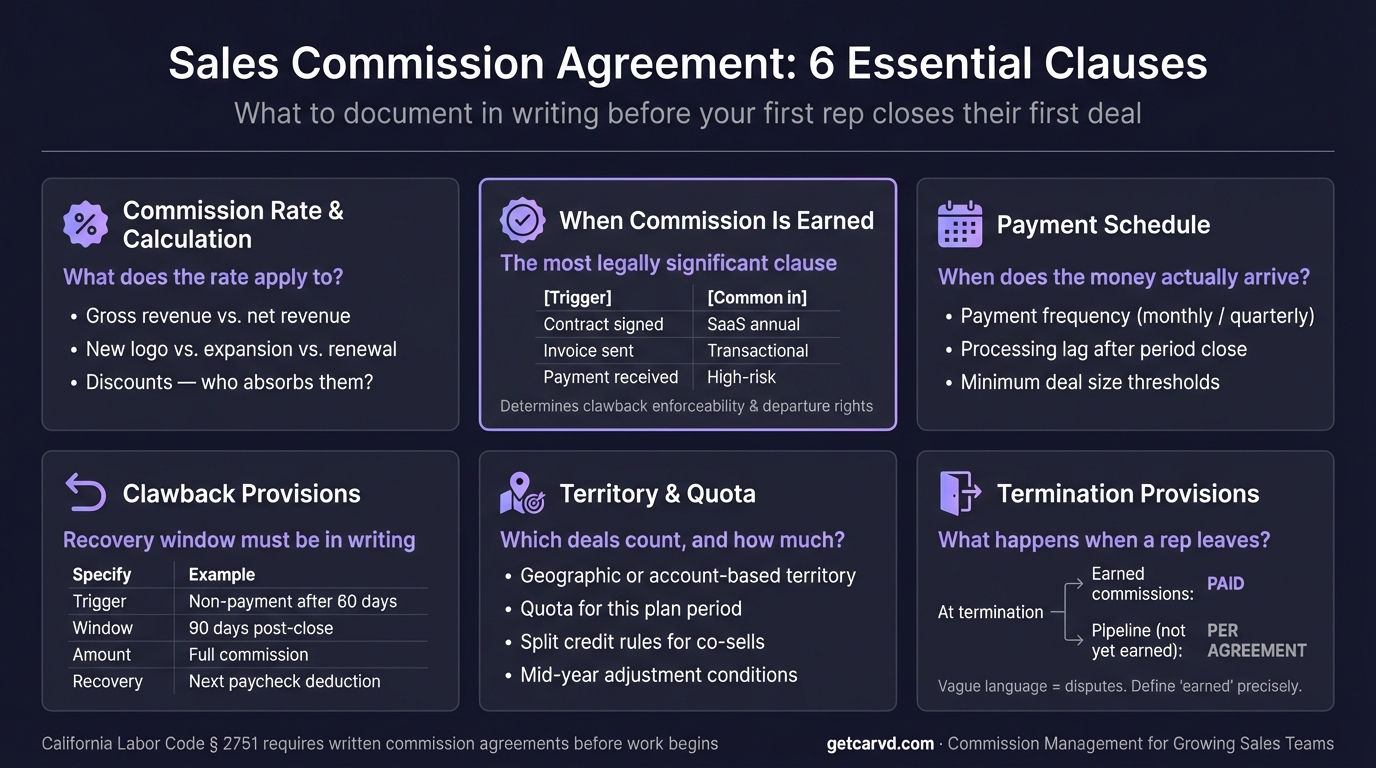
1. Commission structure and calculation basis
This is the section most companies treat as obvious—but specifics here prevent most disputes.
State clearly:
- The commission rate or amount
- What the rate applies to: gross revenue, net revenue, gross profit, or collected cash
- How tiered accelerators work if applicable (exact thresholds, not ranges)
- Whether bundled deals split at list price or contract price
"8% of revenue" isn't enough. "8% of net invoiced revenue, excluding taxes, implementation fees, and any discounts greater than 15% not approved in writing" is a commission structure. The difference shows up when the first deal includes a negotiated discount. Testing these definitions against actual deal data using the commission calculator before the agreement is signed catches ambiguity that plain reading misses.
2. When commission is "earned"
This single clause determines whether your clawback provision is enforceable and whether your post-termination terms hold up in court.
Commission is typically deemed earned at one of three points:
- At contract signature (most rep-friendly, most employer risk)
- At invoice payment (eliminates most clawback scenarios but delays rep income)
- At a defined milestone: delivery, customer acceptance, or first renewal
Courts in Illinois have rejected employer-side "not earned until paid" definitions when companies tried to use them to deny commissions to reps who departed before a check was cut. The Sutula-Johnson v. Office Depot case is the most cited example—the company's definition of "earned" was struck down because it made payment depend on administrative timing the rep had no control over.
Define earning clearly. Tie it to something the rep can influence.
3. Payment timing and schedule
Most states have wage payment frequency requirements that apply to commissions. In California, commissions must be paid at least twice monthly. In New York, they're due within five business days of becoming payable.
The agreement should specify:
- Payment schedule (monthly, bi-weekly, quarterly)
- How long after the triggering event payment is issued
- What documentation the company requires to process payment (closed-won in CRM, signed contract, paid invoice)
"Commission will be paid within 30 calendar days of the customer's invoice being paid in full" is clear. "Commission will be paid at the end of each quarter" is not—it doesn't say which quarter, or which deal cycle it applies to.
4. Clawback provisions
If you pay commission at deal close and deals can fall through, you need a clawback clause—and it needs to be explicit to be enforceable.
The clause should specify:
- What triggers the clawback (customer cancellation, non-payment within X days, contract reversal)
- The clawback window (how long after close the trigger can occur)
- Whether the recovery is full or pro-rated
- How the recovery happens: deduction from future commission, payroll deduction, or invoice to the rep
In California, Labor Code Section 221 prohibits reclaiming "earned" wages. The way around this is to structure clawbacks as recovery of advances on commissions that weren't ultimately earned—which means the "when earned" clause in section 2 directly affects whether your clawback is enforceable. These two provisions work together.
For a deeper look at clawback structure options, see our commission clawback guide.
5. Territory or account definition
If your team sells in defined territories or named accounts, specify them exactly. Geographic boundaries should be stated in legal terms (states, metro areas, or specific counties)—not described loosely as "the Southeast" or "enterprise accounts."
State whether the territory is exclusive (no other rep or direct channel can sell there during the agreement term) or non-exclusive. Undefined territory rights are a leading source of split-credit disputes when two reps work the same account.
6. Split-credit rules
For deals involving multiple reps—an SDR, an AE, and an SE working the same opportunity—the agreement needs to define how credit is allocated. Options include:
- Defined percentage splits by role
- Manager-discretion allocation
- Equal split among contributors
- Winner-take-all based on primary ownership
Leaving this out means every multi-rep deal becomes a negotiation after the fact. That's how $4,200 vs. $3,800 disputes start.
7. Post-termination treatment
When a rep leaves—voluntarily or otherwise—what happens to deals they were working?
The agreement should address:
- Whether commissions on deals closed before departure are paid on schedule
- Whether commission is owed on deals in pipeline that close after departure
- Whether a minimum tenure requirement applies (e.g., rep must be employed on the payment date to receive that payment)
Courts in most states will enforce post-termination commission provisions if they're clear and not unconscionable. Courts will also frequently side with the rep on vague or missing language—treating silence as entitlement to earned commissions.
8. Dispute resolution process
Before mediation, arbitration, or litigation, most commission disputes are solvable if there's a defined internal process. A good agreement specifies:
- How a rep formally disputes a commission calculation
- Timeline for company response
- Escalation path if the first response is unsatisfactory
- Whether disputes pause payment or proceed in parallel
Rep turnover correlates strongly with compensation trust. Sales rep annual turnover runs around 35%—nearly three times the 13% cross-industry average, according to Everstage's analysis of Bureau of Labor Statistics data. Disputes that fester because there's no clear resolution path contribute directly to that number. A dispute resolution workflow with audit trails gives both parties a structured process — and the documentation to resolve escalations quickly.
9. Modification clause
Commission structures change. Plans get updated, accelerators get adjusted, new products get added to the comp plan. The agreement needs to address the company's right to modify terms—and the rep's right to notice.
Standard practice:
- 30 days written notice for material changes
- Changes apply prospectively only (not to deals already in pipeline)
- Rep acknowledgment required before changes take effect
Modifying commission rates mid-cycle without notice is legally risky in states with wage payment protections, and practically risky regardless—it's the fastest way to destroy rep trust.
Common gaps that lead to disputes
No "earned" definition: Companies draft detailed clawback provisions but never define when commission becomes earned. Without that anchor, courts have wide discretion.
Gross vs. net ambiguity: The agreement says "commission on revenue" but doesn't specify whether discounts, taxes, or partner fees are subtracted first. Two reps calculating their own commissions get different answers from the same deal.
Missing signature: California requires the rep to sign and receive a copy of the agreement. Companies that implement agreements verbally or by email acknowledgment lose their statutory compliance.
Plan docs without signatures: A commission plan document distributed to the sales team is not an agreement. It's a document. The agreement is the signed contract. They're different things. The commission plan builder helps you design the plan structure first, so the agreement language maps directly to the calculation logic your team will use.
No post-termination clause: Silence here means the rep—and their attorney—get to argue for the most favorable interpretation.
State-specific requirements to know
California: Written agreement required before work begins (Labor Code Section 2751). Commissions due twice monthly. Clawbacks must be structured as recovery of advances, not deduction of earned wages. California's Private Attorneys General Act (PAGA) allows reps to sue on behalf of co-workers, creating class-action-scale exposure from one dispute.
New York: Written agreement required (Labor Law Section 191). Commissions due within five business days of becoming payable. Earned commissions are wages—deductions require explicit written authorization.
Illinois: No statutory requirement for written agreements, but courts have struck down employer-favorable definitions of "earned" when they appeared designed to delay or deny payment.
All states: If you have reps in multiple states, the agreement should specify which state's law governs and where disputes will be resolved. Don't assume your home state's law applies to a rep working from a different state.
Tracking agreements alongside commission calculations
The agreement defines the rules; the commission calculation applies them. For most companies, these two things live in different systems—the agreement is a PDF, the calculation is a spreadsheet—which means discrepancies accumulate quietly.
Carvd stores plan terms alongside deal-by-deal calculations, so reps can see exactly how their number was derived and flag discrepancies before they become disputes. The agreement defines the framework; the software runs the numbers.
For the full template with clause-by-clause guidance, see our commission agreement template guide.
Related reading:
Last updated: March 22, 2026