Pay for Performance: Does It Actually Work in Sales?
Pay for performance increases sales output by 22% on average — but only when designed correctly. Here's what the research says and how to avoid the traps.
Pay-for-performance is one of the oldest ideas in sales compensation: tie a portion of rep pay to results, and reps will work harder to hit them. The Incentive Research Foundation's meta-analysis of 45 studies found that properly implemented incentive programs increase performance by an average of 22%. Team-based programs can raise that to 44%.
Those numbers explain why pay-for-performance is nearly universal in sales. According to the Alexander Group's 2024 Sales Compensation Trends Survey of more than 300 companies, 71% of organizations are actively emphasizing pay-for-performance approaches in their comp plans.
But the same survey found that only 19% of companies rate their compensation plans as highly effective. The idea works. Most implementations don't.
What pay for performance means in sales
Pay for performance in sales means that a meaningful portion of a rep's total compensation varies based on output — deals closed, revenue generated, or quota attainment. The fixed base salary is guaranteed; the variable portion is earned.
The ratio of base to variable is called pay mix. Alexander Group benchmarks pay mix by role type:
| Role | Typical pay mix (base/variable) |
|---|---|
| Hunter / new business AE | 50/50 |
| Inside sales AE | 70/30 |
| Field / enterprise AE | 60/40 |
| Account Manager (renewal) | 75/25 |
| Sales Manager | 70/30 |
Bridge Group's 2024 SaaS AE Metrics Report found the median SaaS AE OTE at $190,000 with a 53:47 base-to-variable split — nearly equal weighting for a full-cycle role.
The variable portion is typically structured as:
- Commission: A percentage of deal value paid on close, calculated deal-by-deal
- Accelerators: Higher commission rates that kick in after quota is hit — often 1.5x–2x the standard rate above 100%
- Annual bonus: A lump-sum payment tied to year-end attainment or company goals
- SPIFFs: Short-term incentives for specific products, behaviors, or time windows
For how these structures combine into a full comp plan, see the sales incentive plan guide.
The evidence that it works
The research case for pay-for-performance in sales is strong. Misra and Nair's field study, published in HBR in 2015, found that removing commission caps at one company was projected to increase revenue by 8%. After implementation, revenue rose 9% the following year.
Bain & Company found that companies expanding their bonus pools to reward top performers in select accounts booked an additional 14% of operating profit in the first year.
The Alexander Group's 2024 data includes a manufacturing case study where implementing a 60/40 pay mix with individual revenue focus drove a 25% productivity increase and 15% reduction in turnover over three years.
The mechanism isn't mysterious: when reps can calculate their own earning potential and trust that closing deals will move that number, motivation is self-sustaining. Commission plans give reps a real-time score. That's what makes them different from annual bonus programs, which pay out long after the work was done.
For the commission mechanics to hold, Xactly's data shows that companies paying at or above the 75th percentile of market see 50% less rep turnover — meaning the P4P model only works if the earning potential is real, not theoretical.
When it doesn't work
The gap between the 22% performance lift in IRF's research and the 19% of plans rated effective in the Alexander Group survey has a few clear explanations.
Commission caps
Capping commissions is one of the most reliably damaging plan design decisions. A Qobra and Modjo study of French sales organizations found that 74.1% of employees with capped commissions failed to meet their targets, while over 37% of employees with uncapped commissions exceeded them.
The mechanism is straightforward: once a rep hits their cap, further closing effort has zero financial upside. The logical response is to stop closing until the next period resets.
Quota inflation and the ratchet effect
The second major failure mode is quota setting. ICONIQ Growth research found that 58% of companies over-assign quotas, typically by 20–30%. When quotas are unrealistic, reps can't reach the part of the commission curve where pay-for-performance actually pays.
RepVue's Q4 2024 aggregate data shows overall quota attainment at 43.14% across tracked sales roles. When fewer than half of reps hit quota in a given period, the motivational premise of P4P collapses.
The ratchet effect compounds this. Harvard economist Martin Weitzman documented what happens when companies raise quotas after a rep exceeds them: reps learn to sandbag, deliberately holding back deals to avoid inflated future targets. Lab experiments confirmed substantial ratchet effects, and the pattern is widely recognized in sales compensation research.
Gaming high-powered incentives
Larkin's 2014 study in the Journal of Labor Economics analyzed enterprise software sales and found that high-powered incentives caused reps to game deal timing — agreeing to significantly lower pricing in quarters when they had financial incentive to close quickly. The estimated cost to the vendor was 6–8% of revenue.
The lesson isn't to abandon commission plans; it's that plans tied to a single metric like closed deals will be optimized for that metric, sometimes at the expense of deal quality, customer fit, or margin.
Complexity and metric overload
Pay-for-performance breaks down when reps can't calculate their own potential payout. If a comp plan requires a spreadsheet to model, it stops functioning as a motivator. Most compensation researchers recommend no more than 3–5 performance measures. Beyond that, the line of sight between effort and reward becomes too diffuse to influence behavior.
What separates plans that work
The research converges on a few consistent design principles.
Use accelerators instead of caps. Model different accelerator curves using the commission plan builder before rolling out to the team. Accelerators reward overperformance with multipliers — typically 1.5x–2x at 120% quota attainment — rather than cutting off earnings at a ceiling. This keeps top performers engaged without adding unlimited liability, since accelerators only pay out if the rep actually closes more.
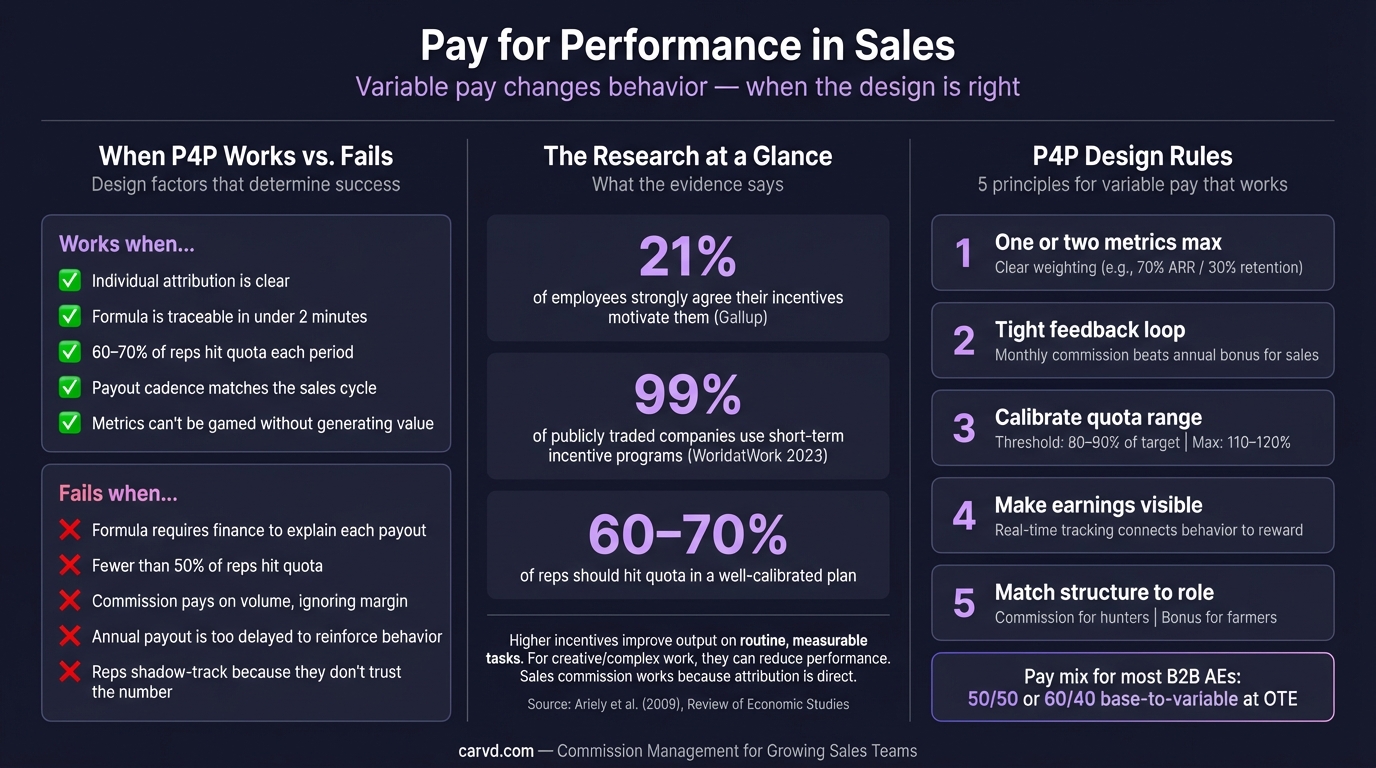
Set quotas at attainable levels. The IRF's research found that quota-based programs yield the strongest results among all incentive structures — but only when the quota represents a real performance bar. The standard benchmark is 60–70% of reps hitting quota in a given period. If attainment is consistently below 50%, the problem is usually quota design, not rep performance.
Segment incentives by performance tier. HBR field research found that accelerators are most effective at keeping top-quartile performers engaged, while quarterly bonuses are more motivating for lower performers who haven't yet hit annual quota. A single plan design doesn't optimize for both ends of the distribution.
Pay on time and show reps the math. Delayed payouts and opaque calculations undermine trust in the entire system. Carvd's rep dashboards give each rep a deal-by-deal view of their earnings so they always know where they stand. When reps don't know how their commission was calculated, they resort to building their own shadow tracking — burning selling time on an administrative task.
Tools like Carvd calculate commissions automatically and give reps a deal-by-deal breakdown of how their payout was derived, so the connection between closing and earning stays visible in real time.
Keep it simple. Every additional metric or exception clause is a place where reps lose track of how the plan works. The most effective plans are the ones reps can explain from memory.
Pay mix benchmarks by industry
Variable compensation weight varies by sector, since some industries have more individually attributable deals than others. SaaS and tech sales typically run higher variable weighting than professional services or manufacturing:
- SaaS AEs: 47–50% variable (Bridge Group 2024)
- Manufacturing field sales: 30–40% variable (Alexander Group)
- Financial services: 40–50% variable, regulated by FINRA in broker roles
- Healthcare / med device: 40–45% variable, often with product-specific accelerators
For commission rate benchmarks by industry and role, see the sales commission rates guide or use the commission rate benchmarks tool to look up rates for your segment.
The bottom line
Pay-for-performance works in sales. The research base is consistent: properly designed plans increase output, reduce turnover, and align rep behavior with company goals.
The failure cases have a common pattern — commission caps that kill top-performer motivation, inflated quotas that make variable pay theoretical, incentive designs that reward the wrong behavior, and plans too complex for reps to track.
The design decisions that matter most are simple: no caps, realistic quotas, accelerators that reward overperformance, and enough transparency that reps always know where they stand. When those four elements are in place, pay-for-performance does what it's supposed to do.
For the broader context on incentive compensation — what ICM software does, when spreadsheets break, and how to evaluate plans at scale — see the incentive compensation management guide.
Last updated: March 22, 2026