Incentive Compensation Management: The Complete Guide
What incentive compensation management is, why spreadsheets break, how to evaluate ICM software, and when to move from manual to automated commission tracking.
Incentive compensation management (ICM) is the process of calculating, tracking, and paying variable compensation — commissions, accelerators, bonuses, SPIFFs — to sales reps and other eligible employees. Most companies start doing this in a spreadsheet. Most eventually need something more.
The global sales performance management market was valued at $2.3 billion in 2023 and is projected to reach $4.4 billion by 2028, according to MarketsandMarkets — a 13.6% compound annual growth rate. That growth is driven almost entirely by companies deciding that manual commission management doesn't scale.
This guide covers what ICM actually is, why spreadsheets break, what to look for in ICM software, and how to evaluate the market — including where enterprise tools are overkill and where simpler software fits.
What incentive compensation management actually means
ICM is a category name that vendors use differently depending on their target market. At its core, it refers to three things:
- Plan design — defining who gets paid what, under what conditions, at what rate
- Commission calculation — applying those rules to actual deal data to produce accurate payouts
- Transparency and audit — showing reps how their commission was calculated, and giving finance a paper trail
ICM software automates the calculation layer and adds structure to the transparency and audit layer. The plan design layer — deciding what kind of commission structure makes sense for your team — is still a human judgment call. Software doesn't design your plans. It implements and executes them accurately.
For a full overview of plan design decisions — tiered vs flat, draw against commission, accelerators — see the sales commission structure guide.
Why spreadsheets break
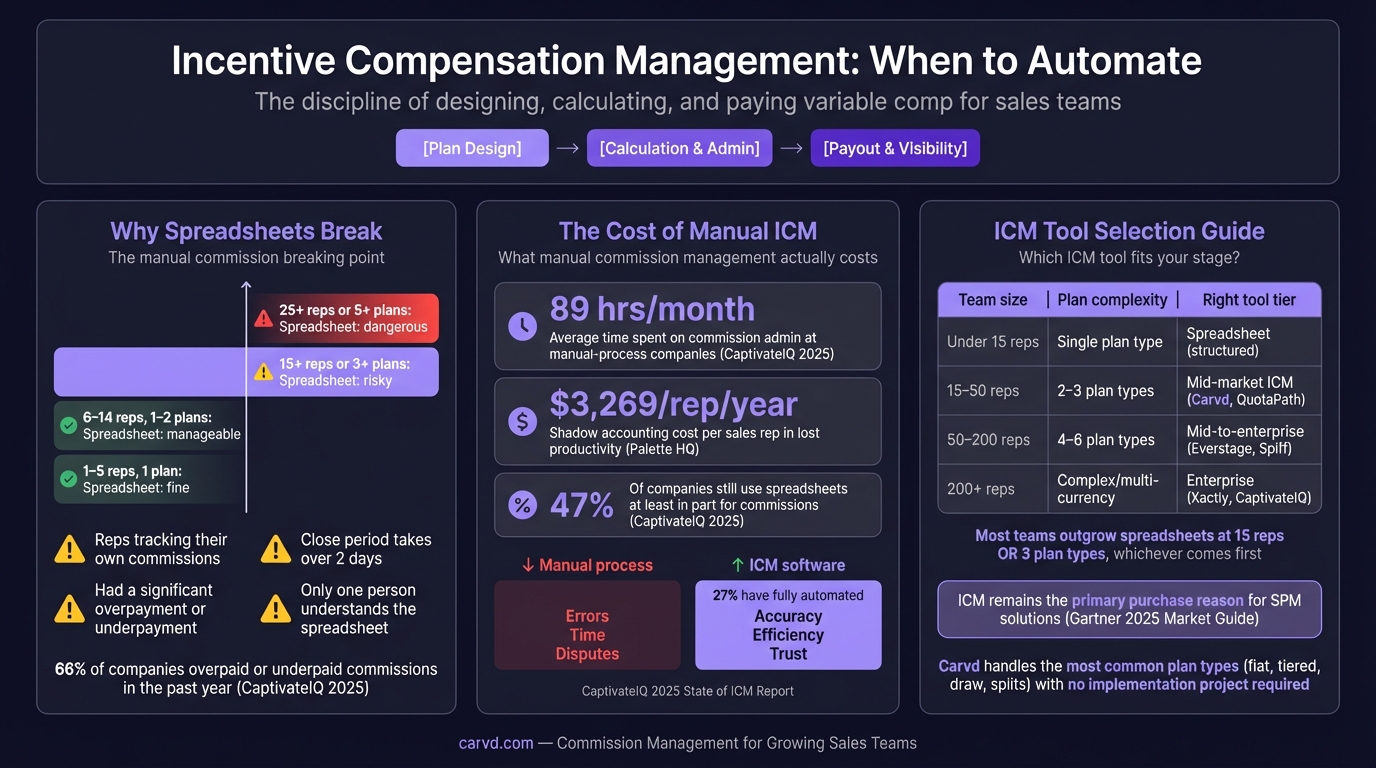
Spreadsheets work for commission management until they don't. The inflection point is usually 10–15 reps or 3+ plan types, whichever comes first.
Below that threshold, a single spreadsheet with clean deal data and one commission rate is manageable. A finance manager or sales ops lead can run the calculation in a few hours per pay period.
Above it, the problems compound:
Calculation errors. According to Xactly's 2024 Sales Compensation Report (surveying 230 RevOps, sales, and finance leaders), 70% of companies still use spreadsheets during the compensation plan design process — and 83% of those companies report missing the mark on commission accuracy at some point. At a 3% error rate, a $1 million annual commission pool has roughly $30,000 in mispaid commissions per year.
Time cost. Processing commission calculations manually for a 20-rep team with three plan types typically takes a full day or more per pay cycle. That's sales ops time spent on arithmetic instead of planning.
Plan complexity. Tiered commission structures, accelerators above quota, per-product rates, draw against commission, clawbacks — each adds a conditional rule that's straightforward in isolation but error-prone when combined in a spreadsheet with 20 reps and 400 deals.
Disputes. When reps can't see how their commission was calculated, they calculate it themselves. Shadow accounting — reps maintaining their own commission tracking spreadsheets to verify payouts — is a reliable indicator that trust in the commission process has broken down. Disputes that should take five minutes to resolve instead become a multi-day back-and-forth between sales, finance, and sometimes legal.
Auditability. Commission payments have accounting implications under ASC 606 (which requires capitalizing contract acquisition costs, including commissions, and amortizing them over the expected customer lifetime). A spreadsheet doesn't produce the audit trail that finance or external auditors need. For a deeper look at the accounting side, see the commission accounting guide.
What ICM software does
ICM software replaces the spreadsheet in the calculation layer. Here's what that looks like in practice:
Deal import. The software connects to your CRM (HubSpot, Salesforce, Pipedrive) or accepts a CSV of closed deals. Fields like deal value, close date, rep name, and product category are mapped once; the import runs automatically each period.
Plan configuration. Commission rules are set up inside the software using a comp plan builder: which rep is on which plan, what rate applies to what deal tier, when accelerators kick in, what the quota is. Once configured, the software applies these rules consistently to every deal — no formula errors, no misapplied rates.
Calculation and statements. The software calculates the payout for every deal and produces a commission statement showing each rep exactly how their number was derived: this deal, this amount, this rate, this payout. Reps don't need to verify the math themselves because the math is visible.
Dispute workflow. If a rep believes a deal was miscalculated, they can flag it directly in the software. The dispute creates a record, gets reviewed by sales ops or finance, and gets resolved with an audit trail — rather than a thread of Slack messages.
Payroll export. The final commission amounts export in a format payroll can use — CSV, spreadsheet, or direct integration — reducing the manual transcription step between commission calculation and payment. Carvd's payroll export generates payroll-ready CSV and PDF statements in one click.
Reporting. ICM software gives managers visibility into team-level payouts, quota attainment, and incentive cost as a percentage of revenue. This is the layer that spreadsheets almost never provide without significant manual work.
The build-vs-buy decision
"Build" in this context usually means extending the existing spreadsheet — adding complexity, adding tabs, adding formulas — rather than developing custom software. For most companies, this isn't a real alternative.
The calculus:
| Factor | Spreadsheet | ICM software |
|---|---|---|
| Setup time | Immediate | Hours to weeks depending on plan complexity |
| Cost | None (licensing) | $49–$199/mo (SMB) to $100K+/yr (enterprise) |
| Error rate | High for complex plans | Low |
| Scalability | Breaks with complexity | Designed for it |
| Rep transparency | Manual, if at all | Built-in statements |
| Audit trail | None | Full history |
| Dispute handling | Email/Slack threads | Structured workflow |
The case for staying with a spreadsheet: your team is under 10 reps, you have one or two plan types, no accelerators, and a sales ops person who owns the process end to end. At that scale, the cost of software is hard to justify against the time it saves.
The case for moving to software: anything above that. Three plan types is usually enough complexity to start making errors. A single commission dispute that drags into the second week of the month is already costing more than the monthly software fee.
What to look for when evaluating ICM software
Not all ICM tools are the same. The market splits broadly into enterprise, mid-market, and SMB categories — and the right tool depends heavily on which segment you're in.
Plan complexity support
The most important question is whether the software can represent your actual plan. Most ICM tools handle flat-rate commission and basic tiered structures. Fewer handle:
- Per-product commission rates (different rates for different SKUs or product lines)
- Overlapping territories (multiple reps crediting the same deal)
- Multi-currency commission payouts
- MBO (management by objective) components alongside revenue commission
- Clawback tracking over rolling windows
If you're running a single-rate flat commission, almost any tool works. If you have accelerators, splits, and per-product tiers, evaluate whether the software can actually model your plan before you commit.
Rep transparency
ICM software that shows reps their total commission without showing how it was calculated doesn't eliminate shadow accounting — it just makes the shadow spreadsheets harder to maintain. Look for deal-by-deal breakdowns: this deal, this rate, this payout. Reps should be able to trace every dollar back to a specific transaction.
Calculation speed and frequency
Some ICM tools run calculations nightly or require manual triggers. Others update in real time as deals close. For rep motivation, real-time or near-real-time updates matter — reps who can see their commission number move when they close a deal are more engaged with the variable pay model.
Dispute handling
How does the software handle when a rep disputes a deal? Look for a structured workflow with a record of what was disputed, who reviewed it, what the resolution was, and what changed. A system that routes disputes through external email or Slack is not a dispute system — it's a documentation failure waiting to happen.
CRM and payroll integrations
Native connections to HubSpot, Salesforce, or Pipedrive reduce import friction. Payroll integrations (or clean CSV export) reduce the transcription step between commission calculation and payment.
Implementation time
Enterprise ICM tools like Xactly and CaptivateIQ typically require four to six months to implement, involving consultants and custom configuration. Mid-market and SMB tools should be live within days to weeks. If a vendor quotes an implementation timeline in months for a 20-rep team, that's a signal they're selling you more tool than you need.
The ICM market: a practical breakdown
The incentive compensation management market covers a wide range. Here's how the main tiers break down as of early 2026:
Enterprise tools
Xactly Incent — One of the oldest purpose-built ICM platforms. Strong in compliance-heavy organizations (public companies, financial services). Enterprise pricing, multi-month implementations. ISG's 2024 Buyers Guide ranked it among the top enterprise ICM vendors.
CaptivateIQ — Named a Leader in Forrester's Wave for Sales Performance Management Solutions for Incentive Compensation (Q1 2025). Handles complex enterprise plan types with a lower-code interface than Xactly. Still requires implementation support and is primarily enterprise-priced.
Salesforce Spiff — Acquired by Salesforce in 2023. Designed to work within the Salesforce ecosystem. Best fit for companies already deeply invested in Salesforce infrastructure.
Oracle and SAP CallidusCloud — Large enterprise platforms where commission management is one module among many. Appropriate for organizations that need ICM as part of a broader ERP or HCM stack.
Mid-market tools
Everstage — Named a Strong Performer in Forrester's Q1 2025 Wave. Covers mid-market commission complexity with a modern interface. Good option for teams moving up from spreadsheets who have more plan complexity than SMB tools handle.
Performio — Strong in companies with complex plan structures and multi-currency requirements. Mid-market pricing, faster implementation than enterprise tools.
ElevateHQ — Modern mid-market tool with a focus on rep-facing transparency. Strong commission calculation and statement features.
SMB tools
QuotaPath — No minimum user requirement, published pricing, sub-six-week onboarding. Good fit for SMB sales teams wanting to move off spreadsheets without enterprise overhead.
Commissionly — SMB-focused with residual commission support. Strong for teams with recurring revenue models.
Carvd — Flat-rate pricing (starting at $49/month), designed for teams of 5–25 reps. Imports deals from HubSpot, Pipedrive, or CSV, handles tiered and per-product plans with accelerators, and gives reps deal-by-deal commission statements. Setup under an hour. Good fit for startups and growth-stage companies that have outgrown spreadsheets but don't need enterprise complexity.
The honest assessment: Carvd doesn't handle multi-currency, territory overlaps, or MBO components. If you have 200+ reps with complex quota modeling and multi-region territory management, CaptivateIQ or Xactly is the right answer. If you have 10–25 reps on straightforward plans who need fast setup and rep-facing transparency, Carvd is built for that.
When to involve sales ops vs finance in ICM selection
ICM touches two teams with different priorities, and the friction between them is often where implementation goes wrong.
Sales ops cares about plan flexibility, rep transparency, and calculation accuracy. They want to be able to update a plan structure without a support ticket, see what a plan change will do to payouts before it goes live, and resolve disputes without a multi-day back-and-forth.
Finance cares about close-cycle time, audit trail, and payroll accuracy. They need to reconcile commission payouts, handle clawbacks and adjustments, and produce the ASC 606 accounting documentation that external auditors expect.
Both teams should evaluate ICM software together. A tool that sales ops loves but finance can't audit is a tool finance won't approve. A tool finance can close books on but sales ops can't administer without IT help will never be configured correctly. When presenting your ICM software recommendation to the board, Deckary builds consulting-grade decks.
Plan governance: what ICM software doesn't solve
ICM software automates the calculation of your existing plan. It doesn't solve problems with the plan itself.
Common plan design problems that software makes worse, not better:
Unrealistic quotas. If quota attainment is consistently below 50%, the problem is the quota, not the calculation engine. Adding ICM software to an unrealistic quota just makes the shortfall more visible. For context on what healthy attainment looks like, see the pay for performance guide. The commission rate benchmarks tool can help you calibrate rates against industry norms.
Too many plan types. Some companies have eight or ten different commission plans across their sales team. ICM software can manage this, but managing ten plan variants in software is still more complex than three. Software is not a reason to avoid plan simplification.
Plans that change mid-period. Changing commission plan rules after a period has started creates a reconciliation problem regardless of what software you're using. A good ICM evaluation process should surface how the tool handles mid-period plan changes — and prompt a conversation about whether those changes are necessary.
Incentive compensation management and plan transparency
The relationship between ICM and rep trust is the most underrated part of this category.
Shadow accounting — reps building their own commission tracking spreadsheets to verify payouts — is a symptom of distrust, not a data quality problem. Reps who don't trust that finance will pay them correctly will always verify independently. The time they spend on shadow accounting is time they're not selling.
ICM software that gives reps a deal-by-deal breakdown eliminates the need for shadow spreadsheets. When a rep can open the software after closing a deal and see exactly what that deal is worth — at current rate, with accelerators applied, net of any clawbacks — there's nothing to verify independently.
This is the compounding benefit of ICM software that most ROI calculations undercount: the selling time recaptured by removing shadow accounting from the rep's workflow.
Related reading
This guide covers ICM at the program level. For deeper dives into specific plan types and compensation topics:
- Sales Incentive Plan: Design, Benchmarks & Examples — how to structure incentive plans for sales roles
- Annual Incentive Plan: How to Design One That Drives Results — AIP design for non-sales and executive roles
- Pay for Performance: Does It Actually Work in Sales? — research on incentive plan effectiveness
- Employee Incentive Plan: A Practical Design Guide — broader incentive plan frameworks beyond sales
- Short-Term Incentive Plan: Design Guide with Benchmarks — STIP structure and metric design
- What Is a SPIFF in Sales? — short-term incentive mechanics
Related reading: Sales Commission Structure: Types, Examples & How to Choose · Variable Compensation: How It Works and When to Use It · On-Target Earnings: What It Means & How to Calculate It
Last updated: March 22, 2026