Employee Incentive Plan: Beyond Commission for Sales Orgs
An employee incentive plan covers more than commissions — bonuses, profit sharing, equity, recognition, and SPIFFs. Here's how to design one that actually motivates.
Most sales organizations have a commission plan. Fewer have a complete employee incentive plan — a coordinated system that covers how everyone from frontline reps to team leads gets rewarded for the right behaviors.
The distinction matters. Commission handles the individual deal-level calculation. An employee incentive plan handles everything else: quarterly goals, team behaviors, retention, specific product pushes, and performance at the edges of quota. Companies that treat commission as their entire incentive strategy end up with blind spots — behaviors that matter but aren't tracked, reps who close deals but ignore renewal health, and teams where overperformers and underperformers look similar on paper.
According to WorldatWork's 2023 Incentive Pay Practices Survey, 92% of organizations — including 93% of privately held companies and 99% of publicly traded ones — run short-term incentive programs. An employee incentive plan is the norm. The question is whether yours is designed intentionally or assembled from defaults.
What an employee incentive plan covers
An employee incentive plan is any structured program that ties pay or rewards to defined outcomes. For sales organizations, the complete picture typically includes:
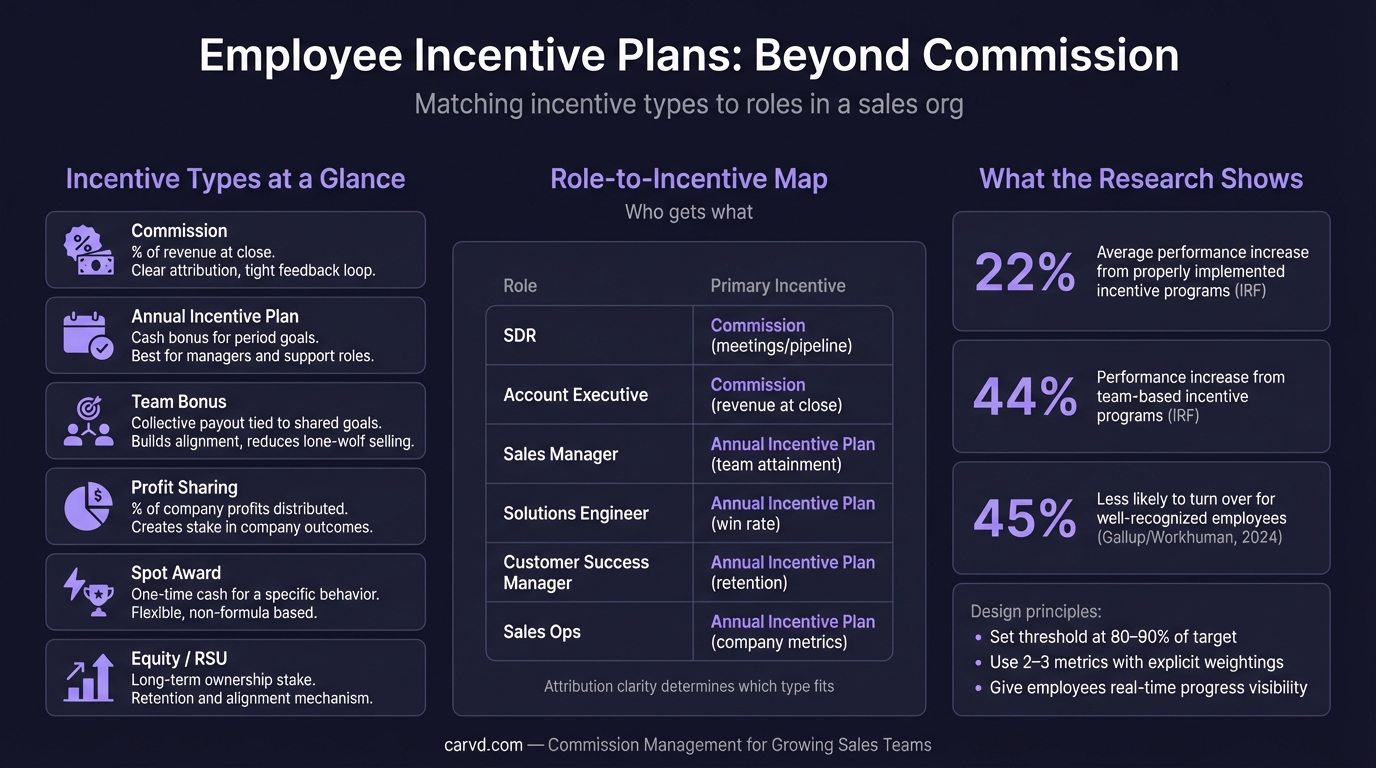
Commission — The primary variable pay mechanism for quota-carrying reps. Commission scales with individual deal volume, usually calculated monthly or quarterly. For a full breakdown of commission structures, see the sales commission structure guide.
Annual incentive plan (AIP) — A cash bonus paid at year-end for hitting company-level or individual performance goals. Common for managers, executives, and roles where individual deal attribution isn't the right measure. The annual incentive plan guide covers how to design goal-based AIPs that hold up.
SPIFFs — Short-term cash bonuses layered on top of regular commissions for specific behaviors: closing a new product line, booking demos in a target vertical, hitting a compressed quota within a defined window. SPIFFs are a surgical tool within the broader incentive plan, not a substitute for commission. See what is a SPIFF in sales for when they work and when they backfire.
Profit sharing — A share of company earnings distributed to employees, usually quarterly or annually. Roughly 44% of 401(k) plans include a profit-sharing component, per Plan Sponsor Council of America's 2024 annual survey. Profit sharing works best when employees have enough visibility into company financials to connect their behavior to the pool.
Equity — Stock options, RSUs, or performance shares that vest over 3–4 years. Relevant primarily for sales leaders and early employees at growth-stage companies. For most sales reps at SMBs, equity is secondary to cash incentives.
Recognition and non-cash rewards — Award points, travel, merchandise, and experiential rewards. The Incentive Research Foundation's 2024 report found that 84% of U.S. businesses spend a combined $176 billion annually on non-cash reward programs. Gallup's 2024 research with Workhuman found that well-recognized employees are 45% less likely to have turned over after two years — making recognition a retention tool with real financial impact.
How sales incentive plans differ from non-sales plans
The structural difference comes down to how directly an individual can influence the metric.
Sales reps have direct, measurable impact on revenue. A deal closes, a commission accrues. That direct line of sight between action and reward is what makes commission work as a motivator — reps can calculate their payout within minutes of closing a deal, which keeps the feedback loop tight.
For non-sales roles — managers, marketing, customer success — the connection between individual behavior and revenue is real but indirect. Those roles typically use annual bonuses tied to team or company goals, often structured as Management by Objectives (MBOs) where a manager and employee co-define targets at the start of the year.
The variable pay ratio also differs:
| Role | Typical pay mix (base / variable) |
|---|---|
| Quota-carrying AE | 50–60% base / 40–50% variable |
| SDR | 65–70% base / 30–35% variable |
| Account manager | 60% base / 40% variable |
| Sales manager | 65% base / 35% variable |
| Non-sales manager | 80–85% base / 15–20% variable |
Higher variable share is appropriate where individual contribution to revenue is direct and measurable. The Alexander Group's 2024 Sales Compensation Trends Survey found that 66% of companies are increasing their pay-for-performance components — shifting more comp from fixed to variable across functions, not just sales.
Designing an employee incentive plan that works
Start with the behavior you want, not the metric
Most incentive plan problems start with this: a company picks a metric that's easy to measure instead of one that captures the behavior they actually want to drive. Revenue closed is easy to track. Expansion revenue in accounts with renewal risk is harder to track — but that's the behavior that matters for a SaaS business trying to grow net revenue retention.
For each role covered by the incentive plan, work backwards: what decisions does this person make that materially affect company outcomes? Those decisions are the behaviors to target. Then find a metric that correlates with those behaviors, not just a proxy that's easy to pull from CRM.
Use two to three metrics, not six
FW Cook's 2024 Top 250 Annual Incentive Plan Report found that 64% of large companies use two to three financial measures in their AIPs. The reason is simple: each additional metric dilutes the weight of every other one. At 5% weight, a metric is decoration — it sends a signal that the company cares about something but doesn't create real consequences for ignoring it. At 25% weight, it changes behavior.
For sales roles, the same logic applies. A commission plan tracking deal revenue, product mix, and renewal contribution will create confused reps. Pick the primary metric — almost always deal revenue — and use a small modifier for the secondary behavior you want to reinforce.
Match payout frequency to variable share
A common rule from compensation practitioners: if variable pay is less than 20% of total target compensation, semi-annual or annual payouts are fine. If variable is 20–35% of TTC, pay quarterly. If variable exceeds 35%, pay monthly.
The underlying principle is that the feedback loop should match the stakes. A rep whose commission is 45% of their expected earnings needs monthly reinforcement that the incentive plan is working. A manager whose annual bonus is 15% of base can wait for year-end. When payout frequency and variable share are misaligned — monthly commission for low-variable roles, or annual bonuses for high-variable reps — the motivational signal degrades.
Build in transparency
Reps who can see exactly how their incentive pay was calculated are less likely to maintain shadow accounting spreadsheets to verify their own numbers. That shadow accounting is real — it's reps spending selling time checking finance's math because they don't trust the output.
Gallup's 2024 research found that only 22% of employees receive the right amount of recognition, despite senior leaders increasingly agreeing it matters (42% in 2024, up from 28% in 2022). The recognition gap is partly a frequency problem and partly a transparency problem — employees don't see clearly how their results connect to their rewards.
For commission, transparency means deal-by-deal breakdowns showing exactly what rate applied, what revenue counted, and how accelerators triggered. Carvd's commission calculator processes your CRM data and gives reps a full breakdown alongside the payroll-ready export — so there's no gap between what finance sees and what reps expect.
Non-cash incentives: where they fit in a sales org
Cash is the primary lever for sales compensation, but non-cash incentives serve a specific role: recognition that reinforces identity, not just income.
The most effective non-cash programs in sales organizations include:
Incentive travel — President's Club or equivalent. The IRF found that 53% of senior leaders consider incentive travel a "need to have," with 90% citing employee retention as the primary strategic rationale. Travel awards work partly because they're visible and social — qualifying is a status signal, not just a financial one.
Recognition programs — Points-based systems, peer recognition, or formal award nominations tied to specific behaviors. Gallup's data shows employees meeting four or more of five strategic recognition pillars are 9x as likely to be engaged. The key is making recognition timely and specific — "great quarter" doesn't land the same way as "you closed the Acme deal faster than anyone in the team's history."
Career development — Training, conference attendance, mentorship programs. Salesforce data cited in multiple compensation studies shows that 42% of reps prioritize career development over base pay as a motivation factor. For roles where the path to earning more money means earning a promotion rather than closing more deals, career development is an effective incentive.
Non-cash incentives shouldn't replace cash for sales roles — they supplement it. A rep facing a cash flow problem won't be motivated by a potential trip to Cancun in Q4. Get the commission plan right first; layer non-cash on top.
Common design failures to avoid
Capping variable pay below top performance. Caps signal that overperformance creates budget problems. If your plan caps commission at 150% of target, your best reps will coast once they hit the ceiling. Consider uncapped commission for direct sales roles — for the trade-offs, see the uncapped commission guide.
Setting goals after the period starts. MBO-based plans where goals are set in Q1 for Q1 performance undermine the plan's credibility. Goals need to be clear before the period opens so behavior change is possible.
Too many modifiers and exceptions. Every modifier added to a commission plan is a calculation reps have to track. Clawbacks, holdbacks, territory exceptions, and product weightings all reduce plan legibility. Use the commission plan builder to test whether reps can predict their own payouts at different attainment levels before finalizing the plan. A rep who can't explain their own payout in two minutes is unlikely to be managing their behavior against the plan.
Misaligned time horizons. Annual bonus tied to a metric the rep can't influence in real time, or commission that pays out on deals that haven't cleared the churn window yet — both create disconnects between behavior and reward that erode the plan's effectiveness.
For a broader look at how incentive compensation fits into a complete management system — including how to evaluate software that automates plan administration at scale — see the incentive compensation management guide.
Last updated: March 22, 2026