Base Salary Plus Commission: Finding the Right Split
Learn how to choose the right base-to-variable split for your sales team. Includes benchmarks by role, common mistakes, and how split affects rep behavior.
Base salary plus commission is the default structure for most sales roles. Pick the wrong split, though, and you either overpay for underperformance or push reps to make short-term decisions that hurt long-term revenue.
The base-to-variable ratio shapes how reps think about their job. A rep on a 70/30 split behaves differently than one on a 40/60 split — even if their OTE is identical. Here's how to set the split correctly for each role on your team.
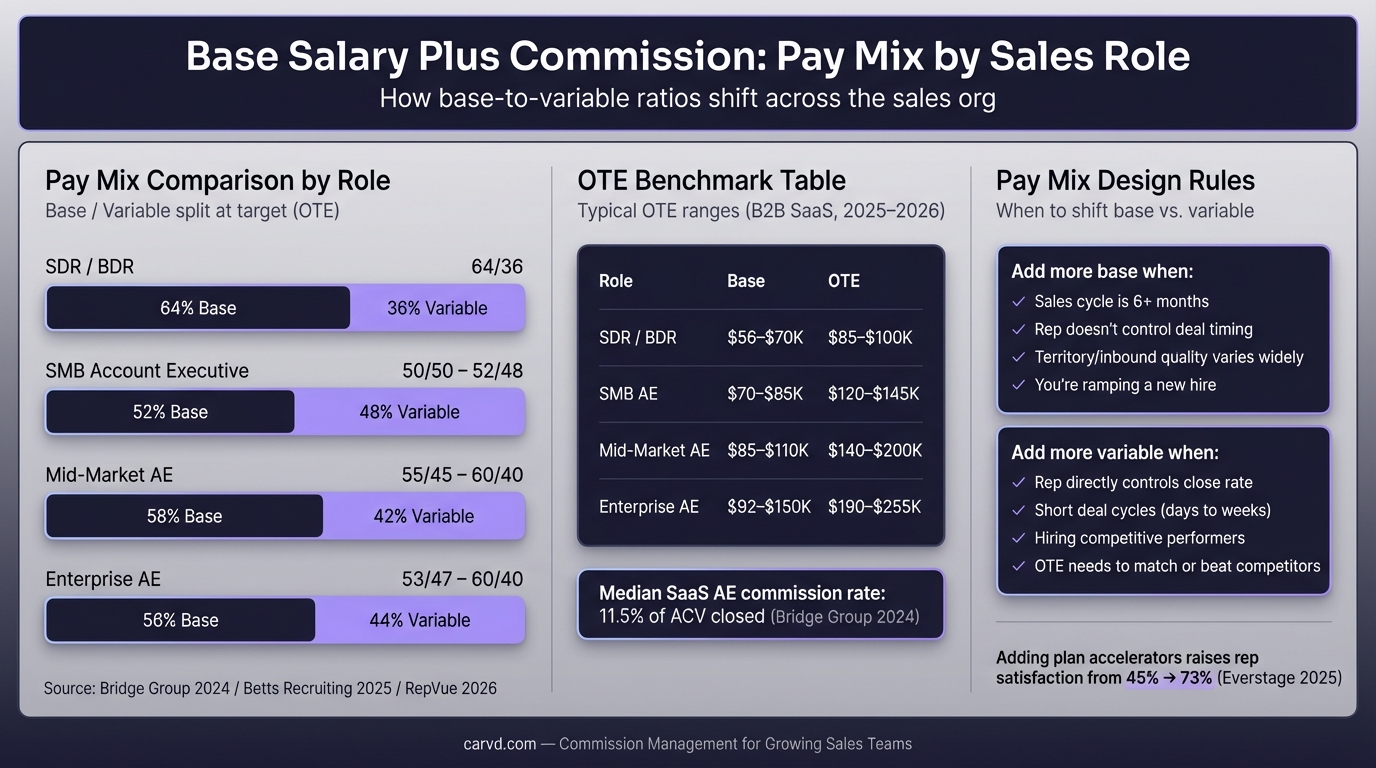
How base salary plus commission works
A base salary plus commission plan pays a fixed salary regardless of performance, plus a variable commission that scales with results. The OTE (on-target earnings) combines both: base + commission at 100% quota attainment.
A rep with $150,000 OTE on a 60/40 split earns:
- $90,000 base — guaranteed, paid on a regular schedule
- $60,000 target commission — earned by hitting 100% of quota
If they close 120% of quota, the commission portion increases (assuming a tiered or linear plan). If they close 80%, it decreases. The base doesn't change.
The split is expressed as base/variable: 60/40, 50/50, 70/30. The first number is always the base percentage.
Benchmarks by role
Split ratios aren't arbitrary — they're calibrated to how much the rep's individual actions actually drive the outcome.
| Role | Typical Split | Rationale |
|---|---|---|
| SDR / BDR | 70/30–75/25 | Activity-based role; rep doesn't control close rates |
| SMB / Inside Sales AE | 60/40 | Short cycles, clear quota attribution, standard starting point |
| Mid-Market AE | 50/50 | Longer cycles, complex deals, but rep influence is high |
| Enterprise AE | 50/50 or 40/60 | Large deal upside justifies more variable; some teams use 60/40 for income stability during 12+ month cycles |
| Account Manager | 70/30–80/20 | Retention/expansion role; excess variable creates wrong incentives |
| VP / Director of Sales | 70/30–75/25 | Variable tied to team ARR, not individual deals |
Data from Xactly (March 2026), PayScale role benchmarks (2026), and HubSpot's sales compensation guide (November 2025) — all three independently converge on the same role-based framework.
One important nuance: these are plan-level splits, not realized pay splits. According to Bravado's State of Sales Compensation (2022), 54% of sales reps missed their quota that year. A rep on a 60/40 plan who hits 75% of quota effectively takes home closer to a 75/25 mix. Set OTE based on realistic attainment, not ceiling attainment. The commission calculator lets you model realized pay at any attainment level for flat and tiered plans.
What the split signals to candidates
The base-to-variable ratio is a signal before it's a cost structure.
A variable-heavy plan (40/60 or 50/50) signals: "We hire closers. The upside is real, and we expect you to earn it." It attracts performance-oriented reps who are confident in their ability. It works well for outbound AE roles, transactional sales, and teams where rep effort clearly drives revenue.
A base-heavy plan (70/30 or 75/25) signals: "This is a complex role. You'll be building relationships and navigating long deals — we're not going to starve you while doing that." It suits technical sales, enterprise deals, account management, and roles where rep input is one of many factors in whether a deal closes.
Neither signal is better. The question is whether the signal matches the role you're hiring for.
Three decisions that determine the right split
1. How much does the individual rep control the outcome?
SDRs book meetings. They don't decide whether those meetings convert to pipeline. An AE inherits pipeline, competitive situations, and economic conditions they didn't create. For roles with high noise between activity and outcome, a heavier base is justified — the rep is being asked to execute a process, not hunt.
Outbound AEs in high-velocity, transactional markets have more direct control. More variable is appropriate because rep effort more cleanly maps to results.
2. How long is the sales cycle?
Long cycles create income uncertainty. An enterprise AE with a 9-month average deal cycle might close zero deals in Q1 not because they performed poorly, but because nothing was in the right stage. A 50/50 split at $200,000 OTE means $100,000 in base — livable, but the rep is taking meaningful risk on timing.
At companies where average cycles exceed 6 months, some teams shift toward a more base-heavy plan (60/40) and rely on accelerators at close to create upside, rather than putting too much of the rep's income at the mercy of timing. Use the commission plan builder to model how different splits and accelerator tiers affect rep payouts at 80%, 100%, and 120% attainment.
3. What behaviors are you incentivizing?
Variable compensation drives the behaviors it rewards. If commission is tied purely to new ACV, reps optimize for new logos — sometimes at the expense of customer fit, expansion potential, or renewal likelihood.
Account managers on aggressive variable plans focused on expansion ARR tend to oversell. Those on more base-heavy plans with modest variable focused on net revenue retention tend to behave better. The incentive structure shapes the work.
Common mistakes
Setting the split without looking at OTE level. A 50/50 split at $80,000 OTE means $40,000 base. In most US markets, that's a thin safety net for an experienced AE. The absolute dollar value of the base matters, not just the percentage. Always check that base salary is competitive as a standalone number before finalizing the split.
Copying the split from another company without adjusting for deal cycle. A 60/40 split works for a SaaS SMB AE with 30-day cycles. It's punishing for an enterprise rep working 12-month strategic accounts. The same split means completely different income risk depending on cycle length.
Not adjusting the split as reps develop. Some companies lock in a split at hire and never revisit it. A rep who ramps from SDR to AE, or moves from SMB to mid-market, has different leverage over outcomes. The split should reflect the role they're actually in.
Overcorrecting after a bad quarter. If attainment drops across the team, the answer is usually quota calibration or pipeline quality, not reducing variable to provide more income certainty. Reducing variable on a down-performing team removes the remaining incentive.
What a 50/50 split looks like in practice
A common SaaS AE structure at a $150,000 OTE:
- Base: $75,000/year ($6,250/month)
- Target variable: $75,000/year at 100% quota
- Quota: $750,000 in new ACV annually
Commission rate depends on the plan structure. On a flat 10% rate against $750,000 quota, the rep earns $75,000 at full attainment — matching the target variable. On a tiered structure, the effective rate varies by attainment band.
At 80% attainment ($600,000 closed), the rep earns $60,000 in commission — total take-home of $135,000, an effective 56/44 mix rather than the plan's 50/50.
At 120% attainment ($900,000 closed), with a 1.5x accelerator above quota, the rep earns $97,500 — total take-home of $172,500, tilting to 43/57 in favor of variable.
Model different pay split scenarios in a Stackrows financial template. This is how a well-designed split is supposed to work: stable base, meaningful upside, no income cliff.
Tracking payouts accurately
The math on base salary is simple — it doesn't change. Commission math is more involved, especially once you layer in tiered plans, accelerators, and mid-period quota adjustments.
Carvd's comp plan builder lets you design the split structure, and the commission calculator calculates payouts from deal data and shows reps their exact earnings with a deal-by-deal breakdown. When the variable portion of pay is material, reps need to see how it was calculated — not just what they're getting paid.
The Everee 2021 Sales Pay & Performance Survey found that 64% of reps want to be paid within one week of closing, and 41% had waited at least a month to receive commission. Speed and transparency matter as much as the split itself.
The short version
The right base-to-variable split depends on the role, the sales cycle, and what behaviors you want to reinforce. Starting benchmarks: 70/30 for SDRs, 60/40 for SMB AEs, 50/50 for mid-market AEs, and 70/30 to 80/20 for account managers.
Don't set the split in isolation — verify the absolute base dollar amount is competitive, calibrate to realistic attainment (not quota ceiling), and make sure the incentive structure rewards the behaviors the role actually requires.
Related reading: Sales Commission Structure: Types, Examples & How to Choose · Draw Against Commission: How It Works · Tiered Commission Structure: How to Build One That Scales · Uncapped Commission: Pros, Cons, and When It Makes Sense
Last updated: March 21, 2026