Straight Commission: Is It Right for Your Sales Team?
Straight commission pays reps only for what they sell — no base salary. Learn how it works, which industries use it, and when it makes sense (or doesn't).
Straight commission is simple: you sell, you get paid. You don't sell, you don't. No base salary, no draw, no safety net.
That simplicity makes it attractive to companies in certain situations — and actively harmful in others. Whether it's right for your sales team depends on the type of selling, the experience level of your reps, and how much income variability you can realistically ask them to absorb.
What is straight commission?
Straight commission is a compensation structure where sales reps earn only a percentage of the deals they close. There's no base salary. Total earnings equal commission earned, nothing more.
A rep on a 10% straight commission plan who closes $500,000 in revenue earns $50,000. A rep who closes nothing earns nothing.
This is the simplest commission structure that exists. It's also one of the most demanding — on reps, and eventually on the companies that use it when turnover starts compounding.
How straight commission works: a calculation example
Straight commission math is straightforward. If a real estate agent has a 3% commission rate and closes a $600,000 home sale:
$600,000 × 3% = $18,000
That's their gross commission for the deal. If they split it 50/50 with their broker, they net $9,000.
For a software sales rep on a 10% straight commission plan:
| Month | Revenue closed | Commission earned |
|---|---|---|
| January | $0 | $0 |
| February | $80,000 | $8,000 |
| March | $210,000 | $21,000 |
Total for Q1: $29,000. With a base salary + commission plan at the same rate, a rep earning $5,000/month in base would have earned $44,000 over the same period.
The difference compounds when you consider income variability. In January, the straight commission rep earned nothing. A base salary plan provides a floor — straight commission doesn't.
Where straight commission is actually common
Straight commission isn't the norm in B2B software sales. The Bridge Group's 2024 SaaS AE Benchmark (covering 170+ B2B SaaS companies) found median AE OTE of $190K with a 53:47 base-to-variable split. Pure commission is essentially absent in this segment — virtually every B2B SaaS sales role includes a base salary.
Straight commission is common in specific contexts:
Real estate. About 87% of the National Association of Realtors' 1.5 million members are classified as independent contractors under IRC §3508, compensated on commission-only structures. The average combined agent commission in 2025 is 5.44% of sale price, per a 2025 nationwide survey of 806 agents.
Insurance. Captive and independent insurance agents frequently operate on commission-only or commission-dominant structures. LIMRA research found only 15% of full-time financial professionals remained with their hiring company after four years — partly a function of income volatility.
Independent manufacturers' reps. Companies that hire commission-only outside reps (often as independent contractors) to expand territory coverage without adding headcount typically use straight commission.
Automotive sales. Many dealerships pay base + commission, but pure commission structures are common for high-volume lots.
Direct sales / MLM. Commission-only structures dominate, though the income distribution is often highly concentrated at the top.
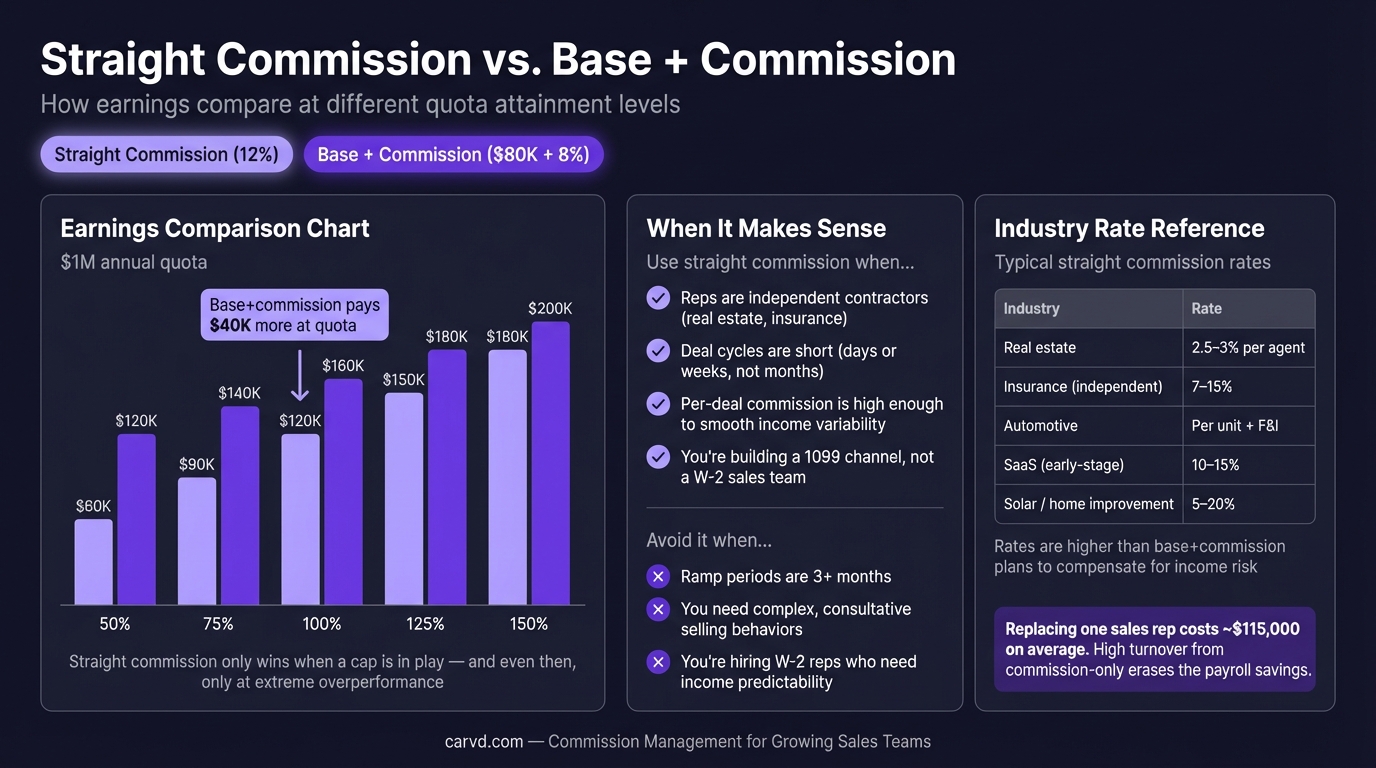
The pattern is consistent: straight commission shows up where deals are relatively high-value, where selling cycles are short enough to produce regular income, or where reps are genuinely independent contractors rather than employees. You can benchmark how straight commission rates compare across these industries using the commission rate benchmarks tool.
Pros of straight commission
Lower fixed cost for the company. No base salary means no guaranteed payroll expense when revenue is flat. For early-stage companies, bootstrapped businesses, or seasonal sales environments, this reduces financial risk.
High earnings potential for top performers. There's no ceiling. A rep who closes 3x their target earns 3x the commission. For experienced, self-motivated sellers in high-volume markets, this is the plan they want.
Commission costs scale with revenue. Unlike a base + variable plan where fixed costs remain even during down months, straight commission means your comp cost moves exactly in proportion to revenue generated.
Self-selecting candidate pool. Experienced, confident reps who know they can perform will take straight commission roles. Reps who aren't confident in their ability to close tend to filter themselves out — which can be a useful signal.
Cons of straight commission
High turnover. Sales already has among the highest turnover rates of any profession — approximately 35% annually, nearly three times the 13% all-industry average, according to HubSpot data cited by Xactly. Straight commission amplifies this. Income instability in slow months drives reps to leave. PayScale's 2025 Compensation Best Practices Report found companies with clear, predictable OTEs improved retention by 12–15% compared to peers without pay transparency.
Difficulty attracting experienced candidates. Senior reps with strong track records have options. Most will choose a role that includes a base salary over a commission-only plan at the same potential earnings — because the downside risk isn't worth it.
Harder to manage. Straight commission reps often have different behavioral incentives than reps on base + variable plans. They may cherry-pick deals, avoid activities that don't directly produce commission (like CRM hygiene or team training), and resist quotas they perceive as arbitrary.
Potential compliance exposure. Straight commission doesn't exempt employers from minimum wage requirements. Even commission-only employees must earn at least the federal minimum wage ($7.25/hr) for all hours worked under the FLSA. If a rep has a slow month and commissions don't cover minimum wage for hours worked, the employer is still liable for the difference. The outside sales exemption applies to field-based reps who spend most of their time away from the office, but it exempts overtime, not minimum wage.
When straight commission makes sense
Straight commission works best when:
- Reps are genuinely independent contractors (real estate agents, manufacturers' reps, etc.) and classified correctly under IRS guidelines
- Selling cycles are short and reps can realistically produce income every month
- The market is established with known customers, existing leads, or a recognizable brand
- Reps are experienced and have a track record of closing
- The company can't afford fixed payroll and revenue is unpredictable enough that a base salary would be a real risk
It's the wrong structure when you're hiring new reps into a greenfield territory, when the sales cycle is over three months, when you need reps to do non-sales activities, or when you're competing against companies that offer base salaries for comparable roles.
The misclassification risk
Companies sometimes use straight commission as a way to classify workers as independent contractors — and avoid payroll taxes, benefits, and labor law obligations. This is a real compliance risk.
Receiving 100% commission does not automatically make a worker an independent contractor. The IRS uses a behavioral control, financial control, and relationship-of-the-parties test. If you control how the work is done — when the rep works, what tools they use, how they run their calls — they're likely an employee regardless of how their comp is structured. The DOL and IRS have both increased enforcement in recent years.
Misclassification liability includes unpaid employer payroll taxes, FUTA, state workers' comp, unemployment premiums, and FLSA back pay. If your straight commission reps have set schedules, required call quotas, and use company-provided tools, talk to legal counsel before treating them as contractors.
Comparing straight commission to related structures
| Structure | Base salary | Income floor | Upside | Best for |
|---|---|---|---|---|
| Straight commission | No | Commission only | Uncapped | Independent reps, real estate, insurance |
| Base + commission | Yes | Base salary | Capped or uncapped | Most B2B sales roles |
| Draw against commission | Yes (repayable) | Draw (temporary) | Uncapped | New reps ramping, seasonal sales |
| Tiered commission | Either | Depends on structure | Accelerators above quota | Teams where performance variance is high |
For most B2B sales teams, base + commission will outperform straight commission on the metrics that matter most: rep retention, predictable performance, and candidate quality. Straight commission isn't a worse structure by definition — it's a specific tool that fits specific contexts.
Tracking commissions on a straight commission plan
Straight commission calculations are simple at the individual level. At scale — multiple reps, different rates, different products, varying deal sizes — they get messy quickly.
The most common mistake: calculating commissions manually in a spreadsheet and discovering an error after payday. Reps who can't verify their own number will re-calculate it themselves (this is called shadow accounting), which creates disputes and erodes trust even when the original math was right. A commission spreadsheet template can reduce errors for smaller teams, but at scale you need automated calculation.
Carvd calculates straight commission payouts automatically from your deal data — CSV, HubSpot, or Pipedrive — and generates a deal-by-deal breakdown each rep can audit themselves. If a rep questions a number, they can see exactly which deals were included and what rate applied.
For a side-by-side look at how Carvd handles straight commission plans versus other tools, see how Carvd compares to Sales Cookie.
Related reading: Sales Commission Structure: Types, Examples & How to Choose · Uncapped Commission: Pros, Cons, and When It Makes Sense · Draw Against Commission: How It Works (With Examples) · Base Salary Plus Commission: Finding the Right Split
Last updated: March 21, 2026