Tech Sales Commission: What SDRs, AEs, and Managers Earn
Tech sales commission ranges from $20/meeting for SDRs to 11.5% of ACV for AEs. Verified commission structures, rates, and earnings by role for 2026.
The variable portion of a tech sales job is where the range is widest. Two AEs at the same company with the same OTE can end up $40,000 apart in annual earnings based on quota attainment, deal timing, and whether accelerators kicked in. Understanding how commission actually works in tech — not just the headline OTE number — tells you more about earning potential than any job posting.
Here's how commission is structured across the main roles in tech sales, and what the actual earnings look like at different attainment levels.
How tech sales commission works by role
Commission in tech sales isn't a single model applied uniformly. The structure differs by role:
- SDRs: Paid per activity or outcome (meetings held, SQLs created), not a percentage of deal value
- AEs: Commission as a percentage of Annual Contract Value (ACV) at close, with accelerators above quota
- Account managers: Commission on renewal and expansion ACV, typically at lower rates than new logo
- Sales managers: Override on team revenue, not personal deal commission
Payout timing also varies. Most B2B SaaS companies pay AE commission quarterly. SDR commissions are typically monthly, since the activity cycle is shorter. Enterprise AEs working deals that span 6–18 months create commission timing complications — some companies pay on booking, others on cash receipt.
SDR commission: per meeting, not per deal
SDRs generate pipeline — they don't close it. Paying SDRs a percentage of closed revenue misaligns incentives, since they don't control close rates or deal size. Instead, tech companies use one of three structures:
Per-meeting (activity-based)
- $20–$50 per held meeting
- Simple to calculate; easier to game by booking meetings with anyone
- Less common at mature SaaS companies
Per-SQL (outcome-based)
- $100–$250 per Sales Qualified Lead accepted by the AE
- Better alignment — the AE validates quality before it counts
- Requires a clear SQL definition both sides agree on
Monthly quota / MBO
- SDR has a monthly meeting or SQL quota (e.g., 12 SQLs/month)
- Variable pays out as a percentage of quota attainment at each tier
- Most common structure at scale-stage companies
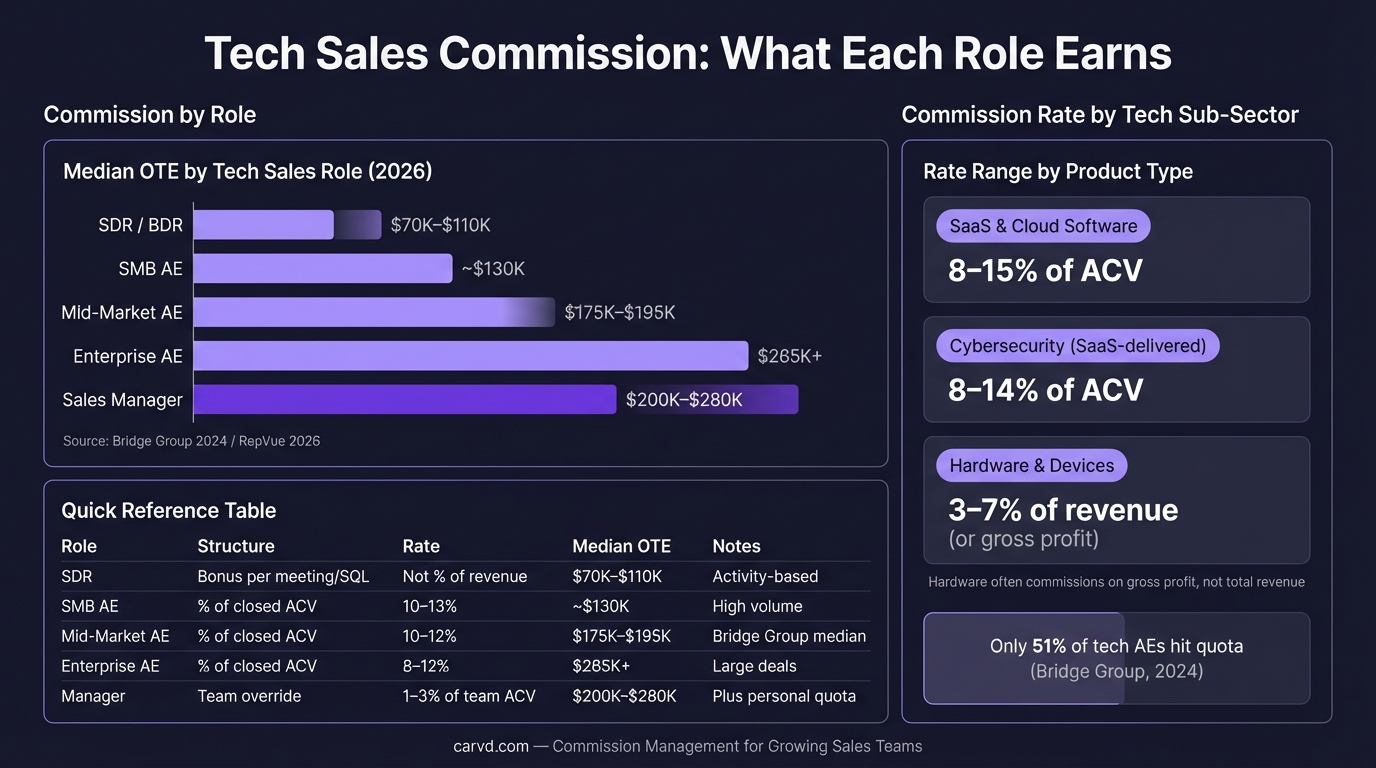
RepVue's March 2026 data puts SDR median OTE at $85,000 on a $60,000 base — about $25,000 in annual variable, or roughly $2,100/month at-plan. Top-quartile SDRs who consistently exceed quota can clear $129,000+. The majority (57% by RepVue's data) do not reach full quota.
AE commission: the percentage model
Account executives earn commission as a percentage of ACV on deals they close. Bridge Group's 2024 AE Metrics & Compensation Benchmark — based on 172 B2B SaaS companies — found a median commission rate of 11.5% of ACV at 100% quota attainment.
Rates compress as segment moves upmarket. Deal sizes grow faster than rates, so the dollar earnings are comparable even at lower percentages:
| Segment | Commission rate | Typical ACV quota | Variable at 100% quota |
|---|---|---|---|
| SMB AE | 10–15% of ACV | $400K–$600K | $40K–$90K |
| Mid-market AE | 8–12% of ACV | $600K–$1M | $48K–$120K |
| Enterprise AE | 5–8% of ACV | $1M–$3M+ | $50K–$240K |
Sources: Bridge Group 2024, Betts Recruiting 2026
At the median, Bridge Group's 2024 data puts AE OTE at $190,000 on a 53:47 base-to-variable split — $100,700 in variable at full attainment. An AE on a $1M quota at 10.07% commission hits that number exactly at 100%.
For context on whether those quota numbers are realistic: Bridge Group's median quota-to-OTE ratio is 4.2x. An AE earning $190K OTE carries roughly $800K in quota. Below 3x the quota feels easy and you'll overpay; above 6x the quota feels impossible and you'll lose reps. You can pressure-test your own ratio with the OTE calculator, which reverse-engineers quota from your base, variable, and commission rate inputs.
How the payout curve works above and below quota
Most tech companies don't pay a flat commission from dollar one to infinity. The payout curve has three zones:
Below the floor (usually below 50–70% quota): No commission paid, or a reduced cliff rate. This protects margin and discourages reps from sandbagging deals into the next period.
Between the floor and 100% quota: Commission at the base rate. Many companies use a linear ramp in this range; others use step functions that jump at 75%, 90%, and 100%.
Above 100% quota (accelerators): 82% of SaaS startups use accelerators above quota, according to a Prowi 2026 analysis of Bridge Group data. The standard multiplier is 1.25x–1.5x on the base rate. An AE at 10% base commission earns 15% on every dollar above quota.
This creates a significant gap between median and top performers. An AE who hits 120% of a $1M quota earns commission on $200K in overachievement at 1.5x rate — an extra $30,000 on top of the base variable, without the company paying any higher rate on the under-quota portion. Accelerators are the cheapest way to reward top performance.
Fewer than 15% of SaaS companies cap commission at quota. If an offer caps commission at OTE, that's worth negotiating — or walking.
Account manager commission
Account managers own renewals and expansions. Because renewals carry lower risk than new logo, AM commission rates are lower — typically 5–10% on renewal or expansion ACV (ICONIQ GTM Guide August 2025 puts renewal commissions in the 2–5% range for AEs who retain renewal responsibility, with dedicated AM roles running higher).
AM OTE typically runs $130K–$190K on a 65/35 base-to-variable split. The base-heavy mix reflects more predictable revenue — which provides income stability but limits the upside that new-logo AEs can earn through accelerators.
For more detail on how commission structures apply across account lifecycle, see sales commission rates by industry and software sales commission rates.
Sales manager commission: override, not deals
Tech sales managers typically stop carrying personal quotas when they move into management. Instead, they earn an override — usually 2–3% of total team ACV closed.
A manager with 6 AEs each carrying a $750K quota:
- Team quota: $4.5M
- Override at 2.5%: $112,500 in variable at 100% team attainment
- Typical OTE: $160K–$200K on a 65/35 base-to-variable split
The override model aligns the manager's incentive with team performance rather than personal deal-chasing, which is why most companies stop paying individual commission the day someone takes a management role. Managers who also close their own deals — common at early-stage startups — are an exception; they typically carry a hybrid structure.
How company stage changes the commission math
Not all tech companies structure commission the same way. Stage matters:
| Stage | Commission rate (AEs) | Accelerator | Typical structure |
|---|---|---|---|
| Seed / Series A | 8–12% of ACV | Aggressive (1.5x–2x) | Higher rates offset employment risk |
| Series B / C | 10–15% of ACV | Standard (1.25x–1.5x) | Bridge Group median range |
| Late stage / pre-IPO | 8–12% of ACV | Moderate (1.25x) | More predictable; equity upside elsewhere |
| Public company | 5–10% of ACV | Conservative | Base-heavy, less commission volatility |
Early-stage companies use higher commission rates partly to offset lower base salaries and equity uncertainty. Mature companies tend toward higher base and lower variable — giving reps more income certainty in exchange for lower upside. Neither is objectively better; it depends on your risk tolerance and sales cycle length.
For a deeper look at how rates vary by software type specifically, see SaaS sales commission rates and software sales commission rates. For total compensation data across tech roles, tech sales salary has the full breakdown by role and company stage.
Red flags in a tech sales commission offer
Before accepting a commission structure, watch for:
Undefined qualification criteria. If the offer says "you earn $X per qualified meeting" but doesn't define what qualifies, the AE team does. You'll find out what that definition means when meetings start being disqualified.
Commission capped at OTE. Ask directly whether commission is capped. Fewer than 15% of SaaS companies cap it, but those that do significantly limit upside for top performers.
Payment on cash receipt vs. booking. Cash receipt means no commission check until the customer pays. For annual contracts with net-60 payment terms, that could be 90+ days post-close.
Clawback terms beyond 90 days. Standard clawback windows run 90–180 days — meaning if a customer churns or cancels within that window, you owe the commission back. Longer than 180 days is unusual and worth clarifying. See commission clawbacks for how these terms typically work.
No draw for new hires. If you're joining with zero inherited pipeline, a recoverable or non-recoverable draw against commission is standard for the first 1–3 months. Without it, you're expected to eat ramen while your pipeline builds. A well-designed comp plan builder should let the company configure draw rules alongside standard commission tiers so the transition is automatic.
Designing tech sales commission plans
If you're setting rates rather than evaluating an offer, the design principles are:
- Set OTE first, then derive the rate. If you want $190K OTE at 50/50 with a $1M quota, the implied commission rate is 9.5%. Work backwards from your target, not forward from an arbitrary rate.
- Use quota-to-OTE ratios to pressure-test. Below 3x, reps hit quota too easily and you overpay. Above 6x, reps miss chronically and churn.
- Accelerators are cheaper than higher base rates. Paying 15% above quota only costs more on the overachievement dollars — not on the first $1M in quota. The math is favorable for rewarding top performance without inflating your baseline sales cost.
Tools like Carvd handle tiered commission calculations, accelerators, and deal-level breakdowns automatically — so reps can see exactly how their commission was derived without waiting on a finance spreadsheet.
For broader commission benchmarks across industries, see sales commission rates by industry. For a side-by-side look at how Carvd handles tech sales commission plans compared to other platforms, see how Carvd compares to CaptivateIQ.
Last updated: March 23, 2026