What Is a Good Commission Rate? (It Depends on These 5 Factors)
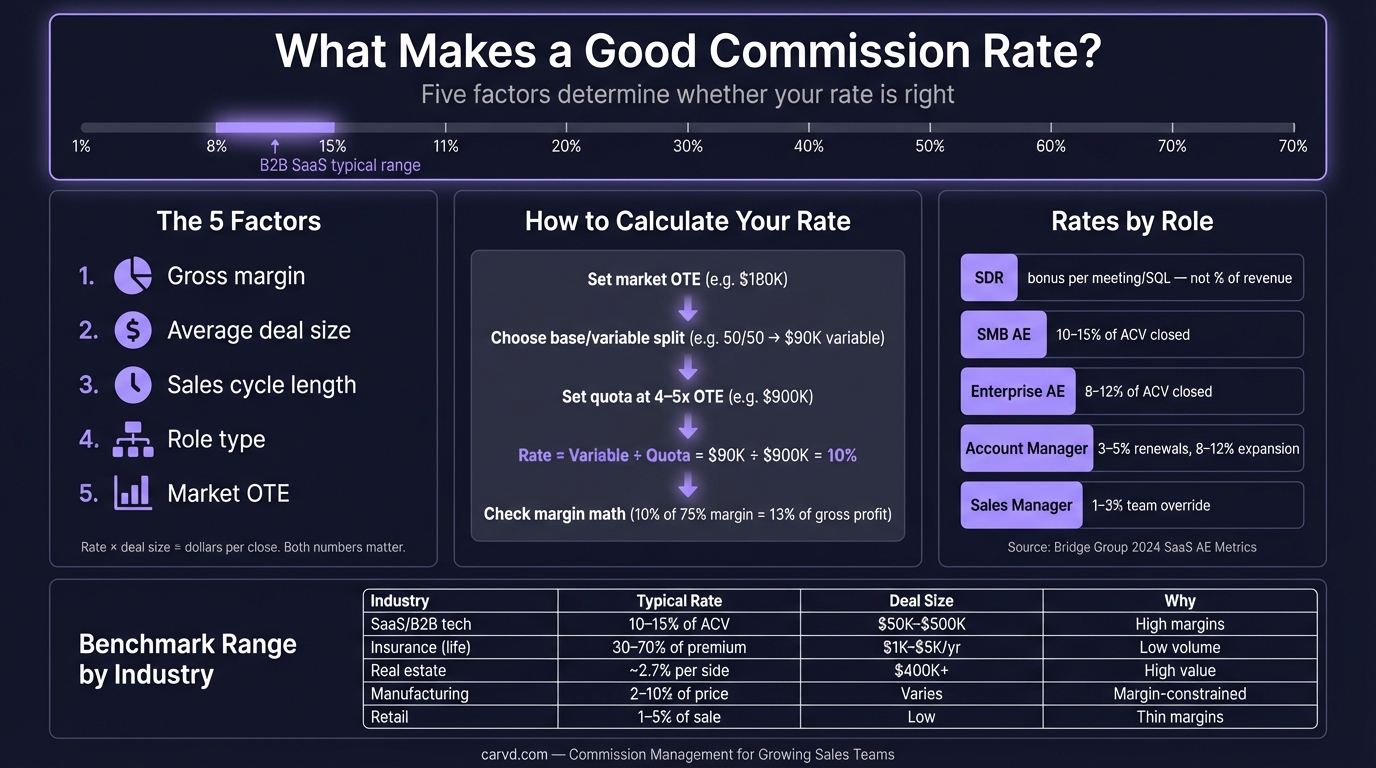
A good commission rate for SaaS AEs is 8–14% of ACV (median 11.5%). But the right rate depends on your industry, deal size, company stage, role, and revenue type.
"10% is the standard commission rate." You'll see this figure everywhere. And for B2B SaaS AEs, it's in the right ballpark — Bridge Group's 2024 survey of 172 companies puts the median at 11.5% of Annual Contract Value. But 10% is a mathematical output, not a design input.
Whether 10% is the right number for your team depends on five variables: industry, deal size, company stage, role type, and whether you're paying on new business, renewals, or expansion. Get those variables right and the commission rate follows. Set the rate in isolation and the plan breaks.
Here's how each factor moves the number.
Factor 1: Industry and product type
Commission rates track inversely with gross margins and directly with sales cycle difficulty. Software can afford higher rates than physical goods because the cost of delivering another unit is near zero.
| Industry | Typical commission rate |
|---|---|
| SaaS / Software | 8–15% of ACV (median ~11.5%) |
| Financial services | 5–20% (7–15% typical) |
| Insurance | 5–15% new; 2–5% renewals |
| Pharmaceutical | 2–10% of territory revenue |
| Manufacturing / Industrial | 5–15% of net sales |
| Staffing / Recruiting | 15–25% of placed salary |
| Retail / Consumer goods | 1–5% |
The extremes make sense when you look at the economics. Life insurance pays 55–120% of the first-year premium to independent agents because acquisition is hard, policies are sticky, and the insurer captures decades of renewals. Retail pays 1–3% because margins are thin and the sales motion is largely transactional.
For SaaS, the 8–15% band reflects a business where CAC is high, churn matters, and reps must prospect, demo, negotiate, and close — not just take orders.
Factor 2: Deal size and sales cycle length
Within any industry, rates compress as deal size grows. This isn't arbitrary — it's arithmetic.
A SaaS company paying 10% on a $50K deal pays out $5,000. Paying 10% on a $500K enterprise deal would mean $50,000 per close. That's manageable for a company with 20%+ net margins, but most enterprise SaaS companies carry CAC payback periods of 18–24 months at those numbers. So rates adjust downward for large deals.
The practical ranges for SaaS by segment:
- SMB (under $25K ACV, short cycle): 8–12%
- Mid-market ($25K–$100K ACV, 3–6 month cycle): 7–10%
- Enterprise ($100K+ ACV, 6–18 month cycle): 4–8%
A 6% rate on a $500K enterprise deal is $30,000 — more commission per close than a 12% rate on a $50K SMB deal. The percentage is lower, but the rep earns more if quota attainment is similar.
Factor 3: Company stage
Early-stage companies routinely pay higher rates — not because they want to, but because they have to.
A startup without a brand name, a shorter runway than a public company, and an unproven product has to compensate reps for taking that risk. Rates of 12–20% are common at pre-Series B companies, often supplemented with equity. ICONIQ's GTM Compensation Guide (2023) notes that 60–70% of early-stage companies include equity in AE incentive packages alongside variable cash.
As companies scale and the brand does more selling work, rates tend to normalize:
- Pre-Series B / early stage: 12–20%
- Series B–D / growth stage: 8–12%
- Enterprise / public company: 5–8%
The calculus is straightforward: would a rep take a lower rate to sell a known brand with a strong product, reliable deal flow, and a clear path to a promotion? Usually yes.
Factor 4: Role type
Commission rate isn't a single number across a sales org — it varies by what the role actually does.
| Role | Rate structure |
|---|---|
| SDR / BDR | Per-meeting ($20–$50) or per-SQL ($100–$250); not a % of deal value |
| SMB AE | 8–12% of ACV |
| Mid-market AE | 7–10% of ACV |
| Enterprise AE | 4–8% of ACV |
| Account manager | 2–5% on renewals; 3–6% on expansion |
| Sales manager | 2–3% override on team revenue |
SDRs are the exception worth explaining: they generate pipeline, not closed revenue. Paying them a percentage of deals they sourced but didn't close misaligns incentives — an SDR can't control close rates or deal size. The standard is to pay per qualified meeting or SQL accepted by the AE.
Bridge Group's 2024 SDR survey found a 64/36 base-to-variable split, with SDR OTE medians around $85K. AEs run closer to 53/47.
Factor 5: New business vs. renewals vs. expansion
In SaaS, not all revenue is treated the same. New logo commission rates are higher than renewal rates for a reason: winning a new customer is harder than retaining one.
- New business: Full rate, typically 8–14% of ACV (median 11.5%, Bridge Group 2024)
- Renewals: When companies pay commission on renewals at all, the rate is typically 3–4% — roughly 40% of the new business rate (ICONIQ 2023)
- Expansion / upsell: Usually 7–8% of expanded ACV — close to the new business rate, because expansion selling requires active effort
About 60% of SaaS companies pay commission on renewals. The other 40% hand renewals to customer success teams with no commission component, or pay CS flat bonuses tied to net revenue retention rather than a per-deal percentage.
The math behind the rate: quota and OTE
Commission rate isn't set in isolation — it's derived from two decisions you make first: OTE and quota.
The formula: Variable OTE ÷ Quota = Commission Rate
If a rep has $100K in variable comp (50/50 OTE split at $200K OTE) and carries a $1M quota, the commission rate is 10%. Raise the quota to $1.2M without changing OTE and the rate drops to 8.3%. Raise OTE to $220K with the same quota and the rate rises to 11%.
This is why "what is a good commission rate" is the wrong question to ask first. The better sequence:
- Determine competitive OTE for the role (Bridge Group, Betts, RepVue) — or model it with an OTE calculator
- Set a quota-to-OTE ratio that's achievable (median 4.2x for SaaS AEs, per Bridge Group 2024)
- Decide your base-to-variable split (50/50 is standard for AEs)
- The commission rate falls out of the math
Bridge Group 2024 puts the median quota-to-OTE ratio at 4.2x, with a healthy range of 3.2x–4.8x. A rep with $190K OTE and a $800K quota at a 50/50 split earns $95K variable — 11.9% of quota at 100% attainment. That's close to the 11.5% median.
What makes a rate "bad"
A rate is bad for one of three reasons:
Too low: Reps at 100% quota attainment earn less than market OTE for their role. You'll lose reps to competitors even when they're winning deals. RepVue's Q4 2024 Cloud Sales Index shows overall quota attainment at 43% — which means most reps are already earning below their stated OTE variable. A low rate makes a bad situation worse.
Too high: The math works for reps but breaks the business. If a 12% commission rate on a $300M revenue base implies $36M in commissions, and your sales team is 50 reps at $200K OTE, the numbers don't add up. Model the blended cost of sales before setting rates.
Too complex: Rates that vary by product, region, customer tier, new vs. expansion, plus accelerators for each combination become untrackable. Reps stop trusting the number. Shadow accounting rises. Alexander Group's 2024 survey found 91% of companies plan to redesign plans for better pay-for-performance clarity — simplicity is the goal, not complexity. Giving reps access to rep dashboards with deal-level breakdowns restores trust even in complex multi-rate plans.
Accelerators: what a good rate looks like above quota
A good commission plan doesn't stop at the base rate. Alexander Group's 2024 survey found 82% of companies use accelerated commissions above quota, with typical payouts boosting by 20–30% once reps surpass their number.
A standard accelerator schedule:
- 0–100% of quota: base rate (e.g., 10%)
- 100–110%: 1.25x base rate (12.5%)
- 110–120%: 1.5x base rate (15%)
- 120%+: 2x base rate (20%)
ICONIQ's guide confirms this pattern: "The typical 10% base commission rate accelerates up to 20% for the highest performers once quota is hit." Accelerators do two things: they reward top performers disproportionately (which they expect), and they make the plan more financially efficient by concentrating high payouts on reps who actually drive revenue.
A practical starting point
If you're designing a plan from scratch and don't have industry-specific data yet:
- Look up median OTE for the role at your company stage on Betts, RepVue, or Bridge Group
- Set quota at 4x–5x OTE for AEs (4.2x is the Bridge Group median)
- Use a 50/50 base-variable split
- Your commission rate will land around 10–12%
- Check it against industry benchmarks for your segment and adjust
Tools like Carvd can run the calculation for any plan type — flat, tiered, or per-product — so you can model rate scenarios before rolling them out to the team.
The rate that results from this process isn't arbitrary. It's what your rep earns per dollar of revenue at 100% quota attainment, set to a number that's competitive with the market and sustainable for the business.
For broader context on how commission rates vary by role and industry, see our sales commission rates by industry guide and the full average sales commission percentage benchmark page. For a side-by-side look at how Carvd handles commission tracking compared to enterprise tools, see how Carvd compares to Visdum.
Last updated: March 23, 2026